RESOURCE

vlc-news-philippines-cancels-rice-import-permit-15102026

Market updates

Philippines Cancels Permit for Controversial 12,480-Metric-Ton Rice Shipment from Viet Nam

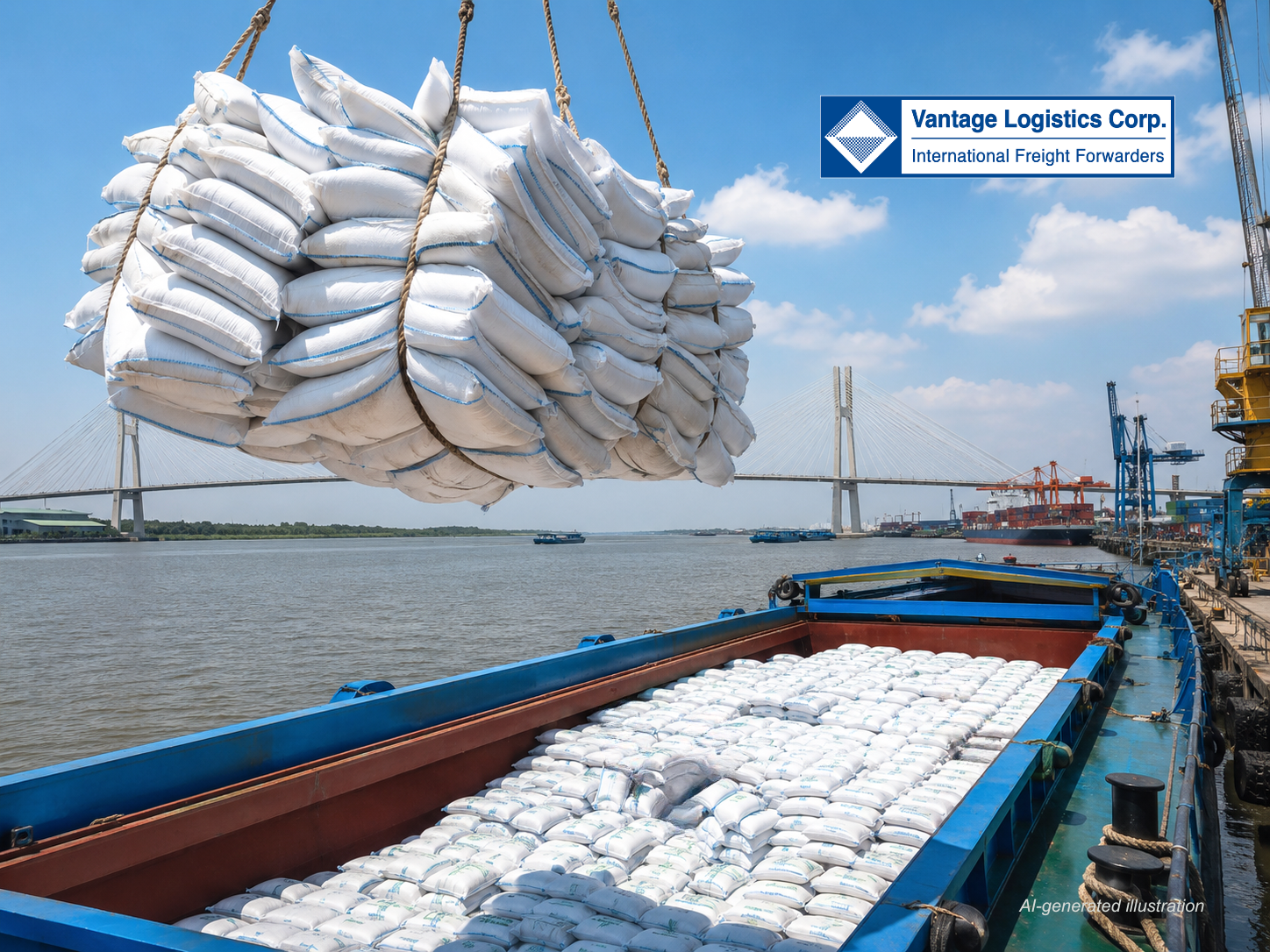
The Philippine Department of Agriculture (DA) said it had ordered the cancellation of the Sanitary and Phytosanitary Import Clearance (SPSIC) for a 12,480-metric-ton rice shipment from Viet Nam before the vessel arrived. The case involves reported discrepancies in rice specifications and an expired import contract, highlighting the risks that can arise when shipping schedules do not align with import requirements in the destination market. 1. Developments at the Port of Arrival According to the Philippine Department of Agriculture (DA) and the Philippine News Agency (PNA), the vessel MV Tay Son 2, carrying 12,480 metric tons of rice from Viet Nam, arrived at the Port of Davao on September 14, 2026. According to these sources, the vessel’s captain refused to submit the shipment for inspection by the Philippine Bureau of Plant Industry (BPI). On September 17, 2026, the vessel departed Davao before the matter had been resolved. Philippine authorities subsequently prevented the cargo from being unloaded at another location and brought the vessel to the Port of General Santos before ordering it to return to Davao for further handling. 2. Rice Specifications and Import Requirements The case involves two issues: reported discrepancies in rice specifications and the status of the import contract and permit. 2.1. Reported Discrepancy in Rice Specifications The importer, Planters Product, Inc. (PPI), reported a discrepancy between the purchase order and the specifications communicated for the shipment: Specifications under the purchase order: 25% broken rice Reported specifications for the shipment: 5% broken rice In agricultural trade, the percentage of broken grains is an important commercial specification. However, the discrepancy remains based on information reported by the importer and has not been confirmed by an official inspection, as the physical inspection process was not completed. 2.2. Expired Contract and Canceled Import Permit In addition to the rice specifications, the delivery timeline and the status of the import documentation were also highlighted by the DA: Estimated time of arrival (ETA): July 2026 Actual arrival: Mid-September 2026 According to the DA, the import contract had expired and the SPSIC had been canceled before the vessel arrived. The vessel’s arrival also coincided with the period when the Philippines was preparing for the wet-season rice harvest. According to published information, import policy during this period was also linked to efforts to limit downward pressure on domestic palay prices. Operational Note: Even when goods meet quality requirements, a shipment may still face customs clearance difficulties if it fails to meet import requirements or if the relevant permit is no longer valid. 3. Proposed Measures for Handling the Shipment According to published information, the Bureau of Customs of the Philippines (BOC) was still considering the final course of action for the shipment. The proposed measures included: Proposed Measure Proposing Authority / Status Return to the Country of Origin The BPI was reported to have recommended returning the shipment to Viet Nam. Seizure and Penalties The DA proposed considering seizure of the shipment and the application of penalties under relevant regulations, subject to the competent authority’s findings and decision. Final Decision The BOC was reviewing the official course of action for the shipment. 4. Conclusion The controversial rice shipment in the Philippines highlights how international trade depends not only on product quality and contractual terms but also on shipping schedules, the validity of import documentation, and regulatory requirements in the destination market. When these elements are no longer aligned, shipments already in transit may face unexpected complications during arrival and customs clearance. Vantage Logistics will continue to provide updates on notable developments in logistics, import-export activities, and international supply chains, offering businesses additional insight into factors that may affect global trade. Contact Vantage Logistics for tailored transport solutions and competitive quotations. Please provide details on cargo type, market, origin, destination, and estimated timeline.   Vantage Logistics Corp – South East Asia (S.E.A) Logistics Provider One-Stop Shop For Integrated Logistics Services Head Office Viet Nam – Suite 6.01, Floor 6th, Block A, RiverGate Residence, 151-155 Ben Van Don, Khanh Hoi Ward, HCMC, Viet Nam Branch Thailand, Laos, Cambodia, Malaysia, Indonesia, Singapore Contact Us Email in**@*****om.vn Hotline +84-909-026-261 Website https://vantage-logistics.com Send your shipment enquiry today and receive a tailored transport plan from the Vantage Logistics team.

15/10/2026

View More
vlc-news-asean-east-asia-trade-15102026

Market updates

ASEAN–East Asia Trade Reaches USD 1.4 Trillion, Up 13.7% in 2025

According to preliminary data from the ASEAN Secretariat, two-way trade between ASEAN and its three East Asian partners (China, Japan, and South Korea) reached USD 1.4 trillion in 2025, representing a 13.7% year-on-year increase. Notably, China–ASEAN trade continued its upward trajectory in the first seven months of 2026, underscoring a sustained expansion in cross-regional trade volumes worth monitoring. 1. Regional Trade Volume and Foreign Direct Investment (ASEAN+3) Trade and investment flows between ASEAN and its three East Asian partners maintain a substantial footprint. In 2025, Foreign Direct Investment (FDI) inflows from China, Japan, and South Korea into ASEAN totaled USD 44.8 billion. Key ASEAN–East Asia Trade & Investment Indicators Indicator Value Growth / Share ASEAN – (China, Japan, South Korea) Trade in 2025 USD 1.4 Trillion Up 13.7% vs 2024 FDI from 3 East Asian Partners into ASEAN in 2025 USD 44.8 Billion Accounted for 18.2% of total ASEAN FDI China – ASEAN Trade (First 7 Months of 2026) USD 744.41 Billion Up 24.7% year-on-year The scale of merchandise trade and investment capital highlights the vital economic linkage between East Asia and Southeast Asia. However, assessing actual freight demand requires a granular evaluation of specific commodity structures, export-import markets, and active transport corridors. 2. Direct Impacts on Transport Networks and Logistics Infrastructure Expanding trade volumes underscore the critical role of regional transport connections. Depending on industry-specific cargo characteristics and delivery requirements, flexible logistics solutions are being actively deployed: Intra-Asia Ocean Freight Connections: For multi-leg shipments, vessel schedule reliability, transit times, and feeder network connectivity are pivotal factors for supply chain managers. Major gateway hubs such as Shanghai, Ningbo, Busan, and Yokohama maintain dense feeder linkages with Southeast Asian ports within ocean carrier networks Integrated Logistics and Multimodal Transport: Depending on lead-time sensitivity, combining ocean freight, Cross-Border Trucking, and inland warehousing offers expanded routing options. Real-world operational efficiency hinges heavily on border crossing clearance times, transit schedules, and the coordination capability of the logistics operator Rules of Origin (C/O) and Customs Compliance: When leveraging Free Trade Agreements such as RCEP, AKFTA, or AJCEP, enterprises must accurately determine rules of origin and prepare compliant documentation to qualify for preferential tariffs. Duty exemption eligibility depends on the specific conditions of each product line and destination market 3. Monitoring Southeast Asian Trade Dynamics and Logistics Connectivity Expanding trade and investment flows reflect an increasingly integrated economic relationship between East Asia and Southeast Asia. This growth in cross-border trade creates momentum for expanding logistics connectivity, helping strengthen supply chain coverage across the region.   Contact Vantage Logistics for tailored transport solutions and competitive quotations. Please provide details on cargo type, market, origin, destination, and estimated timeline. Vantage Logistics Corp – South East Asia (S.E.A) Logistics Provider One-Stop Shop For Integrated Logistics Services Head Office Viet Nam – Suite 6.01, Floor 6th, Block A, RiverGate Residence, 151-155 Ben Van Don, Khanh Hoi Ward, HCMC, Viet Nam Branch Thailand, Laos, Cambodia, Malaysia, Indonesia, Singapore Contact Us Email in**@*****om.vn Hotline +84-909-026-261 Website https://vantage-logistics.com Send your shipment enquiry today and receive a tailored transport plan from the Vantage Logistics team.

15/10/2026

View More

Market updates

SINGAPORE STRENGTHENS PRODUCT SAFETY CONTROLS: WHAT VIETNAMESE EXPORTERS NEED TO KNOW

Singapore is strengthening its product safety controls through two key regulations: the Consumer Protection (Safety Requirements) Regulations (CPSR) and the Consumer Goods (Safety Requirements) Regulations (CGSR). For exporters, these requirements go beyond product compliance. They can also affect delivery schedules, logistics costs, and supply chain reliability. 1. Singapore Strengthens Product Safety Requirements According to information published by Vietnam’s Ministry of Industry and Trade, Singapore applies two main regulatory frameworks for product safety. – CPSR: Covers 33 categories of controlled goods, including electrical and electronic products, household appliances, and gas appliances. Products within scope must meet applicable safety requirements, complete registration, and carry the SAFETY Mark before being supplied or sold in Singapore. – CGSR: Covers general consumer goods such as toys, clothing, furniture, and sports equipment, which must comply with the relevant safety standards. Non-compliant products may be subject to sales restrictions or recalls. Businesses that violate applicable requirements may also face penalties. For exporters, checking compliance requirements before shipment is essential. Addressing documentation or registration issues early can help avoid costly adjustments after cargo has already left the port of origin. 2. Potential Impact on Southeast Asia’s Trade and Logistics Singapore plays an important role in Southeast Asia’s trade and logistics network. Tighter product safety controls may require exporters, importers, and distributors to review their procedures for placing goods on the Singapore market. Several potential risks deserve attention: – Delivery delays: Incomplete documentation or missing certificates may affect cargo acceptance and delivery schedules. – Additional logistics costs: Delays in resolving compliance issues may lead to storage, port handling, or additional transportation costs. – Disrupted distribution plans: Late deliveries can affect inventory planning, distribution schedules, and commitments to business partners. These requirements do not automatically apply across all ASEAN markets. However, they highlight the importance of understanding the specific regulations of each destination country when planning regional trade and distribution. 3. What Should Vietnamese Exporters Prepare? For Vietnamese businesses exporting to Singapore, compliance checks should take place before shipment arrangements are finalized. Exporters should determine whether their products fall under CPSR or CGSR, verify the applicable safety standards and registration requirements, and clarify responsibilities with their Singaporean importers. Documentation preparation should also be factored into the shipping schedule. If an issue is discovered only after cargo arrives at the destination port, businesses may need to manage several challenges simultaneously, including delivery delays, additional costs, and changes to distribution plans. A reliable shipping plan therefore involves more than selecting the right route or sailing schedule. It also requires anticipating potential obstacles before the cargo reaches its destination. 4. Managing Risks Through Early Planning Not every risk in international shipping can be eliminated, but many disruptions can be reduced through early preparation. Reviewing cargo information, documentation, shipping schedules, and destination requirements helps all parties make better-informed decisions. For shipments to Singapore, close coordination among exporters, importers, agents, and logistics providers helps maintain visibility over shipment readiness, address changes, and adjust plans when necessary. At Vantage Logistics, international transportation planning takes into account the practical requirements of each shipment and the coordination needed among relevant parties. This approach helps businesses manage potential disruptions and maintain better control over delivery schedules. As market requirements evolve, careful preparation does more than protect an individual shipment. It also helps businesses maintain reliable supply chains and build lasting partnerships across international markets.

15/10/2026

View More
vlc-news-regulation-july1-EN-2

Market updates

5 Areas Importers Should Review Following the Official Implementation of Circular No. 86/2026/TT-BTC

Effective July 1, 2026, Circular No. 86/2026/TT-BTC on tax administration for exported and imported goods officially came into force. The Circular not only updates various requirements related to customs documentation and tax payment deadlines but also reflects a broader shift toward data-driven tax administration and greater integration between Customs, tax authorities, and other government agencies through interconnected digital systems. For importing businesses, the reduction of paper-based documentation is accompanied by higher expectations for the accuracy, consistency, and traceability of electronic data. To minimize potential supply chain disruptions and reduce the risk of late payment charges, businesses should review and strengthen the following five operational areas. Quick Reference: Key Areas to Review Under Circular No. 86/2026/TT-BTC Key Review Area Primary Responsible Department Potential Compliance & Operational Risks 1. Electronic document identification Procurement / Logistics Inconsistent data may delay processing and customs clearance 2. The “5-business-day” tax payment window Procurement / Finance / Logistics Missing the deadline for additional taxes assessed after customs clearance may result in late payment interest 3. The “last-minute payment” risk Accounting / Finance A payment instruction alone does not constitute successful tax payment if the transaction has not been completed and confirmed 4. Review tax declarations following import VAT refunds Tax Accounting / Import-Export Accounting Failure to adjust tax declarations in a timely manner may lead to tax reassessments and administrative penalties 5. Cross-functional internal coordination Management / Department Heads Poor communication between departments may result in storage charges, demurrage, and compliance risks Strengthen Electronic Document Management Instead of Focusing Solely on Paper Documents One of the notable changes introduced by Circular No. 86 is that customs authorities are permitted to retrieve eligible tax exemption, reduction, and refund documents that are already available through the National Single Window, the ASEAN Single Window, or other specialized government information systems. As a result, businesses are generally no longer required to resubmit paper documents or duplicate scanned copies, provided that the relevant electronic identification information is supplied. This approach reduces duplicate document submissions while placing greater emphasis on maintaining accurate document identifiers from the earliest stages of contract preparation and import documentation. Recommendations Standardize internal document identification information, including contract numbers, file references, and electronic document codes, to minimize declaration errors. When working with a customs brokerage service provider, clearly define responsibilities for data management between the company and the service provider to ensure electronically shared documents are properly identified and any additional required documentation is submitted on time. Manage the Five-Business-Day Deadline for Post-Clearance Tax Adjustments Circular No. 86 clarifies the deadline for paying additional taxes arising after goods have already been released through customs. Taxpayers are required to pay the additional tax within five business days from certain triggering events, including: Receipt of customs classification, laboratory analysis, or inspection results; Determination of the final customs value when the official price was unavailable at the time of customs declaration; or Adjustments that increase customs value, such as royalty fees, license fees, or similar dutiable charges. These requirements highlight the importance of effective coordination among relevant departments to ensure information is communicated promptly and post-clearance tax obligations are fulfilled within the prescribed timeframe. Recommendations Procurement and Logistics teams should establish a tracking process for shipments involving special circumstances, such as customs inspections, provisional pricing, or royalty payments. Once inspection results or supporting documents related to customs value adjustments become available, the information should be transferred promptly to the accounting or tax team to facilitate timely supplementary declarations Avoid the “Last-Minute Payment” Risk When Paying Customs Duties Electronically   Circular No. 86 clarifies that, for electronic tax payments, the official payment date is the date on which funds are successfully debited from the taxpayer’s account and the transaction is confirmed by the payment service provider or intermediary payment service provider. Simply initiating a payment instruction does not mean the tax obligation has been fulfilled. In practice, submitting electronic tax payments close to the statutory deadline increases the likelihood of technical issues or delays in transaction confirmation. Recommendations The accounting team should establish an internal payment deadline that is earlier than the statutory deadline to allow sufficient time for resolving any unexpected technical issues. Avoid initiating electronic tax payments near the end of the banking system’s operating hours or close to the cutoff time of the electronic tax payment system. Review Tax Declarations Following Import VAT Refunds Data sharing between Customs and domestic tax authorities continues to expand, particularly in the administration of overpaid import Value-Added Tax (VAT). When Customs issues a decision approving an import VAT refund, the relevant information may be updated within the tax administration system and shared with the domestic tax authority. If a business has already claimed the same VAT amount as an input VAT credit with the domestic tax authority but fails to adjust its tax declaration after receiving the Customs refund decision, it may be subject to tax reassessment and administrative penalties for claiming tax benefits that are no longer applicable under the regulations. Recommendations Establish a regular reconciliation process between the domestic tax accounting team and the import-export accounting team for all tax refund and tax adjustment decisions issued by Customs. Ensure that every Customs VAT refund decision is reflected in the corresponding domestic tax declaration for the relevant tax period to maintain consistency across tax records. Strengthen Cross-Functional Internal Coordination The changes introduced under Circular No. 86 extend beyond customs declaration procedures and affect multiple business functions, including procurement, accounting, finance, and contract management. In many organizations, purchase contracts, customs value adjustments, payment records, and tax obligations are managed by different departments. As processing timelines become shorter and government systems become increasingly interconnected, ineffective internal coordination can increase the risk of delayed supplementary declarations or late tax payments. Recommendations Businesses may consider strengthening internal coordination through the following operational controls: Document management: Establish a structured process for storing and categorizing electronic documents and records from the contract signing stage through the import process. Customs value monitoring: Track and update any post-clearance adjustments that may affect customs value. Internal communication: Define clear response timelines among Procurement, Accounting, and Logistics whenever additional tax obligations arise. Tax payment verification: Confirm the payment status through the electronic tax payment system before closing a shipment to avoid confusing a payment instruction with a successfully completed transaction. Conclusion Circular No. 86/2026/TT-BTC not only updates the regulatory framework governing tax administration for exported and imported goods but also reflects a broader transition toward digital data management and greater integration across government agencies. As tax administration becomes increasingly data-driven, understanding regulatory requirements alone is no longer sufficient. Businesses should also establish well-defined internal processes, maintain consistent data management practices, and strengthen coordination across departments. These measures can help reduce compliance risks, minimize unexpected costs, and support more stable import operations. With more than 24 years of hands-on experience in customs services and integrated logistics, Vantage Logistics works alongside businesses by providing practical support throughout the customs clearance process, including: Reviewing and standardizing electronic document identifiers and customs declaration data before submission. Advising on post-clearance tax matters for specialized shipments, including those involving royalty fees, customs valuation adjustments, or customs inspections. Assisting in monitoring electronic tax payment status and coordinating related procedures to help minimize disruptions during customs clearance. Circular No. 86 is now in effect. Is your import compliance process fully prepared? Contact Vantage Logistics today to discuss your business requirements with our customs and logistics specialists   Contact Vantage Logistics for tailored transport solutions and competitive quotations. Please provide details on cargo type, market, origin, destination, and estimated timeline. Vantage Logistics Corp – South East Asia (S.E.A) Logistics Provider One-Stop Shop For Integrated Logistics Services Head Office Viet Nam – Suite 6.01, Floor 6th, Block A, RiverGate Residence, 151-155 Ben Van Don, Khanh Hoi Ward, HCMC, Viet Nam Branch Thailand, Laos, Cambodia, Malaysia, Indonesia, Singapore Contact Us Email in**@*****om.vn Hotline +84-909-026-261 Website https://vantage-logistics.com Send your shipment enquiry today and receive a tailored transport plan from the Vantage Logistics team....

10/07/2026

View More
vlc-custom-services-managing-complex-procedures-vi

Vantage News

VANTAGE LOGISTICS CUSTOMS SERVICES: MANAGING THE COMPLEX PROCEDURES BEHIND CUSTOMS DECLARATIONS

For many businesses, the challenge does not lie in submitting a customs declaration. The real challenge is ensuring proper preparation from the outset, managing additional procedural requirements, and coordinating multiple stakeholders to keep cargo moving according to plan. That is why Vantage Logistics goes beyond customs declaration services, supporting businesses throughout the entire preparation and customs execution process. Preparation Before Cargo Is Loaded on Board For project cargo, production lines, industrial equipment, or goods subject to specialized regulatory requirements, many critical decisions must be made before the cargo is loaded for shipment. With more than 24 years of experience handling project cargo, industrial equipment, and shipments requiring specialized customs procedures, the Vantage Logistics team works closely with customers to review documentation, assess applicable regulatory requirements, advise on cargo classification, evaluate import strategies, and prepare all necessary requirements before the cargo arrives at the port of entry. Early preparation enables businesses to proactively manage risks while minimizing the need for documentation revisions or additional procedures after cargo has arrived at the port. Managing Specialized Procedures Beyond Customs Declarations Depending on the type of cargo and the specific requirements of each project, Vantage Logistics supports businesses in managing a wide range of complex procedural requirements, including: Consulting on customs procedures for complete production lines imported in disassembled shipments. Supporting document preparation for used machinery and equipment. Coordinating specialized inspection procedures in accordance with applicable regulations. Supporting duty exemption list registration for eligible investment projects. Monitoring and coordinating the resolution of additional requirements that arise throughout the customs clearance process. Vantage Logistics integrates these activities into a unified workflow, enabling customers to manage the entire process through a single, coordinated approach. Integrating Customs Procedures with Transportation and Logistics Holding an International Multimodal Transport Business License enables Vantage Logistics to proactively design transportation solutions that are closely integrated with customs procedures, particularly for shipments requiring customs-supervised transfers, transfer to another customs office, or cross-border transit movements. This integrated approach keeps transportation planning and customs procedures aligned, helping businesses streamline coordination, optimize costs, and keep import projects on schedule. A Single Point of Contact Throughout the Entire Process After the customs declaration has been registered, the Vantage Logistics team continues to monitor the processing status, coordinate responses to customs authorities, support document supplementation when required, and work with all relevant parties until the shipment has been fully customs cleared. Rather than handling only a single stage of the process, we are committed to helping businesses manage the entire customs process through consistent coordination from start to finish. Vantage Logistics – Supporting Complex Customs Requirements Every shipment has its own documentation requirements, regulatory considerations, and implementation plan. With core capabilities in both specialized customs services and international multimodal transportation, Vantage Logistics helps businesses develop tailored customs and logistics solutions for each project and cargo type, rather than applying a one-size-fits-all approach. Planning to import a production line, industrial equipment, or cargo requiring specialized customs procedures? Contact Vantage Logistics during the planning stage to develop a customs and logistics strategy tailored to your business requirements.   Contact Vantage Logistics for tailored transport solutions and competitive quotations. Please provide details on cargo type, market, origin, destination, and estimated timeline. Vantage Logistics Corp – South East Asia (S.E.A) Logistics Provider One-Stop Shop For Integrated Logistics Services Head Office Viet Nam – Suite 6.01, Floor 6th, Block A, RiverGate Residence, 151-155 Ben Van Don, Khanh Hoi Ward, HCMC, Viet Nam Branch Thailand, Laos, Cambodia, Malaysia, Indonesia, Singapore Contact Us Email in**@*****om.vn Hotline +84-909-026-261 Website https://vantage-logistics.com Send your shipment enquiry today and receive a tailored transport plan from the Vantage Logistics team.....

09/07/2026

View More
vlc-news-comprehensive-international-multimodal

Vantage News

COMPREHENSIVE INTERNATIONAL MULTIMODAL TRANSPORT SOLUTIONS BY VANTAGE LOGISTICS

Not every shipment fits a single mode of transportation. For international routes, a flexible combination of sea, road, rail, and air freight allows businesses to optimize costs, transit times, and end-to-end shipment visibility over the entire journey. With International Multimodal Transport License No. 24-25/GP-BGTVT issued by the Ministry of Transport, Vantage Logistics meets the legal requirements to provide international multimodal transport services in accordance with applicable regulations. Why Choose Vantage Logistics? Licensed International Multimodal Transport Provider: Our official international multimodal transport license provides a solid legal foundation for combined transport solutions. Vantage Logistics is fully authorized to issue Multimodal Transport Bills of Lading for the entire international route, helping simplify transport documentation management. Flexible Multimodal Integration: Depending on commodity characteristics, origins, destinations, and schedule requirements, Vantage Logistics develops tailored multimodal transport solutions – utilizing sea, road, rail, and air freight – to meet specific operational, cost, and transit requirements. Financial Compliance & Professional Liability Insurance: We strictly adhere to financial capacity regulations governing international multimodal transport operations. Vantage Logistics maintains professional liability insurance with a coverage limit of up to $1,000,000 USD, providing additional assurance and minimizing risks for cargo owners. A Single Point of Contact: Instead of coordinating with multiple carriers and service providers throughout the transportation journey, businesses work with a single logistics partner. Vantage Logistics manages transport planning, multimodal coordination, and shipment visibility from origin to destination. When should businesses use this service? Import-export shipments requiring multiple modes of transportation within a single journey International cargo shipments requiring multiple modes of transport Project cargo, industrial equipment, or shipments requiring multi-leg transportation. Businesses seeking a single point of contact to manage the entire transportation and documentation process. Contact Vantage Logistics for tailored transport solutions and competitive quotations. Please provide details on cargo type, market, origin, destination, and estimated timeline. Vantage Logistics Corp – South East Asia (S.E.A) Logistics Provider One-Stop Shop For Integrated Logistics Services Head Office Viet Nam – Suite 6.01, Floor 6th, Block A, RiverGate Residence, 151-155 Ben Van Don, Khanh Hoi Ward, HCMC, Viet Nam Branch Thailand, Laos, Cambodia, Malaysia, Indonesia, Singapore Contact Us Email in**@*****om.vn Hotline +84-909-026-261 Website https://vantage-logistics.com Send your shipment enquiry today and receive a tailored transport plan from the Vantage Logistics team....

08/07/2026

View More
vlc-news-global-rice-market-vi (2)

Market updates

GLOBAL RICE MARKET ENTERS A NEW CYCLE: 5 CHANGES EXPORTERS SHOULD PREPARE FOR

After cooling in the first few months of the year, the global rice market is showing signs of entering a new cycle of volatility. Record-high consumption exceeding production, growing concerns over the return of El Niño later this year, and increased strategic food reserves among key importing countries are driving a renewed pace of international rice trade. For exporters, these developments will not only affect selling prices but also have a direct impact on production planning, warehouse management, vessel schedules, overall logistics costs, and on-time delivery performance. Below are 5 key trends that businesses should monitor in the second half of the year. Demand Outpaces Supply: A Growing Risk of Broad Price Volatility According to the U.S. Department of Agriculture (USDA), global rice production for the 2026–2027 marketing year is projected to reach approximately 537.8 million tonnes, while consumption is expected to hit a record 541.2 million tonnes, resulting in a supply deficit of approximately 3.36 million tonnes. Although global inventories remain relatively stable due to substantial reserves held by China and India, the gap between supply and demand is gradually narrowing. As the market enters a phase where consumption exceeds production, any adverse factor—such as extreme weather or disruptions to ocean shipping – could trigger rapid price volatility. >> Recommendation for businesses:Exporters should closely monitor these developments to proactively plan raw material procurement, contract execution, and logistics capacity. Super El Niño Risk: New Pressure on Supply Chains in the Second Half of the Year While market movements in the first half of the year were driven primarily by pricing factors, weather is expected to become the biggest source of risk in the second half. Forecasts indicate an 82% probability of El Niño developing from July 2026, with a 67% chance of evolving into a Super El Niño in 2027. This extreme weather pattern is expected to directly affect major rice-producing countries, including India, Thailand, Indonesia, and Australia. Faced with potential supply disruptions, importing countries typically increase purchases to strengthen food security. This wave of stockpiling not only raises demand for ocean transportation but also intensifies competition for vessel space, empty containers, and delivery schedules. Major Importing Markets Are Increasing Strategic Reserves, Driving Logistics Demand Several countries have already begun expanding their strategic food reserves. Malaysia has increased its strategic reserve from 3 months to 9 months. The Philippines continues to accelerate rice imports to a record level (projected at 5 million tonnes) to offset potential production losses caused by adverse weather. Indonesia has increased its government rice reserves to 39 million tonnes while expanding its warehousing system to support national stockpiling requirements. This trend indicates that import demand is no longer driven solely by immediate consumption but increasingly by long-term supply security. For logistics providers, it also signals that demand for international transportation, warehousing, and distribution services is likely to remain strong throughout the second half of the year. VietNam’s Rice Exports Maintain Growth Momentum as the Chinese Market Rebounds Strongly During the first five months of 2026, Viet Nam exported approximately 4.3 million tonnes of rice, generating more than USD 2 billion in export revenue. Export volume increased by 1.9%, while export value declined by 7.4% due to lower average export prices compared with the same period last year. Top Import Markets for Vietnamese Rice The export market structure during this period also recorded several notable shifts: The Philippines: Remained Vietnam’s largest rice export market, accounting for nearly 48% of total export volume. China: Recorded remarkable growth, with rice imports from Vietnam increasing by more than 90% year-on-year, accounting for over 31% of China’s total rice imports. The recovery of the Chinese market creates additional opportunities for exporters while also placing greater demands on cross-border transportation, documentation management, and cargo clearance efficiency at border crossings and seaports. As Market Volatility Increases, Logistics Must Be Planned Earlier Geopolitical tensions in the Middle East have significantly increased marine insurance premiums and ocean freight costs on several international shipping routes, making many businesses more cautious when entering into new trade agreements. Against this backdrop, the ability to build a flexible logistics chain is becoming increasingly important. Exporters should proactively implement the following measures: Plan ahead: Secure container equipment and vessel bookings early to reduce the risk of localized equipment shortages. Synchronize the supply chain: Closely coordinate international transportation, domestic trucking, warehousing, and customs clearance processes to reduce waiting time and minimize additional costs. Reduce idle time: Optimize cargo stuffing and unloading schedules to minimize unexpected charges, including demurrage (DEM) and detention (DET) For agricultural commodities, where seasonality and delivery timing are critical, maintaining proactive control over the logistics chain becomes even more important as the market enters a more volatile period. Conclusion The new cycle of the global rice market presents not only opportunities driven by stronger demand but also higher requirements for supply chain management. As the gap between supply and demand narrows, weather conditions become less predictable, and importing countries continue to build strategic reserves, exporters must prepare not only their supply sources but also their logistics capabilities to meet increasingly demanding delivery requirements. Vantage Logistics supports agricultural exporters with integrated logistics solutions – from international sea freight, customs clearance, and trucking to warehousing – helping optimize cargo flows from production areas to global markets. Source: VietnamBiz Rice Market Report – May 2026.   Contact Vantage Logistics for tailored transport solutions and competitive quotations. Please provide details on cargo type, market, origin, destination, and estimated timeline. Vantage Logistics Corp – South East Asia (S.E.A) Logistics Provider One-Stop Shop For Integrated Logistics Services Head Office Viet Nam – Suite 6.01, Floor 6th, Block A, RiverGate Residence, 151-155 Ben Van Don, Khanh Hoi Ward, HCMC, Viet Nam Branch Thailand, Laos, Cambodia, Malaysia, Indonesia, Singapore Contact Us Email in**@*****om.vn Hotline +84-909-026-261 Website https://vantage-logistics.com Send your shipment enquiry today and receive a tailored transport plan from the Vantage Logistics team....

07/07/2026

View More
vlc-news-cai-mep-thi-vai-port

Market updates

HO CHI MINH CITY BREAKS GROUND ON QTM INTERNATIONAL PORT, PLANNED FOR 16 MILLION TONNES OF ANNUAL CARGO CAPACITY

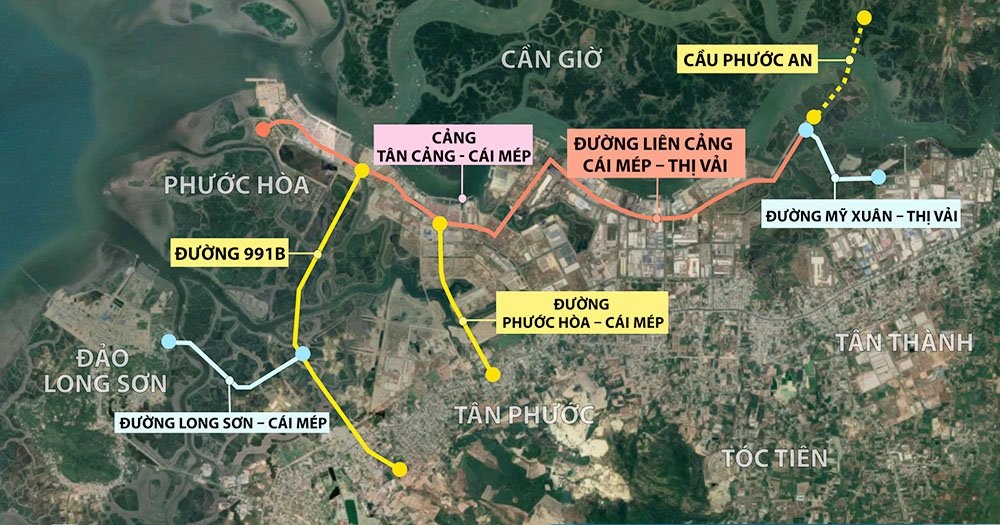
The groundbreaking of QTM International Port in the Cai Mep – Thi Vai port complex adds another large-scale infrastructure project to southern Viet Nam’s seaport system. Developed as an integrated seaport and logistics project, the port is designed to expand the operational capacity of the Cai Mep – Thi Vai port complex while strengthening supply chain connectivity across southern Viet Nam. Project officially breaks ground with an investment of approximately VND 6.9 trillion Construction of QTM International Port officially commenced on July 5 in the Cai Mep – Thi Vai port complex, Ho Chi Minh City. The project will be developed in two phases. Phase 1 includes the construction of three berths with a combined quay length of approximately 762 meters. The berths are designed to accommodate vessels of up to 100,000 DWT and provide an annual cargo handling capacity of approximately 7.5 million tonnes. The first berth is scheduled to enter operation in the first quarter of 2028. Phase 2 is planned for implementation between 2030 and 2033, adding five additional berths with a combined quay length of approximately 1,055 meters. Upon full completion, QTM International Port will comprise eight berths with a total quay length of approximately 1,817 meters. The port will be capable of accommodating vessels ranging from 60,000 to 100,000 DWT and will have a designed annual cargo handling capacity of approximately 16 million tonnes, adding capacity to the Cai Mep – Thi Vai deep-water port complex. An overview of the Cái Mép – Thị Vải deep-sea port complex, the strategic location for the newly initiated QTM International Port project (Image: Internet) Developed as an integrated seaport and logistics project In addition to its berth system, the project is being developed as an integrated seaport and logistics project covering more than 80 hectares. According to the project plan, QTM International Port will include nearly 200,000 square meters of general cargo warehouses, bonded warehouses, cold storage facilities, container yards, and supporting logistics services, enhancing the integration between port operations and supply chain activities. The port is planned to handle a wide range of cargo, including agricultural products, grains, animal feed ingredients, fertilizers, construction materials, and containerized cargo. This development model aligns with the direction adopted by many modern seaports, where hinterland logistics infrastructure plays an increasingly important role in warehousing, distribution, transportation, and value-added logistics services. Connected to southern Viet Nam’s key infrastructure network One of QTM International Port’s key advantages is its location within the Cai Mep – Thi Vai port complex, with access to major infrastructure projects in southern Viet Nam, including the Bien Hoa – Vung Tau Expressway, Long Thanh – Dau Giay Expressway, Ho Chi Minh City Ring Roads 3 and 4, and Long Thanh International Airport. The integration of seaport, road, air transport, and industrial zones supports the development of multimodal transportation while facilitating cargo movement between production areas, manufacturing centers, logistics hubs, and international trade gateways. Images: Internet Growing cargo volumes drive investment in seaport infrastructure Investment in expanding seaport infrastructure comes as cargo transportation demand in Viet Nam continues to grow. During the first five months of 2026, total cargo throughput across Viet Nam’s seaports and inland waterway ports exceeded 546 million tonnes, up approximately 15% year-on-year. Container throughput surpassed 15 million TEUs, representing an increase of approximately 14%. The continued growth in cargo volumes underscores the need to further expand seaport capacity, warehousing, and logistics infrastructure to accommodate future transportation demand. Strengthening Viet Nam’s port and logistics network The development of QTM International Port forms part of Viet Nam’s broader investment in seaport and logistics infrastructure. Together with new expressways, airports, logistics centers, and other infrastructure projects currently under development, the project will expand the operational capacity of the Cai Mep – Thi Vai port complex and increase its ability to accommodate large oceangoing vessels. As international trade continues to grow and global supply chains evolve, coordinated investment in seaports, transport connectivity, and logistics infrastructure will help strengthen transport capacity, improve connectivity, and support Viet Nam’s long-term import and export activitiesn.   Contact Vantage Logistics for tailored transport solutions and competitive quotations. Please provide details on cargo type, market, origin, destination, and estimated timeline. Vantage Logistics Corp – South East Asia (S.E.A) Logistics Provider One-Stop Shop For Integrated Logistics Services Head Office Viet Nam – Suite 6.01, Floor 6th, Block A, RiverGate Residence, 151-155 Ben Van Don, Khanh Hoi Ward, HCMC, Viet Nam Branch Thailand, Laos, Cambodia, Malaysia, Indonesia, Singapore Contact Us Email in**@*****om.vn Hotline +84-909-026-261 Website https://vantage-logistics.com Send your shipment enquiry today and receive a tailored transport plan from the Vantage Logistics team....

06/07/2026

View More
vlc-news-taiwan-coconut-imports-grow

Market updates

Viet Nam Ranks Among the World’s Top Five Coconut Exporters, Remains Taiwan’s Leading Fresh Coconut Supplier

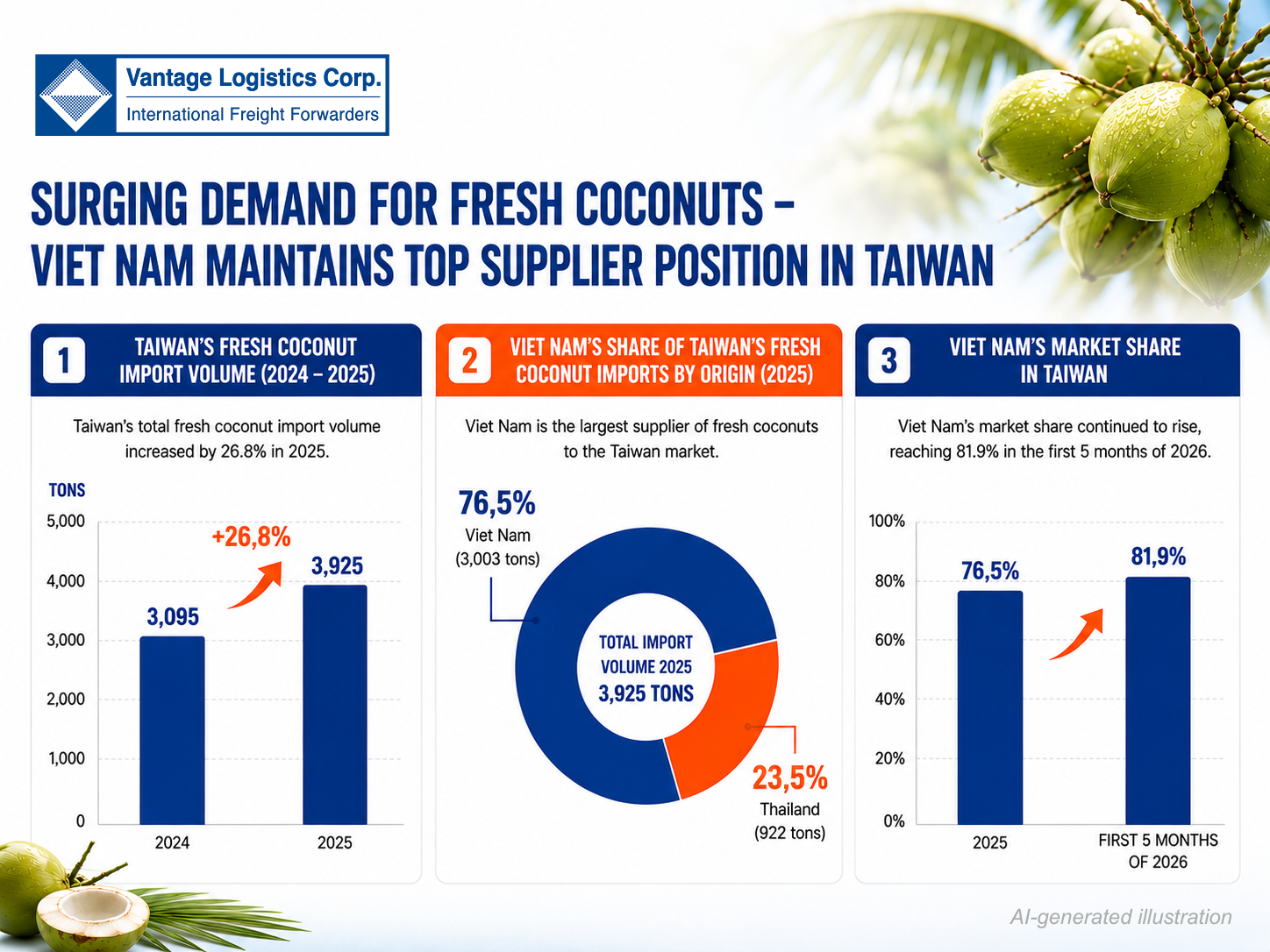
Viet Nam is among the world’s top five coconut-exporting countries, following the Philippines, Indonesia, Malaysia, and Sri Lanka. Vietnamese coconuts are now exported to major international markets, including China, the United States, the European Union (EU), Australia, New Zealand, and Taiwan. Among these markets, Taiwan continues to stand out as demand for fresh coconuts grows, with Vietnam maintaining its position as the market’s largest supplier. For exporters, this trend represents more than growing market demand. It also highlights the increasing importance of cold chain management, phytosanitary compliance, and reliable international logistics in maintaining product quality throughout the export journey. Viet Nam Continues to Lead Taiwan’s Fresh Coconut Market According to the VietNam Trade Office in Taipei, Taiwan imported approximately 3,925 metric tons of fresh coconuts in 2025, representing a 26.8% increase compared to 2024. Viet Nam supplied approximately 3,003 metric tons, accounting for 76.5% of Taiwan’s total fresh coconut imports and generating approximately USD 1.75 million in export value. Export volume from Viet Nam increased 17.9% year over year, reinforcing the country’s position as Taiwan’s leading fresh coconut supplier. The momentum continued into 2026, with Vietnam’s market share rising to 81.9% during the first five months of the year, reflecting sustained demand for Vietnamese fresh coconuts. With limited domestic coconut production, Taiwan relies heavily on imported supply. Viet Nam has become the country’s primary supplier, playing a central role in meeting demand across the Taiwanese fresh coconut market. Growing Consumer Demand Creates New Export Opportunities According to the Viet Nam Trade Office in Taipei, Taiwanese consumers are increasingly choosing natural and plant-based food products. Fresh coconuts are widely available through retail channels while also serving as an important ingredient for the beverage and food processing industries. This trend presents additional opportunities for Vietnamese exporters, particularly as demand for fresh agricultural products and tropical fruits continues to grow across international markets. Fresh Coconut Exports Depend on a Well-Controlled Logistics Chain For fresh coconuts, product quality alone is not enough to ensure export success. Maintaining quality throughout the supply chain is equally critical. Exporters must comply with phytosanitary requirements, maintain product traceability, follow standardized packing procedures, and preserve appropriate storage conditions throughout transportation. Selecting suitable shipping schedules and minimizing transit time also help reduce quality risks for perishable cargo. As importing markets continue to tighten quality and food safety requirements, logistics has evolved from a transportation function into a strategic component of export competitiveness. Vantage Logistics Supports Fresh Coconut Exporters To meet the requirements of international markets, Vantage Logistics provides specialized logistics solutions for fresh agricultural products, including: Reefer container transportation: Deploying advanced, specialized temperature-controlled systems helps preserve freshness from origin to destination Flexible multimodal transportation: Sea and air freight solutions tailored to shipment schedules, transit time requirements, and transportation costs Door-to-door logistics services: Customs clearance, phytosanitary support, and export documentation handled through a single logistics solution Real-time shipment visibility: Continuous shipment tracking enables businesses to monitor cargo movements and respond quickly to operational changes throughout international transportation With 24+ years of experiencein international freight forwarding, Vantage Logistics helps businesses optimize costs, safeguard product quality, and enhance their competitive edge in the global marketplace. As global demand for fresh coconuts continues to scale, partnering with an experienced agricultural logistics provider ensures greater control over schedules, quality, and market expansion capabilities. Contact Vantage Logistics today for expert consultation on tailored shipping and export solutions for fresh coconuts across target markets.   Contact Vantage Logistics for tailored transport solutions and competitive quotations. Please provide details on cargo type, market, origin, destination, and estimated timeline. Vantage Logistics Corp – South East Asia (S.E.A) Logistics Provider One-Stop Shop For Integrated Logistics Services Head Office Viet Nam – Suite 6.01, Floor 6th, Block A, RiverGate Residence, 151-155 Ben Van Don, Khanh Hoi Ward, HCMC, Viet Nam Branch Thailand, Laos, Cambodia, Malaysia, Indonesia, Singapore Contact Us Email in**@*****om.vn Hotline +84-909-026-261 Website https://vantage-logistics.com Send your shipment enquiry today and receive a tailored transport plan from the Vantage Logistics team....

06/07/2026

View More
vlc-news-vn-domestic-carbon-exchange

Market updates

VIET NAM LAUNCHES ITS DOMESTIC CARBON EXCHANGE: WHAT DOES IT MEAN FOR IMPORTERS, EXPORTERS, AND THE LOGISTICS INDUSTRY?

On June 29, 2026, Viet Nam officially launched its domestic carbon exchange at the Hanoi Stock Exchange, marking a significant milestone in the country’s roadmap for developing a national carbon market. The inaugural trading session recorded 1,210 tonnes of CO₂e in matched transactions, with prices ranging from VND 130,000 to VND 136,000 per tonne of CO₂e. While the market initially focuses on major emitting industries, the launch establishes the country’s first domestic carbon price reference and signals that carbon emissions are increasingly becoming an economic consideration for businesses operating across global supply chains. From Environmental Policy to a Market-Based Mechanism The domestic carbon exchange represents more than an environmental initiative – it introduces a market mechanism that allows regulated businesses to trade allocated carbon emission allowances. During the initial phase, trading is limited to emission allowances allocated to three carbon-intensive sectors: thermal power generation, cement manufacturing, and steel production. According to the Government’s roadmap, carbon credits generated from emission reduction and carbon removal projects are expected to be incorporated in future phases. To encourage market participation, the Vietnamese Government has also announced a 100% waiver of transaction service fees through the end of 2028. Businesses are encouraged to familiarize themselves with the official legal framework of Viet Nam’s carbon trading market to prepare appropriate financial and technical compliance strategies. Challenges and Opportunities for Importers and Exporters Amid Green Trade Requirements Global trade is rapidly moving beyond sustainability commitments toward measurable carbon transparency across supply chains. Regulatory frameworks such as the European Union’s Carbon Border Adjustment Mechanism (CBAM), together with growing ESG requirements from multinational corporations, are making emissions data an increasingly important part of supplier qualification and procurement decisions. The launch of Viet Nam’s carbon exchange does not mean that all businesses will immediately participate in emissions trading. However, it clearly indicates that the ability to measure, manage, and reduce carbon emissions will become an increasingly important competitive advantage for exporters serving international markets. Businesses should begin preparing by: Measuring emissions across manufacturing and logistics operations Building reliable emissions data to support ESG reporting Monitoring developments in carbon market regulations and green trade policies Identifying opportunities to reduce emissions through supply chain optimization Why Logistics Is Becoming Part of the Carbon Equation Although the logistics sector is not among the industries participating in the initial emissions trading phase, transportation emissions remain a significant component of many companies’ Scope 3 emissions and broader supply chain decarbonization strategies. As a result, logistics decisions are expected to play an increasingly important role in determining the overall carbon footprint of exported products. Shifting non-urgent cargo from air freight to sea freight can substantially reduce emissions per tonne transported Improving container utilization lowers emissions per shipment while enhancing cost efficiency Optimizing transport routes and minimizing empty trips help reduce fuel consumption Leveraging multimodal transportation can balance transit time, transportation costs, and carbon reduction objectives In this context, logistics is evolving from a transportation function into a strategic contributor to supply chain sustainability and ESG performance. What Should Businesses Consider Next?   The launch of the domestic carbon market will not create immediate operational changes for every business. However, it clearly indicates where international trade is heading. Companies should consider several strategic priorities: Develop emissions inventories to support both internal management and customer reporting requirements. Review logistics networks to identify opportunities for improving efficiency while reducing emissions. Work with logistics providers to optimize transportation modes, routing strategies, and container utilization. Monitor developments in Viet Nam’s carbon market to assess potential long-term business impacts and future compliance requirements. Early preparation will help businesses strengthen supply chain resilience while responding to evolving environmental expectations from customers, regulators, and global markets. Vantage Logistics: Partnering with Businesses to Build Sustainable Supply Chains As ESG requirements and carbon management become increasingly integrated into international trade, logistics is no longer solely about moving cargo from origin to destination. It has become an essential component of building efficient, transparent, and resilient supply chains. Through international freight forwarding, multimodal transportation, customs brokerage, and integrated supply chain solutions, Vantage Logistics helps businesses optimize logistics operations while preparing for the evolving sustainability requirements of global commerce. Contact Vantage Logistics today to explore tailored supply chain solutions, elevate your logistics efficiency, and build a proactive strategy for product carbon footprint tracking ahead of the next phase of global trade.   Contact Vantage Logistics for tailored transport solutions and competitive quotations. Please provide details on cargo type, market, origin, destination, and estimated timeline. Vantage Logistics Corp – South East Asia (S.E.A) Logistics Provider One-Stop Shop For Integrated Logistics Services Head Office Viet Nam – Suite 6.01, Floor 6th, Block A, RiverGate Residence, 151-155 Ben Van Don, Khanh Hoi Ward, HCMC, Viet Nam Branch Thailand, Laos, Cambodia, Malaysia, Indonesia, Singapore Contact Us Email in**@*****om.vn Hotline +84-909-026-261 Website https://vantage-logistics.com Send your shipment enquiry today and receive a tailored transport plan from the Vantage Logistics team....

03/07/2026

View More
Vantage-Logistics-Post (1)

Vantage News

VANTAGE LOGISTICS – INTERNATIONAL AIR FREIGHT SOLUTIONS

Vantage Logistics provides specialized international air freight solutions, connecting Viet Nam with global markets through an extensive transportation network. As an IATA-accredited cargo agent (Code: 3730023004), we maintain direct partnerships with leading airlines, enabling reliable flight schedules, consistent cargo capacity, and dependable supply chain performance for businesses. Operational Capabilities & Key Trade Lanes Vantage Logistics maintains direct agreements with international airlines and leverages stable cargo volumes to provide greater flexibility in flight schedules, space availability, and transportation planning. Shipments are handled through VietNam’s major international airports, including Ho Chi Minh City, Ha Noi, and Da Nang, with connections to key global markets. North America & the United States Air freight is well suited for high-tech products, electronics, and cross-border e-commerce shipments where delivery deadlines are critical. Fast transit times help businesses respond to seasonal demand, maintain inventory flow, and improve cash conversion. Europe Our services support industries with strict transportation requirements, including pharmaceuticals, medical equipment, and luxury goods. Air freight also provides an alternative when ocean freight routes face disruptions caused by geopolitical developments. Australia & New Zealand Compared with ocean freight, which may take several weeks, air freight reduces transit times to approximately 1–3 days, helping preserve the quality of fresh produce, seafood, and other perishable food products entering Oceania. Intra-Asia Frequent flight schedules enable the rapid movement of electronic components, garments, and other production materials between manufacturing facilities across the region, with same-day or next-day delivery available on selected routes. India, the Middle East & Africa Through strategic Gulf hub connections, Vantage Logistics supports the rapid distribution of pharmaceuticals and vaccines while extending access to inland destinations across Africa, helping overcome limitations in local transportation infrastructure. Specialized Solutions for Every Cargo Type Vantage Logistics offers multiple transportation options, including: Airport-to-Airport Door-to-Door Charter Flight Services Our air freight solutions are designed to safely and efficiently handle a wide variety of cargo, including: Perishable cargo High-value and vulnerable cargo General cargo Dangerous goods Oversized and overweight cargo Urgent and time-sensitive shipments To further optimize logistics throughout the Indochina region, Vantage Logistics also provides integrated road-air transportation solutions from Cambodia to worldwide destinations via our Ho Chi Minh City gateway. Before each shipment departs, our specialists review shipping documents, packaging requirements, and customs declarations to help ensure smooth customs clearance while minimizing potential delays and additional costs. Operational Excellence & International Compliance Vantage Logistics maintains key qualifications and certifications for international air freight operations, including: IATA Cargo Agent IATA Registration Number: 3730023004 HAWB Registration: #980/QĐ-CHK IATA Dangerous Goods Regulations (DGR) Certification: #159783 We are also an active member of international logistics networks including WCA, JCTRANS, IFLN, CLN, GAC, CROSSTRADE, OLO, and VLA. Our operations are supported by internationally recognized management and compliance systems, including: C-TPAT supply chain security FMC regulatory compliance ISO quality management HSE (Health, Safety, and Environment) management These credentials provide customers with confidence when shipping cargo that requires strict operational controls or specialized handling. Enhancing Export Competitiveness Speed & Flexibility: Reduce international transit times to meet urgent orders, time-critical shipments, and the transportation requirements of perishable cargo. Protection for High-Value Cargo: Specialized handling procedures and shorter transit times help minimize transportation risks, making air freight an ideal choice for high-value, sensitive, and security-critical shipments. Global Market Reach: Flexible service options – including Airport-to-Airport, Door-to-Door, and Charter Flight solutions – help businesses connect efficiently with customers across global markets.   Contact Vantage Logistics for tailored transport solutions and competitive quotations. Please provide details on cargo type, market, origin, destination, and estimated timeline. Vantage Logistics Corp – South East Asia (S.E.A) Logistics Provider One-Stop Shop For Integrated Logistics Services Head Office Viet Nam – Suite 6.01, Floor 6th, Block A, RiverGate Residence, 151-155 Ben Van Don, Khanh Hoi Ward, HCMC, Viet Nam Branch Thailand, Laos, Cambodia, Malaysia, Indonesia, Singapore Contact Us Email in**@*****om.vn Hotline +84-909-026-261 Website https://vantage-logistics.com Send your shipment enquiry today and receive a tailored transport plan from the Vantage Logistics team....

02/07/2026

View More
vlc-news-customs-office-codes-july1 (3)

Market updates

FROM JULY 1, 2026: CUSTOMS OFFICE CODES OFFICIALLY STANDARDIZED ACROSS THE ENTIRE SYSTEM – IMPORTANT NOTICE FOR CUSTOMS DECLARATIONS

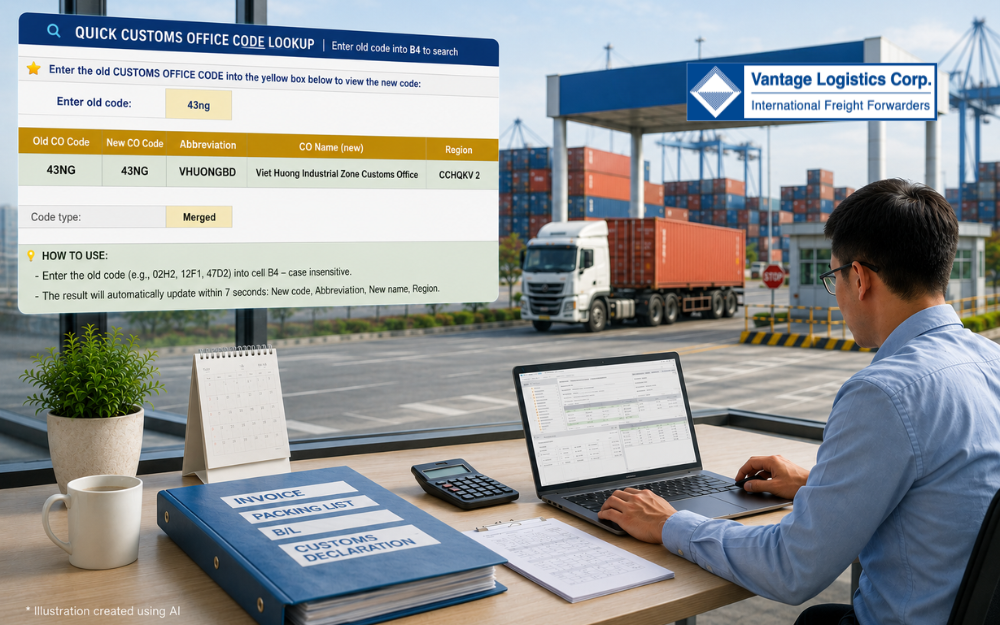
Nationwide Standardization of Customs Office Codes Takes Effect from July 1 Using the correct customs office code is essential because it serves as the key input for the customs system to receive declarations, assign inspection channels, manage records, and monitor tax obligations. Specifically, effective July 1, 2026, customs office codes will be adjusted for border-gate and non-border-gate customs offices that have been merged under the new organizational structure. At the same time, codes will be standardized in cases where multiple customs office codes currently exist for the same unit. The Customs Department has issued an urgent official dispatch instructing Regional Customs Sub-departments to implement the nationwide standardization of customs office codes from July 1, 2026. Businesses are required to update their declaration codes to avoid procedural disruptions and customs clearance delays. The adjustment of customs office codes applies to customs offices that have been merged under the new organizational structure, while also consolidating cases where more than one customs office code currently exists. When businesses register import or export declarations or carry out related procedures such as tax payment, tax refund, or cargo management, the information will be recorded and processed based on the customs office code of the customs authority where the procedures are completed. Using the correct customs office code is important because it is the input information used by the customs system to receive declarations, assign inspection channels, manage records, and monitor tax obligations. In addition to the code transition, the Customs sector has been instructed to review and resolve all pending and suspended declarations in the system before July 1, 2026. To ensure a smooth transition, the Customs Department has instructed Directors of Regional Customs Sub-departments to proactively communicate with and guide the business community in updating the new code list, while providing support for any issues arising during the implementation process. At the same time, customs units are required to review and completely resolve all pending and suspended declarations before the transition date. For declarations subject to cancellation, goods placed under preservation, or goods released under customs procedures, customs authorities are required to coordinate with businesses to complete the necessary procedures in accordance with regulations. Cases that are not yet eligible for processing must be assigned to designated officers for continued monitoring and follow-up to ensure completion and prevent backlogs after the customs office codes are updated. Businesses handling shipments through the Hai Phong area or seeking to strengthen customs compliance for import and export cargo are encouraged to contact Vantage Logistics for advice on document review, customs declaration, and customs clearance coordination tailored to each shipment. Vantage Logistics provides licensed customs brokerage services as part of its integrated logistics solutions. >> Quick Customes Office Code Lookup: Click here   Contact Vantage Logistics for tailored transport solutions and competitive quotations. Please provide details on cargo type, market, origin, destination, and estimated timeline. Vantage Logistics Corp – South East Asia (S.E.A) Logistics Provider One-Stop Shop For Integrated Logistics Services Head Office Viet Nam – Suite 6.01, Floor 6th, Block A, RiverGate Residence, 151-155 Ben Van Don, Khanh Hoi Ward, HCMC, Viet Nam Branch Thailand, Laos, Cambodia, Malaysia, Indonesia, Singapore Contact Us Email in**@*****om.vn Hotline +84-909-026-261 Website https://vantage-logistics.com Send your shipment enquiry today and receive a tailored transport plan from the Vantage Logistics team....

01/07/2026

View More
1 … 10 11 12 13 14 … 43