BLOG

vlc-news-shipping-container-guide-13102026

Logistics

A GUIDE TO SHIPPING CONTAINER TYPES: DIMENSIONS, CAPACITY AND TECHNICAL SPECIFICATIONS

Choosing the right shipping container depends on the cargo’s dimensions, characteristics, weight and handling requirements. Understanding container specifications helps businesses determine the most suitable equipment and plan cargo loading more effectively. This guide provides a quick reference to 12 container types, covering their dimensions, internal volume and key weight specifications. Key Considerations When Selecting a Shipping Container Check the internal dimensions: Use the container’s internal dimensions to calculate the available loading space. Compare the cargo’s length, width and height against the usable internal dimensions, allowing for the clearance needed for loading and unloading Understand payload and gross weight limits: Payload refers to the maximum cargo weight a container is designed to carry, while maximum gross weight includes both the container’s tare weight and the cargo. For inland transportation, also check the applicable vehicle weight limits and road regulations along the planned route Inspect the container before loading: Check the container’s exterior, floor and doors for damage or signs of water ingress. For refrigerated containers, verify that the refrigeration unit is operating properly and that the required temperature can be maintained for the cargo Note: Specifications may vary by container model and manufacturer. Always check the equipment plate on the assigned container before loading.   Contact Vantage Logistics for tailored transport solutions and competitive quotations. Please provide details on cargo type, market, origin, destination, and estimated timeline. Vantage Logistics Corp – South East Asia (S.E.A) Logistics Provider One-Stop Shop For Integrated Logistics Services Head Office Viet Nam – Suite 6.01, Floor 6th, Block A, RiverGate Residence, 151-155 Ben Van Don, Khanh Hoi Ward, HCMC, Viet Nam Branch Thailand, Laos, Cambodia, Malaysia, Indonesia, Singapore Contact Us Email in**@*****om.vn Hotline +84-909-026-261 Website https://vantage-logistics.com Send your shipment enquiry today and receive a tailored transport plan from the Vantage Logistics team.

13/10/2026

View More
vlc-news-blog-what-is-ddp

Blog, Logistics

What is DDP? Who Pays Duty and Tax in International Shipping

What is DDP? DDP (Delivered Duty Paid) is an Incoterm where the seller delivers goods to the buyer’s destination and pays all costs, including transport, import duties, and taxes, while the buyer simply receives the goods. DDP places maximum responsibility on the seller. It is the opposite of EXW and represents the highest level of service – and risk – in international trade.   How DDP Works The seller manages the entire journey, from factory to final destination, including the import process in the buyer’s country. Seller’s responsibilities under DDP: Export packaging and documentation Export customs clearance All transport to named destination Import customs clearance at destination Payment of all import duties, VAT, and taxes Delivery to the named place Bear all risks until goods are delivered   Buyer’s responsibilities under DDP: Unload goods at the named destination (unless otherwise agreed) Receive the goods   Risk transfer point: When goods are placed at the buyer’s disposal at the named destination, ready for unloading.   Key Differences Between EXW, DAP and DDP   EXW DAP DDP Export clearance Buyer Seller Seller Main transport Buyer Seller Seller Import clearance Buyer Buyer Seller Import duties & taxes Buyer Buyer Seller Unloading at destination Buyer Buyer Buyer Seller’s risk level Lowest Moderate Highest Buyer’s risk level Highest Low–Moderate Lowest See also: What is DAP? | What is EXW? | Incoterms 2020: Complete Guide   When DDP Makes Sense DDP works best in specific, limited scenarios – not as a default arrangement for regular commercial trade. DDP is appropriate for: Low-value shipments where import duties are minimal and predictable Replacement parts and spare parts deliveries Free samples and marketing materials Situations where the buyer has no import experience and the seller has an established legal presence in the destination country E-commerce fulfilment where the seller operates cross-border logistics infrastructure   DDP is not appropriate for: Regular high-value commercial imports Shipments where the seller has no legal entity in the destination country Any situation where the seller cannot legally act as importer of record Shipments into markets with complex, unpredictable, or frequently changing duty structures   What DDP Actually Costs the Seller DDP is often quoted as a single all-in price, but several hidden cost drivers affect the final cost: Import duties volatility Tariffs may change after pricing is agreed, increasing seller exposure. VAT exposure In many markets, import VAT must be paid upfront and may not be recoverable for foreign sellers, making it a sunk cost embedded in the price. Importer of Record (IOR) requirement To clear goods, the seller must act as – or appoint – the Importer of Record. In many countries, this requires a locally registered entity, adding cost and compliance complexity.   The Risk Buyers Often Miss DDP reduces operational workload – but does not eliminate legal exposure. Buyer may still be liable Customs authorities may hold the importer accountable for classification, valuation, and compliance – even if duties were paid by the seller.   DDP in Practice: China–Viet Nam Shipments For Vietnamese importers sourcing from China, DDP is widely marketed by Chinese forwarders as a simple, all-inclusive service. It works well for small or infrequent shipments. For regular commercial imports: The seller or their agent must act as importer of record Import VAT (typically 8–10%) is embedded in pricing Classification differences may create duty discrepancies For recurring shipments, DAP (Delivered at Place) or FOB (Free On Board) with a local customs broker often provides better cost control and compliance visibility.   Decision Insight: DDP vs DAP vs FOB If you prioritise convenience and have low shipment value, DDP simplifies operations. If you need cost transparency, compliance control, and scalability: DAP or FOB is usually more effective than DDP for regular commercial imports   FAQ Is DDP the same as door-to-door shipping? Not exactly. Door-to-door is a service description – it tells you about the physical journey. DDP is a trade term – it defines who pays for what and who bears risk. A door-to-door service can be structured under several Incoterms, including DAP or DDP. Can the seller exclude VAT from DDP? Yes. It can be structured as “DDP (VAT unpaid)” if agreed. What is the difference between DDP and DDU? DDU (Delivered Duty Unpaid) was a term under Incoterms 2000, replaced by DAP in Incoterms 2010. Under DDU, the seller delivered to destination but did not pay import duties – which is the same structure as DAP today. DDU is no longer a valid term under current Incoterms rules. Who is the importer of record under DDP? The seller or their appointed agent.   See also: What is FOB? | What is CIF?   Vantage Logistics advises on Incoterm structuring for cross-border shipments across ASEAN, including China – Viet Nam routes where DDP, DAP, and FOB carry different cost and compliance implications. Contact our team for a practical assessment of your shipping terms and total landed cost. — VANTAGE LOGISTICS South East Asia (S.E.A) Logistics Provider One-Stop Shop For Integrated Logistics Services   CONTACT US Head Office: Suite 6.01, Block A, RiverGate Residence, 151-155 Ben Van Don, Khanh Hoi Ward, HCMC, Viet Nam Email: in**@*****om.vn Phone: +84-28 382 67312 – Hotline: +84-909-026-261 Website: https://vantage-logistics.com

17/04/2026

View More
vlc-news-blog-what-is-dap

Blog, Logistics

What is DAP? Delivered at Place Explained with Risks and Examples

What is DAP? DAP is a rule under Incoterms 2020 where the seller delivers goods to a specified destination, ready for unloading. Risk transfers at that point – before unloading begins. The buyer is responsible for import clearance, duties, taxes, and unloading.   How DAP Works  The seller manages everything up to delivery at the named place. The buyer takes over from arrival.   Seller’s responsibilities under DAP: Export packaging and documentation Export customs clearance All transport to the named destination – inland, ocean or air, and delivery to site Delivery of goods ready for unloading Bear all risk during transit   Buyer’s responsibilities under DAP: Unload goods at the named destination Handle import customs clearance Pay import duties, VAT, and taxes Arrange any onward transport after the named place   Risk transfer point: When goods arrive at the named place, ready for unloading – but before unloading begins. One important detail: the named place must be specific. “Ho Chi Minh City” is not sufficient. “Buyer’s warehouse at [address]” or “Cat Lai Port, Ho Chi Minh City” gives both parties clear reference points for when risk and cost transfer.   DAP vs DDP vs DPU: Where the Confusion Starts  DAP is often confused with DPU (Delivered at Place Unloaded) and DDP (Delivered Duty Paid).   DAP DPU DDP Seller arranges transport to destination yes yes yes Seller unloads at destination no yes no Seller handles import clearance no no yes Seller pays import duties & taxes no no yes Risk transfers Before unloading After unloading Before unloading   DAP vs DPU: the difference is unloading. DPU is the only rule where the seller bears unloading risk. DAP vs DDP: DDP requires the seller to act as importer, taking on duties and tax obligations.   See also: What is DDP?   When DAP Makes Sense  DAP works well when: The buyer has a reliable customs broker at the destination country The buyer wants direct control over import duty calculation and payment The seller wants to offer door-delivery service without taking on import tax liability The shipment is to a buyer’s own warehouse or named facility The seller wants to avoid registering as an importer of record in the destination country   When DAP Does NOT Work  DAP is not suitable when: The buyer has no local customs capability or broker Import duties are complex, high, or unpredictable at the destination The named destination is remote or difficult for the seller’s carrier to access precisely   Practical Insights: The Risks That Catch Buyers Off Guard   Customs delays become the buyer’s cost. If import clearance is delayed, storage and demurrage charges apply – and these fall entirely on the buyer. Unloading is often overlooked. DAP delivers goods ready for unloading – but the buyer must handle equipment and labour. This becomes critical for heavy or project cargo. Vague destination creates disputes. A general location like “Ho Chi Minh City” creates ambiguity. A precise address or terminal is required to define risk transfer clearly.   DAP in Practice: ASEAN Cross-Border Shipments  For shipments into Viet Nam, DAP is commonly used for machinery, equipment, and project cargo where the seller – often a European or Chinese manufacturer – arranges delivery to the buyer’s factory or project site.   The buyer’s customs broker handles import clearance under Vietnamese regulations.   Decision Insight: When to Choose DAP vs DDP If your team has customs capability and wants control over import costs, DAP is usually more efficient than DDP. If not, DDP may reduce operational risk, even if total cost is higher due to supplier pricing.   FAQ Does DAP include insurance? No. Insurance is not mandatory. The seller bears risk but is not required to insure the goods. What is the difference between DAP and DDU? DDU (Delivered Duty Unpaid) was the predecessor term under Incoterms 2000. It was replaced by DAP in Incoterms 2010 and remains unchanged in 2020. DAP is the current, valid term – DDU is no longer in use under the current rules. Can DAP be used for sea freight? Yes. DAP applies to all transport modes. Who arranges unloading under DAP? The buyer. This is one of the most frequently misunderstood points.   See also: What is FOB? | What is EXW?   Vantage Logistics supports cross-border and project cargo shipments across ASEAN under DAP and other Incoterms structures. Contact our team for guidance on structuring your shipment terms and controlling total cost. — VANTAGE LOGISTICS South East Asia (S.E.A) Logistics Provider One-Stop Shop For Integrated Logistics Services   CONTACT US Head Office: Suite 6.01, Block A, RiverGate Residence, 151-155 Ben Van Don, Khanh Hoi Ward, HCMC, Viet Nam Email: in**@*****om.vn Phone: +84-28 382 67312 – Hotline: +84-909-026-261 Website: https://vantage-logistics.com

17/04/2026

View More
vlc-news-shipping-container-guide-13102026

Logistics

A GUIDE TO SHIPPING CONTAINER TYPES: DIMENSIONS, CAPACITY AND TECHNICAL SPECIFICATIONS

Choosing the right shipping container depends on the cargo’s dimensions, characteristics, weight and handling requirements. Understanding container specifications helps businesses determine the most suitable equipment and plan cargo loading more effectively. This guide provides a quick reference to 12 container types, covering their dimensions, internal volume and key weight specifications. Key Considerations When Selecting a Shipping Container Check the internal dimensions: Use the container’s internal dimensions to calculate the available loading space. Compare the cargo’s length, width and height against the usable internal dimensions, allowing for the clearance needed for loading and unloading Understand payload and gross weight limits: Payload refers to the maximum cargo weight a container is designed to carry, while maximum gross weight includes both the container’s tare weight and the cargo. For inland transportation, also check the applicable vehicle weight limits and road regulations along the planned route Inspect the container before loading: Check the container’s exterior, floor and doors for damage or signs of water ingress. For refrigerated containers, verify that the refrigeration unit is operating properly and that the required temperature can be maintained for the cargo Note: Specifications may vary by container model and manufacturer. Always check the equipment plate on the assigned container before loading.   Contact Vantage Logistics for tailored transport solutions and competitive quotations. Please provide details on cargo type, market, origin, destination, and estimated timeline. Vantage Logistics Corp – South East Asia (S.E.A) Logistics Provider One-Stop Shop For Integrated Logistics Services Head Office Viet Nam – Suite 6.01, Floor 6th, Block A, RiverGate Residence, 151-155 Ben Van Don, Khanh Hoi Ward, HCMC, Viet Nam Branch Thailand, Laos, Cambodia, Malaysia, Indonesia, Singapore Contact Us Email in**@*****om.vn Hotline +84-909-026-261 Website https://vantage-logistics.com Send your shipment enquiry today and receive a tailored transport plan from the Vantage Logistics team....

13/10/2026

View More
vlc-news-blog-what-is-ddp

Blog, Logistics

What is DDP? Who Pays Duty and Tax in International Shipping

What is DDP? DDP (Delivered Duty Paid) is an Incoterm where the seller delivers goods to the buyer’s destination and pays all costs, including transport, import duties, and taxes, while the buyer simply receives the goods. DDP places maximum responsibility on the seller. It is the opposite of EXW and represents the highest level of service – and risk – in international trade.   How DDP Works The seller manages the entire journey, from factory to final destination, including the import process in the buyer’s country. Seller’s responsibilities under DDP: Export packaging and documentation Export customs clearance All transport to named destination Import customs clearance at destination Payment of all import duties, VAT, and taxes Delivery to the named place Bear all risks until goods are delivered   Buyer’s responsibilities under DDP: Unload goods at the named destination (unless otherwise agreed) Receive the goods   Risk transfer point: When goods are placed at the buyer’s disposal at the named destination, ready for unloading.   Key Differences Between EXW, DAP and DDP   EXW DAP DDP Export clearance Buyer Seller Seller Main transport Buyer Seller Seller Import clearance Buyer Buyer Seller Import duties & taxes Buyer Buyer Seller Unloading at destination Buyer Buyer Buyer Seller’s risk level Lowest Moderate Highest Buyer’s risk level Highest Low–Moderate Lowest See also: What is DAP? | What is EXW? | Incoterms 2020: Complete Guide   When DDP Makes Sense DDP works best in specific, limited scenarios – not as a default arrangement for regular commercial trade. DDP is appropriate for: Low-value shipments where import duties are minimal and predictable Replacement parts and spare parts deliveries Free samples and marketing materials Situations where the buyer has no import experience and the seller has an established legal presence in the destination country E-commerce fulfilment where the seller operates cross-border logistics infrastructure   DDP is not appropriate for: Regular high-value commercial imports Shipments where the seller has no legal entity in the destination country Any situation where the seller cannot legally act as importer of record Shipments into markets with complex, unpredictable, or frequently changing duty structures   What DDP Actually Costs the Seller DDP is often quoted as a single all-in price, but several hidden cost drivers affect the final cost: Import duties volatility Tariffs may change after pricing is agreed, increasing seller exposure. VAT exposure In many markets, import VAT must be paid upfront and may not be recoverable for foreign sellers, making it a sunk cost embedded in the price. Importer of Record (IOR) requirement To clear goods, the seller must act as – or appoint – the Importer of Record. In many countries, this requires a locally registered entity, adding cost and compliance complexity.   The Risk Buyers Often Miss DDP reduces operational workload – but does not eliminate legal exposure. Buyer may still be liable Customs authorities may hold the importer accountable for classification, valuation, and compliance – even if duties were paid by the seller.   DDP in Practice: China–Viet Nam Shipments For Vietnamese importers sourcing from China, DDP is widely marketed by Chinese forwarders as a simple, all-inclusive service. It works well for small or infrequent shipments. For regular commercial imports: The seller or their agent must act as importer of record Import VAT (typically 8–10%) is embedded in pricing Classification differences may create duty discrepancies For recurring shipments, DAP (Delivered at Place) or FOB (Free On Board) with a local customs broker often provides better cost control and compliance visibility.   Decision Insight: DDP vs DAP vs FOB If you prioritise convenience and have low shipment value, DDP simplifies operations. If you need cost transparency, compliance control, and scalability: DAP or FOB is usually more effective than DDP for regular commercial imports   FAQ Is DDP the same as door-to-door shipping? Not exactly. Door-to-door is a service description – it tells you about the physical journey. DDP is a trade term – it defines who pays for what and who bears risk. A door-to-door service can be structured under several Incoterms, including DAP or DDP. Can the seller exclude VAT from DDP? Yes. It can be structured as “DDP (VAT unpaid)” if agreed. What is the difference between DDP and DDU? DDU (Delivered Duty Unpaid) was a term under Incoterms 2000, replaced by DAP in Incoterms 2010. Under DDU, the seller delivered to destination but did not pay import duties – which is the same structure as DAP today. DDU is no longer a valid term under current Incoterms rules. Who is the importer of record under DDP? The seller or their appointed agent.   See also: What is FOB? | What is CIF?   Vantage Logistics advises on Incoterm structuring for cross-border shipments across ASEAN, including China – Viet Nam routes where DDP, DAP, and FOB carry different cost and compliance implications. Contact our team for a practical assessment of your shipping terms and total landed cost. — VANTAGE LOGISTICS South East Asia (S.E.A) Logistics Provider One-Stop Shop For Integrated Logistics Services   CONTACT US Head Office: Suite 6.01, Block A, RiverGate Residence, 151-155 Ben Van Don, Khanh Hoi Ward, HCMC, Viet Nam Email: in**@*****om.vn Phone: +84-28 382 67312 – Hotline: +84-909-026-261 Website: https://vantage-logistics.com...

17/04/2026

View More
vlc-news-blog-what-is-dap

Blog, Logistics

What is DAP? Delivered at Place Explained with Risks and Examples

What is DAP? DAP is a rule under Incoterms 2020 where the seller delivers goods to a specified destination, ready for unloading. Risk transfers at that point – before unloading begins. The buyer is responsible for import clearance, duties, taxes, and unloading.   How DAP Works  The seller manages everything up to delivery at the named place. The buyer takes over from arrival.   Seller’s responsibilities under DAP: Export packaging and documentation Export customs clearance All transport to the named destination – inland, ocean or air, and delivery to site Delivery of goods ready for unloading Bear all risk during transit   Buyer’s responsibilities under DAP: Unload goods at the named destination Handle import customs clearance Pay import duties, VAT, and taxes Arrange any onward transport after the named place   Risk transfer point: When goods arrive at the named place, ready for unloading – but before unloading begins. One important detail: the named place must be specific. “Ho Chi Minh City” is not sufficient. “Buyer’s warehouse at [address]” or “Cat Lai Port, Ho Chi Minh City” gives both parties clear reference points for when risk and cost transfer.   DAP vs DDP vs DPU: Where the Confusion Starts  DAP is often confused with DPU (Delivered at Place Unloaded) and DDP (Delivered Duty Paid).   DAP DPU DDP Seller arranges transport to destination yes yes yes Seller unloads at destination no yes no Seller handles import clearance no no yes Seller pays import duties & taxes no no yes Risk transfers Before unloading After unloading Before unloading   DAP vs DPU: the difference is unloading. DPU is the only rule where the seller bears unloading risk. DAP vs DDP: DDP requires the seller to act as importer, taking on duties and tax obligations.   See also: What is DDP?   When DAP Makes Sense  DAP works well when: The buyer has a reliable customs broker at the destination country The buyer wants direct control over import duty calculation and payment The seller wants to offer door-delivery service without taking on import tax liability The shipment is to a buyer’s own warehouse or named facility The seller wants to avoid registering as an importer of record in the destination country   When DAP Does NOT Work  DAP is not suitable when: The buyer has no local customs capability or broker Import duties are complex, high, or unpredictable at the destination The named destination is remote or difficult for the seller’s carrier to access precisely   Practical Insights: The Risks That Catch Buyers Off Guard   Customs delays become the buyer’s cost. If import clearance is delayed, storage and demurrage charges apply – and these fall entirely on the buyer. Unloading is often overlooked. DAP delivers goods ready for unloading – but the buyer must handle equipment and labour. This becomes critical for heavy or project cargo. Vague destination creates disputes. A general location like “Ho Chi Minh City” creates ambiguity. A precise address or terminal is required to define risk transfer clearly.   DAP in Practice: ASEAN Cross-Border Shipments  For shipments into Viet Nam, DAP is commonly used for machinery, equipment, and project cargo where the seller – often a European or Chinese manufacturer – arranges delivery to the buyer’s factory or project site.   The buyer’s customs broker handles import clearance under Vietnamese regulations.   Decision Insight: When to Choose DAP vs DDP If your team has customs capability and wants control over import costs, DAP is usually more efficient than DDP. If not, DDP may reduce operational risk, even if total cost is higher due to supplier pricing.   FAQ Does DAP include insurance? No. Insurance is not mandatory. The seller bears risk but is not required to insure the goods. What is the difference between DAP and DDU? DDU (Delivered Duty Unpaid) was the predecessor term under Incoterms 2000. It was replaced by DAP in Incoterms 2010 and remains unchanged in 2020. DAP is the current, valid term – DDU is no longer in use under the current rules. Can DAP be used for sea freight? Yes. DAP applies to all transport modes. Who arranges unloading under DAP? The buyer. This is one of the most frequently misunderstood points.   See also: What is FOB? | What is EXW?   Vantage Logistics supports cross-border and project cargo shipments across ASEAN under DAP and other Incoterms structures. Contact our team for guidance on structuring your shipment terms and controlling total cost. — VANTAGE LOGISTICS South East Asia (S.E.A) Logistics Provider One-Stop Shop For Integrated Logistics Services   CONTACT US Head Office: Suite 6.01, Block A, RiverGate Residence, 151-155 Ben Van Don, Khanh Hoi Ward, HCMC, Viet Nam Email: in**@*****om.vn Phone: +84-28 382 67312 – Hotline: +84-909-026-261 Website: https://vantage-logistics.com...

17/04/2026

View More
vlc-news-blog-what-is-fob

Blog, Logistics

What is FOB? When to Use FOB to Control Shipping Costs

What is FOB? FOB (Free On Board) is a shipping term under Incoterms 2020 where the seller is responsible for goods until they are loaded onto the vessel at the port of origin. From that point, the buyer assumes all costs and risks.     How does FOB work? Seller: Prepares goods Handles export clearance Buyer: Books freight Pays shipping cost Arranges insurance Key point: Risk transfers at the port of loading   FOB vs CIF: Key differences Tiêu chí FOB CIF Freight Buyer Seller Insurance Buyer Seller Control Higher Lower   >> See also: What is CIF I Incoterms 2020   When should you use FOB? Use FOB if you: Have a reliable freight forwarder Want cost control Have import experience   Common risks Unexpected port charges Schedule delays Limited control without a forwarder   FAQ Does FOB include shipping cost? No. FOB only covers costs until goods are loaded. Who should use FOB? Businesses with logistics experience.   Need help choosing between FOB and CIF? Contact Vantage Logistics for tailored advice. — VANTAGE LOGISTICS South East Asia (S.E.A) Logistics Provider One-Stop Shop For Integrated Logistics Services   CONTACT US Head Office: Suite 6.01, Block A, RiverGate Residence, 151-155 Ben Van Don, Khanh Hoi Ward, HCMC, Viet Nam Email: in**@*****om.vn Phone: +84-28 382 67312 – Hotline: +84-909-026-261 Website: https://vantage-logistics.com...

16/04/2026

View More
vlc-news-C-O-certification

Blog, Logistics

Choosing The Right C/O Form: A Strategy For Profit Optimisation In Exports

C/O Definition and Importance for Export Businesses C/O (Certificate of Origin) is one of the most critical documents in an import-export dossier. Issued by competent authorities, this document certifies that goods are manufactured or processed in compliance with origin criteria in a specific country. For Vietnamese export businesses, a C/O provides three practical benefits: Preferential Tariff Treatment: Most Free Trade Agreements (FTAs) involving Viet Nam offer preferential tax rates ranging from 0% to significantly lower than standard MFN rates, provided a valid C/O is presented. Enhanced Competitive Advantage: Goods with clear origin certification facilitate smoother customs clearance, build trust with import partners, and allow businesses to compete on price against other suppliers. Compliance with Mandatory Import Requirements: Many markets require a C/O as a mandatory condition for customs clearance, regardless of whether tax incentives apply. However, many businesses encounter serious errors, such as selecting the incorrect Form for a specific market, preparing incorrect documentation leading to rejection, or inaccurate declarations resulting in the loss of tax incentives.     Common C/O Forms for Vietnamese Businesses Viet Nam is currently a member of various FTAs, each corresponding to one or more specific C/O Forms. Choosing the correct Form is the prerequisite for applying preferential tariffs. No. C/O Form Target Market Agreement (FTA) Legal Basis 1 Form D ASEAN Internal Market ATIGA Circular 10/2022/TT-BCT 2 Form E China ACFTA Circular 12/2019/TT-BCT 3 Form EUR.1 European Union (EU) EVFTA Circular 11/2020/TT-BCT 4 Form AK/ VK Korea AKFTA / VKFTA Circular 20/2014/TT-BCT & Circular 40/2015/TT-BCT 5 Form AJ/ VJ Japan AJCEP / VJEPA Circular No. 20/2014/TT-BCT, as amended by Article 2 of Circular No. 04/2024/TT-BCT & Circular No. 10/2009/TT-BCT 6 Form AI India AIFTA Circular 15/2010/TT-BCT 7 Form S/X Laos / Cambodia Border Trade Agreements Circular 04/2010/TT-BCT & Circular 17/2011/TT-BCT 8 Form VC Chile VCFTA Circular 31/2013/TT-BCT 9 Form B Other Markets Non-preferential Circular 05/2018/TT-BCT Important Note: For certain markets like Korea or Japan, businesses can choose between regional Forms (AK, AJ) or bilateral Forms (VK, VJ). Selecting the correct Form ensures tax optimisation; selecting the incorrect Form results in the loss of incentives and potential penalties for inaccurate declarations.   Distinguishing Form E Authorised and Form E Third Party Invoicing Among C/O Forms, Form E (ACFTA) is the most frequently used but also the most prone to confusion, particularly in transactions involving intermediaries. When importing from China where the manufacturer is not the direct party on the contract but operates through another entity, Form E will fall into one of two categories: Authorised or Third Party Invoicing. Failure to distinguish these correctly often leads to Viet Nam Customs rejecting the C/O, forcing businesses to pay 100% of the import duty.   >> Case 1: Authorised C/O (Entrusted / Authorised) Case Description: The manufacturer produces the goods but lacks an export licence or does not wish to handle procedures. They hire a trading company in China to act as the exporter. The commercial invoice is issued by this trading company to the buyer. Box 1 (Exporter): Name of the Authorised Trading Company. Box 7 (Description of Goods): Must include the phrase: “MANUFACTURER: [Actual Manufacturer Name]”. Box 13: Do NOT tick “Third Party Invoicing”.   >> Case 2: Third Party Invoicing C/O Case Description: The buyer purchases goods through an intermediary in a third country (e.g. Hong Kong, Singapore) to benefit from price differences, but goods are shipped directly from the Chinese factory to Viet Nam. The commercial invoice is issued by the third-party company. Box 1 (Exporter): Name of the actual Manufacturer/Exporter in China. (Do not enter the Hong Kong/Singapore entity here). Box 7 (Description of Goods): Must include the name and address of the third-party invoice issuer. Box 10 (Invoice No.): Must reflect the invoice number issued by the third party. Box 13: MUST tick “Third Party Invoicing“. Risk Warning: In third-party transactions via Hong Kong, entering the Hong Kong entity name in Box 1 will result in immediate rejection, as Hong Kong is not an ACFTA member. Box 1 must be a legal entity registered in Mainland China or an ASEAN member state.   Risk Mitigation Solutions in C/O Declaration To protect financial interests and ensure smooth customs clearance, businesses should implement strict control measures: Verify the nature of the transaction before instructing partners to complete the C/O. Identify the actual invoice issuer and the actual exporter. Cross-check C/O information against the Invoice, Packing List, and Bill of Lading before accepting documents. Consult logistics experts or units experienced in Form E processing before signing commercial contracts.   Vantage Logistics Supports C/O Optimisation for Businesses With specialised experience in logistics and international trade, Vantage Logistics provides comprehensive C/O consultancy and support services for Vietnamese export and import businesses: Consultancy on selecting the correct C/O Form for specific markets and commodities. Verification of origin criteria to ensure goods meet agreement rules. Support in dossier preparation to minimise risks of document rejection or loss of tax incentives. Guidance on distinguishing specialised cases such as Authorised and Third Party C/O. Fast and accurate C/O processing to meet shipping deadlines. Contact Vantage Logistics experts for immediate support on C/O. — VANTAGE LOGISTICS South East Asia (S.E.A) Logistics Provider One-Stop Shop For Integrated Logistics Services   CONTACT US Head Office: Suite 6.01, Block A, RiverGate Residence, 151-155 Ben Van Don, Khanh Hoi Ward, HCMC, Viet Nam Email: in**@*****om.vn Phone: +84-28 382 67312 – Hotline: +84-909-026-261 Website: https://vantage-logistics.com...

03/04/2026

View More

Blog, Logistics

Local Charges in Sea Freight: The Costs Businesses Often Overlook in Import-Export Pricing

In many import-export transactions, companies tend to focus on the sea freight rate when comparing quotations between carriers or forwarders. However, once the cargo arrives at the port, a series of port-related fees – collectively known as local charges – begin to arise. If not calculated in advance, these charges can significantly increase the total logistics cost compared to the initial estimate.   In practice, for an international container shipment, total local charges at both origin and destination ports can account for around 10–30% of total logistics costs, depending on the trade lane, Incoterms, and the surcharge policies of each carrier. Understanding the structure of these charges helps businesses forecast costs more accurately and avoid unexpected expenses.     Common Local Charges in Container Shipping Below are the charges most frequently encountered during container handling at ports and throughout the international shipping process: THC – Terminal Handling Charge: container handling at the port, including loading, unloading, yard movement, and positioning. D/O Fee – Delivery Order Fee: issuance of the delivery order by the carrier or its agent. CIC – Container Imbalance Charge: surcharge applied when there is an imbalance of empty containers between regions. Documentation / Handling Fee: processing of shipping documents, issuance of bills of lading, booking, and related paperwork. AMS / ENS / AFR / ISF Filing Fee: manifest filing fees required by customs/security authorities in the US, EU, Japan, etc. Seal Fee: cost of sealing the container during stuffing. CFS Fee (for LCL cargo): charges for handling less-than-container-load shipments at the Container Freight Station.   Container Management Costs in Sea Freight Beyond port handling charges, businesses must also consider costs related to container usage time: Demurrage: charged when a container stays at the port beyond the free time allowed. Detention: charged when a container is taken out of the port but not returned to the depot within the permitted time. These costs can escalate quickly on a daily basis and become substantial if cargo pick-up or container return is delayed.   Other Hidden Charges Businesses Should Know In addition to the common charges, several surcharges are often overlooked in initial quotations: B/L Fee (Bill of Lading Fee): issuance of the bill of lading. Telex Release Fee: electronic release of cargo without presenting the original bill of lading. LSS (Low Sulphur Surcharge): fuel surcharge under IMO 2020 regulations. BAF / EBS (Bunker Adjustment Factor / Emergency Bunker Surcharge): fuel-related surcharges due to oil price fluctuations. PSC / CSC (Port Security Charge / Container Service Charge): port security and container service fees. DDC (Destination Delivery Charge): delivery charge at the destination port, commonly applied on US trade lanes. Fumigation Fee: container fumigation, often required for agricultural or wood products. Destination THC (DTHC): terminal handling charge at the destination port.   Local Charges Are Often Overlooked in Sea Freight Cost Comparisons A common reason is that businesses only compare the sea freight rate without considering local charges at both origin and destination ports. Factors leading to cost discrepancies include: Quotations showing only sea freight, excluding local charges. Different fee structures among carriers and forwarders. Incoterms defining cost responsibilities differently between buyer and seller. Poor control of cargo pick-up and container return times. Thus, two quotations with the same sea freight rate can result in very different total logistics costs.   How Businesses Can Effectively Control Local Charges Request detailed quotations: including freight, local charges at origin and destination, and carrier surcharges. Compare total costs (all-in): not just the freight rate. Control container usage time: to avoid demurrage and detention. Work with transparent logistics partners: experienced providers will clarify fee structures and advise on potential hidden charges.   Transparency in Logistics Costs – A Key Factor in Supply Chain Management Local charges are an integral part of international shipping. When understood and managed properly, they enable businesses to plan costs more accurately and avoid unnecessary surprises during cargo handling. Vantage Logistics provides clear and transparent shipping quotations, along with advisory support on potential charges for each trade lane and delivery condition.   Contact Vantage Logistics today for detailed consultation and tailored shipping quotations for your cargo. — VANTAGE LOGISTICS South East Asia (S.E.A) Logistics Provider One-Stop Shop For Integrated Logistics Services   CONTACT US Head Office: Suite 6.01, Block A, RiverGate Residence, 151-155 Ben Van Don, Khanh Hoi Ward, HCMC, Viet Nam Email: in**@*****om.vn Phone: +84-28 382 67312 – Hotline: +84-909-026-261 Website: https://vantage-logistics.com...

09/03/2026

View More
vlc-news-banner-dem-det-storage-2822026 (4)

Blog

DEMURRAGE, DETENTION & STORAGE: The “Hidden Costs” in Export–Import Operations

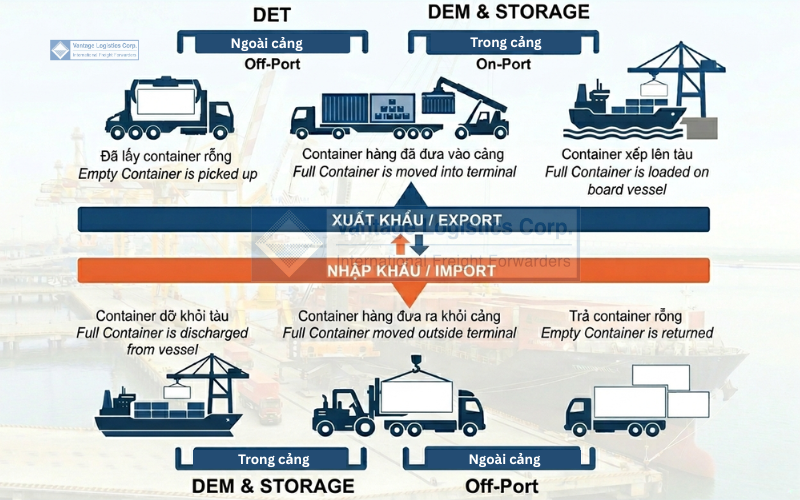
In international trade, many businesses tend to focus solely on freight rates. However, in practice, Demurrage, Detention and Storage are the hidden charges that quietly erode profit margins. A lack of control over these costs can cause expenses to escalate rapidly – sometimes reaching tens of thousands of pounds within just a few days.   DEM (Demurrage – Container Storage at Port) Demurrage (DEM) is the fee charged when a container remains at the port after being discharged from the vessel but not collected within the free time allowance. Once the free time expires, the shipping line begins charging per day. In essence, the container continues to occupy port space, incurring storage costs. This typically occurs when customs clearance is not completed or transport arrangements are delayed.   DET (Detention – Container Storage Outside Port) Detention (DET) is the fee charged when a container is taken out of the port but returned empty later than the agreed free time. The key distinction: Detention applies outside the port, relating to the management of the container’s lifecycle after cargo has been removed. Common causes include delays in unloading, warehousing bottlenecks, or inadequate logistics planning to return the container on time.   Storage Charge – Port Yard Storage Fee Unlike Demurrage, Storage is a fee levied directly by the port when a container occupies yard space beyond the permitted free time. Businesses may face both DEM (charged by the shipping line) and Storage (charged by the port) simultaneously if a container remains in the yard too long. Important: Storage is a port‑levied fee, not a shipping line charge. Why Businesses Commonly Incur These Costs Documentation not ready: vessel arrives but paperwork is incomplete, leaving containers stuck. Collection plan not aligned with vessel schedule: trucks not arranged in time. Poor monitoring of free time: miscalculation of dates, missing the deadline. Lengthy customs inspection: no contingency plan, containers held longer than expected. Daily charges can range from tens to several hundred USD per container depending on the shipping line. Just 3–5 days of delay can result in costs running into tens of thousands.   Case Study: Company A’s Costly Lesson Company A, a Vietnamese agricultural exporter, regularly ships to the US. In one recent consignment, the firm faced Demurrage, Detention and the risk of Storage charges, causing logistics costs to spike. Vessel arrival: Containers discharged, but import documentation was delayed by the overseas partner. Demurrage: Containers remained at port for 4 days beyond free time. The shipping line charged USD 80/container/day. With 10 containers, the total reached USD 3,200. Detention: After removal from port, containers were returned empty 3 days late due to warehouse congestion. The line charged USD 60/container/day, totalling USD 1,800. Storage risk: As containers occupied port yard space during the documentation delay, the port could also levy Storage fees in parallel with Demurrage, further inflating costs. Unexpected total: USD 5,000 (~GBP 4,000), excluding potential Storage charges if yard delays continued.   Lessons learned: Container costs extend beyond freight – DEM, DET and Storage must all be managed. Proactive planning is more effective than reactive problem‑solving. Negotiating suitable free time with forwarders and carriers, and monitoring yard occupancy closely, is essential to avoid overlapping charges.   How to Avoid Demurrage, Detention & Storage Prepare documentation well before ETA. Track vessel schedules and arrival notices closely. Arrange transport in advance of discharge. Monitor free time for each shipment. Work with forwarders who provide early warnings and flexible support.   Controlling Container Costs to Boost Efficiency Effective management of Demurrage, Detention and Storage helps businesses: Stabilise cash flow by avoiding unexpected charges. Reduce unnecessary logistics costs. Strengthen competitiveness with more consistent pricing for customers. If your business has experienced container cost overruns, reviewing current processes is the first step to prevent “money lost in vain” in future.   Contact us today for detailed consultation! — VANTAGE LOGISTICS South East Asia (S.E.A) Logistics Provider One-Stop Shop For Integrated Logistics Services   CONTACT US Head Office: Suite 6.01, Block A, RiverGate Residence, 151-155 Ben Van Don, Khanh Hoi Ward, HCMC, Viet Nam Email: in**@*****om.vn Phone: +84-28 382 67312 – Hotline: +84-909-026-261 Website: https://vantage-logistics.com...

27/02/2026

View More

Blog

AMS Filing Process for U.S.-Bound Cargo Under CBP Regulations: What Businesses Need to Know

AMS filing for shipments to the USA is a mandatory requirement for all cargo exported to the United States by sea or air. Late or inaccurate submission may result in containers being denied loading, cargo being held, or penalties of up to USD 10,000 per violation. Exporters must understand the 24-hour rule, legal responsibilities and the relationship between AMS and ISF to mitigate operational risk.   I. AMS (Automated Manifest System) AMS (Automated Manifest System) is an electronic manifest submission system administered by U.S. Customs and Border Protection (CBP). It requires detailed shipment data to be transmitted before the vessel or aircraft departs the last foreign port of loading. Following tightened security regulations after 9/11, the United States implemented stricter pre-loading data controls. AMS is not merely an administrative formality; it is a security and risk management mechanism. Failure to complete AMS filing for shipments to the USA correctly or on time may lead to: Containers being refused loading. Cargo being detained upon arrival. Administrative penalties and storage costs. Disruption to delivery schedules and cash flow.   II. AMS Filing Process for Shipments to the USA 2.1. Preparation of Shipment Data Mandatory data elements include: Full shipper and consignee details Precise cargo description in English (no vague wording) Quantity and gross weight Harmonised System (HS) code aligned with the cargo description Bill of Lading (B/L) or Air Waybill (AWB) number Port of loading and port of discharge Transport details !All information must be consistent with the Commercial Invoice, Packing List and transport documents.   2.2. Submission via the CBP System Depending on the mode of transport, AMS filing is performed by: Ocean carrier / NVOCC / freight forwarder (Ocean AMS) Airline / air cargo agent (Air AMS) Typically, the forwarder files the House AMS, while the carrier files the Master AMS. Legal liability and indemnity obligations in case of penalties are usually defined in the service agreement.   2.3. CBP Response CBP will issue either: Acceptance confirmation Rejection or “Do Not Load” status If marked “Do Not Load”, the container cannot be loaded until corrections are submitted and approved.   2.4. Record Retention Exporters and service providers should retain filing confirmations and related data for compliance audits.   III. Ocean AMS vs Air AMS   3.1. Ocean AMS – Sea Freight Shipments Deadline: At least 24 hours before the container is loaded onto the vessel at the last foreign port. In practice, many carriers require submission 48 hours before ETD to allow time for amendments. Key data elements: Bill of Lading details SCAC code Filer code Container information Consequences of non-compliance: Container denied loading Demurrage and booking amendment costs Potential CBP penalties Ocean AMS represents the majority of AMS filings for exports from Viet Nam to the United States.   3.2. Air AMS – Air Freight Shipments Air AMS operates under the Air Cargo Advance Screening (ACAS) programme. Deadline: At least 1 hour prior to aircraft departure. Required data: Master Air Waybill (MAWB) House Air Waybill (HAWB) Shipper, consignee and cargo description details Penalties: May range from USD 5,000 to USD 10,000 per violation, depending on severity. For high-value or time-sensitive air shipments, AMS errors can result in missed flights and cascading delivery delays.   IV. AMS and ISF: Parallel Compliance Obligations In addition to AMS filing for shipments to the USA, importers must submit ISF (Importer Security Filing). AMS: responsibility of the carrier or forwarder. ISF: responsibility of the US importer or its agent. If AMS and ISF data are inconsistent, CBP may flag the shipment as high risk and conduct additional inspections.   V. Five Common AMS Filing Errors Overly generic cargo descriptions (e.g., “general merchandise”). Incorrect declaration of the last port of loading. HS code inconsistent with product description. Consignee changes close to ETD without AMS amendment. Data mismatch between AMS and ISF. Such errors can delay loading at origin before the shipment even departs.   VI. AMS Filing Is Risk Control, Not Just Compliance AMS filing for shipments to the USA is a compulsory step in the export chain. Exporters should: Standardise documentation data. Strictly monitor the 24-hour (Ocean) and 1-hour (Air) deadlines. Ensure alignment between shipper, forwarder and importer. Clearly define legal responsibilities in service contracts. Proactive AMS control reduces loading risk, prevents avoidable costs and safeguards delivery performance. Contact Vantage Logistics to ensure your AMS filing for shipments to the USA complies with CBP regulations, meets the 24-hour rule and aligns accurately with ISF requirements. — VANTAGE LOGISTICS South East Asia (S.E.A) Logistics Provider One-Stop Shop For Integrated Logistics Services   CONTACT US Head Office: Suite 6.01, Block A, RiverGate Residence, 151-155 Ben Van Don, Khanh Hoi Ward, HCMC, Viet Nam Email: in**@*****om.vn Phone: +84-28 382 67312 – Hotline: +84-909-026-261 Website: https://vantage-logistics.com...

25/02/2026

View More
1 2 3