RESOURCE

Market updates

SINGAPORE STRENGTHENS PRODUCT SAFETY CONTROLS: WHAT VIETNAMESE EXPORTERS NEED TO KNOW

Singapore is strengthening its product safety controls through two key regulations: the Consumer Protection (Safety Requirements) Regulations (CPSR) and the Consumer Goods (Safety Requirements) Regulations (CGSR). For exporters, these requirements go beyond product compliance. They can also affect delivery schedules, logistics costs, and supply chain reliability. 1. Singapore Strengthens Product Safety Requirements According to information published by Vietnam’s Ministry of Industry and Trade, Singapore applies two main regulatory frameworks for product safety. – CPSR: Covers 33 categories of controlled goods, including electrical and electronic products, household appliances, and gas appliances. Products within scope must meet applicable safety requirements, complete registration, and carry the SAFETY Mark before being supplied or sold in Singapore. – CGSR: Covers general consumer goods such as toys, clothing, furniture, and sports equipment, which must comply with the relevant safety standards. Non-compliant products may be subject to sales restrictions or recalls. Businesses that violate applicable requirements may also face penalties. For exporters, checking compliance requirements before shipment is essential. Addressing documentation or registration issues early can help avoid costly adjustments after cargo has already left the port of origin. 2. Potential Impact on Southeast Asia’s Trade and Logistics Singapore plays an important role in Southeast Asia’s trade and logistics network. Tighter product safety controls may require exporters, importers, and distributors to review their procedures for placing goods on the Singapore market. Several potential risks deserve attention: – Delivery delays: Incomplete documentation or missing certificates may affect cargo acceptance and delivery schedules. – Additional logistics costs: Delays in resolving compliance issues may lead to storage, port handling, or additional transportation costs. – Disrupted distribution plans: Late deliveries can affect inventory planning, distribution schedules, and commitments to business partners. These requirements do not automatically apply across all ASEAN markets. However, they highlight the importance of understanding the specific regulations of each destination country when planning regional trade and distribution. 3. What Should Vietnamese Exporters Prepare? For Vietnamese businesses exporting to Singapore, compliance checks should take place before shipment arrangements are finalized. Exporters should determine whether their products fall under CPSR or CGSR, verify the applicable safety standards and registration requirements, and clarify responsibilities with their Singaporean importers. Documentation preparation should also be factored into the shipping schedule. If an issue is discovered only after cargo arrives at the destination port, businesses may need to manage several challenges simultaneously, including delivery delays, additional costs, and changes to distribution plans. A reliable shipping plan therefore involves more than selecting the right route or sailing schedule. It also requires anticipating potential obstacles before the cargo reaches its destination. 4. Managing Risks Through Early Planning Not every risk in international shipping can be eliminated, but many disruptions can be reduced through early preparation. Reviewing cargo information, documentation, shipping schedules, and destination requirements helps all parties make better-informed decisions. For shipments to Singapore, close coordination among exporters, importers, agents, and logistics providers helps maintain visibility over shipment readiness, address changes, and adjust plans when necessary. At Vantage Logistics, international transportation planning takes into account the practical requirements of each shipment and the coordination needed among relevant parties. This approach helps businesses manage potential disruptions and maintain better control over delivery schedules. As market requirements evolve, careful preparation does more than protect an individual shipment. It also helps businesses maintain reliable supply chains and build lasting partnerships across international markets.

15/10/2026

View More
vlc-news-shipping-container-guide-13102026

Logistics

A GUIDE TO SHIPPING CONTAINER TYPES: DIMENSIONS, CAPACITY AND TECHNICAL SPECIFICATIONS

Choosing the right shipping container depends on the cargo’s dimensions, characteristics, weight and handling requirements. Understanding container specifications helps businesses determine the most suitable equipment and plan cargo loading more effectively. This guide provides a quick reference to 12 container types, covering their dimensions, internal volume and key weight specifications. Key Considerations When Selecting a Shipping Container Check the internal dimensions: Use the container’s internal dimensions to calculate the available loading space. Compare the cargo’s length, width and height against the usable internal dimensions, allowing for the clearance needed for loading and unloading Understand payload and gross weight limits: Payload refers to the maximum cargo weight a container is designed to carry, while maximum gross weight includes both the container’s tare weight and the cargo. For inland transportation, also check the applicable vehicle weight limits and road regulations along the planned route Inspect the container before loading: Check the container’s exterior, floor and doors for damage or signs of water ingress. For refrigerated containers, verify that the refrigeration unit is operating properly and that the required temperature can be maintained for the cargo Note: Specifications may vary by container model and manufacturer. Always check the equipment plate on the assigned container before loading.   Contact Vantage Logistics for tailored transport solutions and competitive quotations. Please provide details on cargo type, market, origin, destination, and estimated timeline. Vantage Logistics Corp – South East Asia (S.E.A) Logistics Provider One-Stop Shop For Integrated Logistics Services Head Office Viet Nam – Suite 6.01, Floor 6th, Block A, RiverGate Residence, 151-155 Ben Van Don, Khanh Hoi Ward, HCMC, Viet Nam Branch Thailand, Laos, Cambodia, Malaysia, Indonesia, Singapore Contact Us Email in**@*****om.vn Hotline +84-909-026-261 Website https://vantage-logistics.com Send your shipment enquiry today and receive a tailored transport plan from the Vantage Logistics team.

13/10/2026

View More
vlc-news-cross-border-logistics-10102026

Vantage News

VANTAGE LOGISTICS – INTEGRATED CROSS-BORDER TRANSPORT SOLUTIONS IN THE MEKONG REGION

Connecting supply chains across Viet Nam, Cambodia, Laos, and Thailand through synchronized maritime-road corridors and cross-border transit customs. In manufacturing and international trade, moving raw materials, components, and finished goods across Mekong countries requires a balance between delivery speed and logistics costs. Compared to sea freight, cross-border trucking reduces transit times significantly. However, the most critical operational challenges involve transit customs procedures and differing axle-load regulations across jurisdictions. A minor documentation discrepancy at the border or an axle-load calculation error can cause border congestion and incur substantial truck demurrage fees. Vantage Logistics delivers integrated Cross-Border Logistics solutions, combining multimodal connectivity, strict regulatory compliance, and localized operational management: 1. Flexible Transport Configurations Tailored to project budgets, delivery schedules, and vehicle circulation regulations across each market, Vantage Logistics deploys adaptable transport options: Border Transshipment (Back-to-Back Trucking): Coordinating cargo transfers or prime mover swaps at key border checkpoints (such as Moc Bai / Bavet and Lao Bao / Dansavanh) to optimize operating costs when vehicles are restricted from operating deep into the destination country Direct Cross-Border Trucking: Providing vehicles with valid international road transport permits and logbooks, ensuring seamless door-to-door delivery from dispatch facility to consignee warehouse Cross-Border Axle-Load Compliance: Calculating and distributing cargo weight in strict accordance with national regulations across Viet Nam, Cambodia, and Laos, preventing fines or forced offloading at border weigh stations Bonded Trucking: Managing cargo transit under customs supervision with intact customs seals from seaports to export border checkpoints or designated bonded facilities 24/7 GPS Tracking: Delivering real-time vehicle positioning to monitor route progress, milestone checkpoints, and actual on-site delivery 2. Transit Customs Clearance & GMS Framework Expertise Synchronizing documentation workflows to maintain uninterrupted cross-border cargo flow: Multilateral Transport Frameworks (GMS & Bilateral Agreements): Assisting clients in completing applications for cross-border transport permits and logbooks under the Greater Mekong Subregion (GMS) Cross-Border Transport Agreement and bilateral road transport pacts between Viet Nam, Cambodia, and Laos Pre-Arrival Document Synchronization: Closely coordinating between documentation teams in Viet Nam and our Phnom Penh branch office / localized partner networks to cross-check transit declarations and commercial invoices before vehicles arrive at the border, minimizing wait times at border checkpoints Transit Customs Clearance via Viet Nam: Managing customs transit declarations for international shipments moving through Viet Nam’s major seaports (Cat Lai, Cai Mep, Hai Phong, Da Nang) to Cambodia, Laos, and vice versa Quarantine & Tariff Consultation: Representing cargo owners in specialized inspections (phytosanitary and veterinary quarantine) at international border gates; advising on HS code classification and verifying the validity of Certificate of Origin (C/O Form D) under the ATIGA framework to ensure applicable tariff preferences Proof of Delivery (POD) Management: Collecting, reviewing, and delivering official POD documents endorsed by customs authorities at both borders for tax finalization, while providing advisory support on local road tolls and regional fiscal requirements 3. Multimodal Transport Connectivity Beyond road transport, Vantage Logistics bridges cross-border corridors with international ocean freight loops to expand regional reach: Regional Export Gateway Support: Facilitating overland cargo movement from Cambodia and Laos to Viet Nam’s major seaport hubs, connecting regional exports with mainline ocean carriers bound for global destinations Project Cargo & Heavy Machinery Coordination: Mobilizing specialized equipment in coordination with our in-house Project Logistics technical team for oversized/overweight machinery, industrial plant equipment, and temporary import/re-export shipments 4. Commercial Value for Businesses Transit Time Optimization: Reducing transit time on key corridors – such as Viet Nam to Cambodia within 1–2 days (compared to 5–8 days by sea) – securing continuous raw material flow for manufacturing lines Cost Efficiency: Delivering substantial cost savings compared to air freight while meeting rapid delivery requirements across diverse cargo categories Direct Localized Presence: Backed by 5 branch offices in Viet Nam (Ho Chi Minh City, Ha Noi, Hai Phong, Da Nang, Qui Nhon) and an established branch office in Phnom Penh, Cambodia, Vantage Logistics ensures rapid problem resolution and on-site support without reliance on third-party intermediaries Looking for an optimal transport solution between Viet Nam, Cambodia, Laos, and Thailand? Contact Vantage Logistics for routing advice and tailored quotations.   Contact Vantage Logistics for tailored transport solutions and competitive quotations. Please provide details on cargo type, market, origin, destination, and estimated timeline. Vantage Logistics Corp – South East Asia (S.E.A) Logistics Provider One-Stop Shop For Integrated Logistics Services Head Office Viet Nam – Suite 6.01, Floor 6th, Block A, RiverGate Residence, 151-155 Ben Van Don, Khanh Hoi Ward, HCMC, Viet Nam Branch Thailand, Laos, Cambodia, Malaysia, Indonesia, Singapore Contact Us Email in**@*****om.vn Hotline +84-909-026-261 Website https://vantage-logistics.com Send your shipment enquiry today and receive a tailored transport plan from the Vantage Logistics team.

10/10/2026

View More
vlc-news-custom-law-amended-mar1-04092026-vi (2)

Market updates

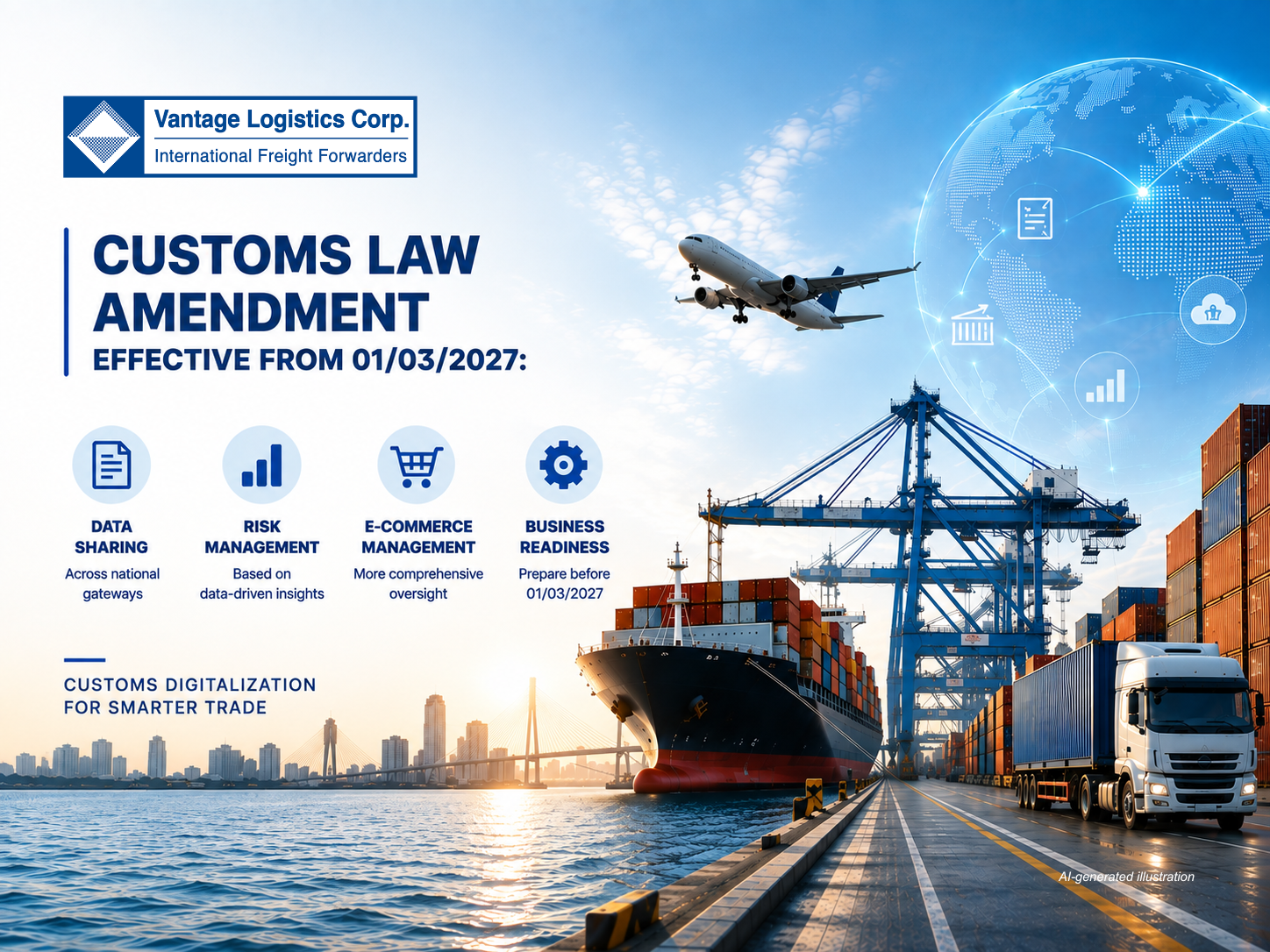
Vietnam’s Amended Customs Law Effective March 1, 2027: New Mandates on Data Governance

Passed by the National Assembly on August 23, 2026, and officially taking effect on March 1, 2027, Law No. 11/2026/QH16 (amending and supplementing certain articles of the Customs Law) represents a strategic shift in import-export governance. Regulatory oversight is pivoting decisively from “paper-based document sufficiency” to “end-to-end data integrity, consistency, and automated cross-system reconciliation.” Here are the key regulatory updates and a practical roadmap that trading enterprises must navigate ahead of the 2027 enforcement deadline. I. Inter-Agency Data Sharing via National Single Window (NSW): Eliminating Redundant Filings Under amended Article 24, customs declarations and supporting documents submitted as electronic data messages carry full legal validity, provided they satisfy integrity standards and established e-transaction data schemas. The “Once-Only” Submission Principle: Permits and specialized inspection results issued by line ministries via the National Single Window (NSW) are channeled straight into the customs automated system. Declarants are no longer required to re-submit or present physical or separate electronic copies The Consistency Imperative: As inter-agency system integration becomes fully automated, any discrepancy in commodity descriptions, HS codes, quantities, customs valuation, or origin across the declaration, Commercial Invoice, Packing List, and Certificate of Origin (C/O) will be flagged automatically by the system II. Risk Management and Customs Compliance: Powered by AI and Big Data Amended Articles 17 and 17a establish a clear legal basis for customs authorities to deploy Big Data analytics and Artificial Intelligence (AI) to collect, process, and cross-reference data for risk profiling and compliance tiering. Audit Trails and Historical Data Profiling: Customs evaluations will no longer focus solely on isolated shipments. The system tracks continuous data lineage: Internal ERP à Commercial Invoices/Docs à Historical Declarations à Post-Clearance Records Tangible Benefits for High-Compliance Traders: Businesses with clean transaction histories, consistent HS code classifications, and proactive self-amendment mechanisms will qualify for trade facilitation privileges: lower Yellow/Red channel physical inspection rates, streamlined specialized inspections, and reduced post-clearance audit frequency III. Dedicated Oversight for Cross-Border E-Commerce Article 16a introduces a focused regulatory framework for import and export operations transacted via e-commerce marketplaces: Entities and individuals conducting cross-border transactions through e-commerce platforms must undergo electronic identification and authentication Platform operators, international express couriers, 3PL providers, and bonded warehouse operators are mandated to interface directly with the customs data infrastructure, transmitting order details, logistics tracking milestones, and transaction values in real time IV. Shared Data Accountability Across the Supply Chain The amended law broadens the scope of reporting entities to include cargo owners, logistics service providers, carriers, licensed customs brokers, and digital platforms. A compliant customs declaration now relies on data integrity across multiple hands. Importers and exporters must clearly delineate responsibilities within Service Level Agreements (SLAs): Which data attributes must be validated and certified directly by the supplier/shipper? Which specific data fields are keyed and cross-checked by the customs broker? What are the clear liability and indemnification terms when data errors result in customs penalties, shipment holds, or supply chain disruptions? V. Strategic Roadmap: 5 Actionable Steps Before March 1, 2027 While the Government and the Ministry of Finance draft detailed implementing Decrees and Circulars, enterprises should establish internal data controls through the following operational flow: ERP/Accounting Source Data à Master Data Standardization à Document Pre-Audit à Sign-off à Filing & Digital Archiving Cleanse Product Master Data: Consolidate and lock standard product catalogs, including validated 8-digit HS codes, explicit commercial descriptions, standard Units of Measure (UOM), and country of origin rules for all regular product lines Eliminate Software Integration Gaps: Audit data interfaces between ERP systems, Warehouse Management Systems (WMS), accounting databases, and customs declaration software (e.g., VNACCS/ECUS). Remove manual copy-paste interventions that introduce human error Institute a 5-Point Pre-Filing Validation Checklist: Does line-item data on the declaration match the Commercial Invoice and Packing List exactly? Are cargo descriptions precise and technical, completely avoiding ambiguous or generic trade names? Are the assigned HS codes backed by verifiable technical documentation or formal Advance Rulings? Have specialized inspection certificates or licenses populated correctly on the National Single Window portal? Can all supporting technical literature and cost accounting records be retrieved and presented within 24 hours in the event of an audit inquiry? Institutionalize Electronic Archiving Protocols: Store comprehensive digital dossiers by shipment and declaration number. Ensure digital signatures remain cryptographically verifiable and metadata stays intact for post-clearance audits (PCA) Monitor Sub-Law Guidance: Track forthcoming ministerial Circulars through 2026–2027 detailing technical data schemas, API integration protocols, and voluntary compliance frameworks Digital customs compliance from 2027 onward requires a shift toward rigorous data governance rather than surface-level document assembly. Proactive businesses that clean their data today will turn regulatory compliance into an operational edge – securing faster green-channel clearance and lowering total landed costs. Looking to audit your customs data workflows, evaluate your compliance posture, or structure integrated logistics solutions ahead of the 2027 regulatory shift? Contact Vantage Logistics to consult with our trade compliance and freight advisory specialists.   Contact Vantage Logistics for tailored transport solutions and competitive quotations. Please provide details on cargo type, market, origin, destination, and estimated timeline. Vantage Logistics Corp – South East Asia (S.E.A) Logistics Provider One-Stop Shop For Integrated Logistics Services Head Office Viet Nam – Suite 6.01, Floor 6th, Block A, RiverGate Residence, 151-155 Ben Van Don, Khanh Hoi Ward, HCMC, Viet Nam Branch Thailand, Laos, Cambodia, Malaysia, Indonesia, Singapore Contact Us Email in**@*****om.vn Hotline +84-909-026-261 Website https://vantage-logistics.com Send your shipment enquiry today and receive a tailored transport plan from the Vantage Logistics team....

10/09/2026

View More

Market updates

PRODUCTION SHIFTING TO SOUTHEAST ASIA: WHAT DOES THIS MEAN FOR VIETNAM’S PORT AND MARITIME TRANSPORT INDUSTRY?

Southeast Asia is strengthening its position in the restructuring of global supply chains as multinational corporations continue to reallocate production capacity. For Viet Nam, the shift in investment and manufacturing activity could expand cargo volumes for ports and maritime transport, but it does not automatically translate into higher port throughput. The extent of the benefit depends on three factors: cargo composition, connectivity to international shipping networks, and the logistics capacity connecting factories with ports. Notably, Vietnam’s maritime connectivity has been showing clear progress. According to UNCTAD, Vietnam’s Liner Shipping Connectivity Index (LSCI) increased by 12% between June 2024 and June 2025, indicating that Vietnam’s position within the international container shipping network continues to strengthen. I. Production Shifts Create More Cargo, but Not All Cargo Moves by Sea 1/ Cargo Composition Determines the Mode of Transport The shift of manufacturing activity across ASEAN is creating clear two-way transportation demand: imports of machinery, components, and production inputs, alongside exports of finished goods to major consumer markets. However, the actual volume of cargo moving through ports depends directly on cargo composition: High-tech shipments, compact components, high-value goods, and time-sensitive cargo tend to favor air freight. By contrast, industries with high volumes of production inputs and finished goods, such as textiles and apparel, footwear, machinery, furniture, and consumer electronics, are major sources of containerized cargo demand for maritime transport. FDI and production shifts create potential cargo volumes; the actual amount moving through seaports still depends on cargo characteristics, import and export markets, and supply chain structures. 2/ Who Actually Benefits from the New Cargo Flows? New cargo flows do not distribute benefits evenly across the supply chain. For seaports, the direct impact is higher demand for container handling, particularly at gateways capable of receiving large vessels and integrated into international shipping networks. For Vietnam’s maritime transport industry, the more immediate opportunities are concentrated in intra-Asia routes, feeder services, coastal shipping, and cargo connectivity between ports within the region. Meanwhile, on direct deep-sea routes to North America and Europe, vessel capacity remains primarily controlled by international container shipping lines. As a result, Vietnamese logistics companies have clearer opportunities in connecting cargo sources to international shipping networks, through feeder services, barges, trucking, warehousing, and customs services. Vietnam’s share of cargo flows from Asia to North America & Europe Source: Compiled from Kirin Capital & International Maritime Reports II. Shipping Networks Determine Which Ports Actually Benefit Channel depth and berth capacity are necessary conditions. However, to convert handling capacity into actual throughput, a port must be integrated into the service networks of international shipping lines. The restructuring of service networks toward a Hub-and-Spoke model makes this factor even more important. A port may be selected as a mainline port of call, a regional connection point, or a feeder port; each position creates different cargo volumes and flow patterns. In Viet Nam, Cai Mep–Thi Vai and Lach Huyen continue to serve as two key deep-water port clusters within the international maritime transport network. Cai Mep’s performance shows how the ability to handle mainline vessels is being converted into actual throughput: In the first 10 months of 2025, the Cai Mep–Thi Vai port cluster handled nearly 6.3 million TEUs of mainline-vessel cargo, up more than 18% year over year At CMIT, during the first 11 months of 2025, the port handled more than 350 mainline vessel calls and over 8,000 barge and feeder vessel calls; mainline-vessel throughput exceeded 1.1 million TEUs, up 28%, while maintaining 8 direct international service routes to North America, Europe, and intra-Asia markets Cai Mep–Thi Vai port cluster: mainline-vessel cargo throughput surges Source: Viet Nam Seaports Association – VPA III. Logistics Connectivity Determines The Ability To Handle Cargo Flows A deep-water port is only one node in the overall journey. For cargo from manufacturing centers to effectively enter the international maritime network, the port must be seamlessly connected to road transport, inland waterways, ICDs, warehousing, and customs clearance services. When shipping lines operate on tight schedules and cut-off times, a delay in transporting cargo from the factory to the port can cause the shipment to miss its mainline vessel. This is particularly important for major manufacturing centers. Barge and trucking capacity, as well as the ability to consolidate cargo from industrial parks and move it to deep-water ports, directly affect the time, cost, and reliability of the entire journey. Beyond infrastructure expansion, port operating performance in Vietnam is also improving. According to the 2025 Container Port Performance Index (CPPI) published by the World Bank and S&P Global in 2026, Cai Mep ranked 11th and Hai Phong ranked 13th among more than 400 ports evaluated. This shows that port competitiveness is not determined solely by capacity scale, but increasingly by the ability to operate reliably and connect efficiently with the broader network. IV. Three Challenges To Watch The benefits of supply chain shifts will not automatically translate into uniform growth across the market. Three challenges require close attention: Post-port infrastructure connectivity: The expansion of berths needs to be accompanied by sufficient inland waterway and barge capacity, road connections, satellite ICD networks, and customs clearance capacity to prevent localized bottlenecks. Capacity competition among terminals: New terminals coming into operation give shippers more options, but they also intensify competition for cargo among terminals within the same area if cargo growth does not keep pace with capacity expansion. Changes in shipping networks: Changes in route allocation and port-call frequency by international shipping alliances can cause cargo flows to shift between port clusters. V. Conclusion: From Port Capacity To Supply Chain Synchronization Production shifts create cargo; shipping networks determine which ports handle that cargo; and logistics capacity behind the port determines whether the entire supply chain can convert that opportunity into economic efficiency. The advantage of Vietnam’s seaports today is measured not only by berth length, but by their ability to provide seamless connectivity from the factory gate to the mainline vessel. For shippers, port selection is increasingly shifting from the question “Which port has lower handling fees?” to “Which transportation option can keep the entire cargo journey reliable, on schedule, and as cost-efficient as possible?” Vantage Logistics provides integrated transportation solutions, connecting ocean freight, inland waterway barges, trucking, warehousing, and end-to-end customs clearance. Contact us to develop a transportation and logistics plan aligned with your production schedule and vessel schedules.   Contact Vantage Logistics for tailored transport solutions and competitive quotations. Please provide details on cargo type, market, origin, destination, and estimated timeline. Vantage Logistics Corp – South East Asia (S.E.A) Logistics Provider One-Stop Shop For Integrated Logistics Services Head Office Viet Nam – Suite 6.01, Floor 6th, Block A, RiverGate Residence, 151-155 Ben Van Don, Khanh Hoi Ward, HCMC, Viet Nam Branch Thailand, Laos, Cambodia, Malaysia, Indonesia, Singapore Contact Us Email in**@*****om.vn Hotline +84-909-026-261 Website Send your shipment enquiry today and receive a tailored transport plan from the Vantage Logistics team....

10/09/2026

View More
vlc-news-uae-vn-import-tariff-09092026

Market updates

VIET NAM IMPORT TARIFFS ON GOODS FROM THE UAE: KEY CEPA COMPLIANCE CONSIDERATIONS FOR IMPORTERS

The Comprehensive Economic Partnership Agreement (CEPA) between Viet Nam and the UAE officially took effect on February 3, 2026. In conjunction with the agreement, the Government of Viet Nam enacted a Decree establishing the Special Preferential Import Tariff Schedule under CEPA for the 2026–2027 period. Qualifying imports from the UAE are eligible for preferential customs duty rates (CEPA tariff rates). To determine the applicable duty rate for each shipment, importers must cross-check three key elements: tariff classification (HS code), origin criteria, and declaration dates. 1/ Key Highlights of the CEPA Tariff Framework Product-Specific Duty Rates: The CEPA tariff schedule details preferential rates at the 8-digit HS code level for 2026 and 2027. It covers major import categories from the UAE, including raw plastics, chemicals, and base metals. Tariff lines marked with an asterisk (*) are excluded from preferential treatment under this agreement. Effective Date: While the governing decree was promulgated later, preferential CEPA tariff treatment applies retrospectively to customs declarations registered on or after February 3, 2026. 2/ Three Eligibility Requirements for Preferential Treatment  To qualify for CEPA tariff rates, an import shipment must meet all three requirements: HS Code Eligibility: The merchandise must fall under an eligible HS code in the CEPA Special Preferential Import Tariff schedule. Direct Consignment from the UAE: Goods must be imported directly from the UAE into Vietnam in compliance with the agreement’s transport and transshipment regulations. Origin and Valid Proof of Origin: The goods must satisfy CEPA rules of origin and be accompanied by a valid Certificate of Origin (C/O) or compliant origin declaration issued in accordance with regulations from the Ministry of Industry and Trade. Note on Origin: Purchasing or shipping goods from the UAE does not automatically confer UAE origin. Importers must confirm the originating status and valid origin documentation with suppliers prior to customs filing. 3/ Tariff Application & Duty Adjustment Provisions Current and Upcoming Entries: Importers should ensure that valid proof of origin (C/O or prescribed origin declarations) is ready at the time of customs clearance to secure CEPA duty rates immediately, avoiding provisional declarations under higher Most-Favored-Nation (MFN) rates. Prior Shipments (Registered from February 3, 2026): Regulatory provisions allow for the adjustment and refund of overpaid import duties if the goods met all CEPA qualification criteria but were cleared at higher tariff rates. Importers with unadjusted entries from this period should review their shipment files to initiate duty adjustment procedures with customs authorities.  4/ Pre-Import Checklist for Importers Confirm correct 8-digit HS classification Check applicable CEPA preferential duty rates Verify origin criteria compliance with the foreign supplier Secure compliant proof of origin (C/O or declaration) Cross-check all shipping and customs documentation prior to filing  5/ How Vantage Logistics Can Support  Pre-verifying HS codes, rules of origin, and applicable duty rates before shipment arrival mitigates compliance risks and prevents clearance delays. Vantage Logistics assists importers with: Pre-clearance document verification and tariff schedule reviews Customs clearance handling and duty treatment reconciliation End-to-end international freight and inland transportation from the UAE to Viet Nam   Regulatory References: Government Decree on the Special Preferential Import Tariff Schedule for the Implementation of CEPA (2026–2027); Ministry of Industry and Trade Regulations on Rules of Origin under CEPA.   Contact Vantage Logistics for tailored transport solutions and competitive quotations. Please provide details on cargo type, market, origin, destination, and estimated timeline.   Vantage Logistics Corp – South East Asia (S.E.A) Logistics Provider One-Stop Shop For Integrated Logistics Services Head Office Viet Nam – Suite 6.01, Floor 6th, Block A, RiverGate Residence, 151-155 Ben Van Don, Khanh Hoi Ward, HCMC, Viet Nam Branch Thailand, Laos, Cambodia, Malaysia, Indonesia, Singapore Contact Us Email in**@*****om.vn Hotline +84-909-026-261 Website https://vantage-logistics.com...

09/09/2026

View More
vlc-news-vn-imports-2025-08092026-cover (1)

Market updates

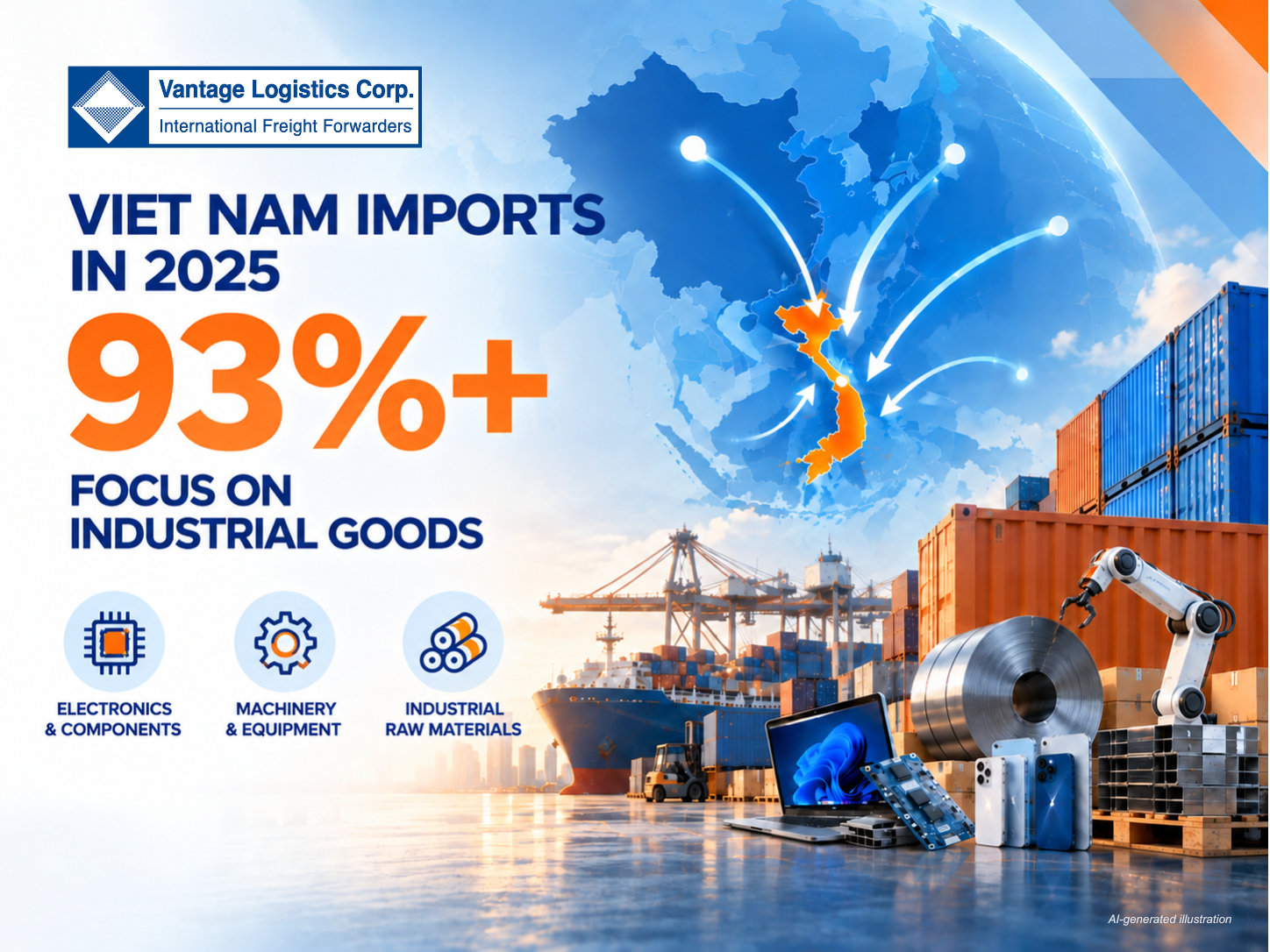
VIET NAM IMPORTS 2025: OVER 93% CONCENTRATED IN INDUSTRIAL GOODS, SUPPLY CHAIN OUTLOOK FOR 2026

In 2025, Vietnam’s total merchandise imports reached approximately USD 455.03 billion, up about 19.5% from 2024. The import mix remained heavily concentrated in goods used for manufacturing, processing, and exports. Industrial goods accounted for more than USD 426 billion, or around 93.6% of total import value, with machinery, equipment, and production materials making up the bulk of imports. I. IMPORT COMPOSITION: INDUSTRIAL GOODS ACCOUNT FOR MORE THAN 93% OF TOTAL IMPORT VALUEP Vietnam’s industrial imports in 2025 were concentrated in machinery, technology equipment, and materials used in production: 1/ Three technology, electronics, and machinery groups reach nearly USD 223 billion Combined imports of three groups – (1) Computers, electronic products and components; (2) Machinery, equipment, tools and spare parts; and (3) Telephones and components – reached approximately USD 223 billion, equivalent to nearly 49% of total importsc. Computers, electronic products and components: Imports reached USD 150.70 billion, up 40.7% from 2024, making this the country’s largest import category. According to the Ministry of Industry and Trade, the group includes key technology components such as chips, displays, semiconductor components, and specialized parts used in electronics manufacturing and assembly for export Machinery, equipment, tools and spare parts: Imports totaled USD 61.03 billion, up 24.8%. FDI companies accounted for 66.7% of the group’s import value, at USD 40.7 billion, up 37.1%. The increase came as demand for production equipment, automation, and capacity expansion grew. Electrical and electronic equipment was the largest segment, at USD 23.7 billion Telephones and components: Imports reached USD 11.26 billion, up 8.2%. FDI companies accounted for 92.5% of total imports in this category 2/ Raw materials for processing and manufacturing Textile, garment, and footwear materials: Imports exceeded USD 28.30 billion, up 2.4% from 2024. Fabrics accounted for the largest share at USD 15.20 billion (+1.9%), representing 53.7% of the group. Textile, garment, and leather materials totaled USD 7.4 billion; cotton USD 2.9 billion; and textile fibers and yarn USD 2.8 billion Plastics and plastic products: Imports reached USD 23.40 billion, up 13.4%. FDI companies accounted for USD 15.3 billion, or 65.2% of the group Iron and steel: Import volume reached 16.13 million metric tons, valued at USD 11.20 billion, down 10.9% in value as the average import price fell to USD 697 per ton. The import mix shifted, with steel sheet imports rising to USD 1.98 billion (+21.8%), while steel coil imports declined II. KEY IMPORTS OF AGRICULTURAL, SEAFOOD, AND ENERGY INPUTS Alongside industrial goods, imports of agricultural and seafood products for processing, as well as fuels and minerals, remained significant: Agricultural and seafood products for processing: Imports reached USD 25.55 billion, up 13.8% (5.6% of total imports). Cashew nuts reached USD 4.49 billion (+39.3%), mainly for processing; seafood imports hit a record USD 3.38 billion (+28.2%); rubber reached USD 3.08 billion; and corn for animal feed totaled USD 2.95 billion Fuels and minerals: Coal imports reached 65.4 million metric tons (USD 6.60 billion); petroleum products 9.96 million metric tons (USD 6.82 billion); crude oil approximately USD 6.2 billion (including USD 6.1 billion supplied by Kuwait to domestic refineries); and ores and other minerals USD 3.2 billion (+10.6%) III. SOURCING MARKETS: ASIA REMAINS THE MAIN SOURCE OF IMPORTS By source, Asia accounted for 82.6% of Vietnam’s total import value, reaching USD 375.90 billion, up 20.5% from 2024. This highlights Vietnam’s continued reliance on regional supply networks for production inputs. Within the region, China remained Vietnam’s largest source of imports, with import value reaching USD 186.0 billion (up 29.0%), equivalent to 40.8% of total national imports. China remained a major source of machinery and equipment, electronic components, and industrial materials. IV. FDI CAPACITY EXPANSION AND SUPPLY CHAIN OUTLOOK FOR 2026 Machinery imports as a signal of FDI production growth In 2025, FDI enterprises imported USD 40.7 billion worth of machinery, equipment, and spare parts, up 37.1%, significantly outpacing the national average. FDI firms accounted for 66.7% of total machinery imports and 92.5% of telephone and component imports. This surge highlights stronger investment in production lines, automation, and capacity expansion. It will be a key driver of demand for imported raw materials, components, and logistics services in 2026 Two supply chain and logistics issues to watch in 2026 Environmental and traceability requirements: Export markets are tightening standards. The EU’s CBAM (covering steel and aluminum) and the EU Deforestation Regulation (EUDR, covering wood, rubber, coffee, and soy) require detailed emissions data and supply-chain traceability. Companies must prepare documentation and data from the raw-material sourcing stage to remain compliant. Managing Asia-centric supply concentration: With 82.6% of imports sourced from Asia, firms face heightened exposure to regional suppliers, ports, and transport routes. Building contingency inventories and adopting flexible transport solutions will help mitigate risks from freight-rate volatility, container shortages, and customs delays   Contact Vantage Logistics for tailored transport solutions and competitive quotations. Please provide details on cargo type, market, origin, destination, and estimated timeline. Vantage Logistics Corp – South East Asia (S.E.A) Logistics Provider One-Stop Shop For Integrated Logistics Services Head Office Viet Nam – Suite 6.01, Floor 6th, Block A, RiverGate Residence, 151-155 Ben Van Don, Khanh Hoi Ward, HCMC, Viet Nam Branch Thailand, Laos, Cambodia, Malaysia, Indonesia, Singapore Contact Us Email in**@*****om.vn Hotline +84-909-026-261 Website https://vantage-logistics.com Send your shipment enquiry today and receive a tailored transport plan from the Vantage Logistics team....

08/09/2026

View More
vlc-news-vn-total-trade-2025-792026

Market updates

VIET NAM IMPORT-EXPORT REPORT 2025

  In 2025, Vietnam’s international trade achieved a breakthrough, with total import-export turnover reaching USD 930.1 billion (an increase of 18.2% compared to 2024, representing an increase of USD 143.1 billion). The trade balance maintained a trade surplus for the 10th consecutive year, reaching USD 20.05 billion. Of which: Export turnover reached USD 475.08 billion, growing by 17.0%. Import turnover reached USD 455.03 billion, growing by approximately 19.5% Major merchandise import and export markets in 2025 I. EXPORT PERFORMANCE BY COMMODITY GROUP The structure of export commodities continued to show a clear differentiation between the processing and manufacturing group and the raw materials and agricultural product groups. Structure of export commodity groups in 2025 Processing and manufacturing continued to account for an overwhelming share, reaching USD 404.56 billion, equivalent to 85.2% of total export turnover. Notably, computers, electronic products, and components reached USD 107.75 billion, up 48.4%, underscoring the expanding role of technology products in the export structure Agricultural and aquatic products reached USD 44.60 billion, accounting for 9.4%. Aquatic products reached USD 11.29 billion, coffee reached USD 8.90 billion, and fruits and vegetables reached USD 8.60 billion, demonstrating that this group continued to make a significant contribution despite its smaller scale compared to processing and manufacturing Fuels and minerals continued to account for a small proportion, with crude oil reaching USD 1.39 billion, down 19.3% in value; coal reached USD 157.2 million, up 37.8% in volume but down 2.5% in value. This structure further demonstrates that Vietnam’s exports are increasingly reliant on processed and manufactured goods rather than the export of raw materials II. IMPORT PERFORMANCE BY COMMODITY GROUP Vietnam’s imports in 2025 remained heavily concentrated on production materials, reflecting demand for raw materials, machinery, and equipment to support industrial manufacturing and export orders. Structure of import commodity groups in 2025 Production materials held a clear dominance, with major commodity lines including: Computers, electronic products, and components: USD 134.5 billion Machinery, equipment, tools, and spare parts: USD 53.7 billion Fabrics: USD 14.7 billion Iron and steel: USD 11.1 billion Plastics in primary forms: USD 10.8 billion The import structure indicates that Vietnam’s role in the supply chain extends beyond the export of finished goods. Substantial volumes of raw materials, components, machinery, and equipment are brought into Vietnam before being utilized in production, processing, and assembly operations. III. IMPORT-EXPORT PERFORMANCE BY MARKET The year 2025 recorded a distinct polarization across continents: Asia served as the largest input supply base, while the Americas and Europe were Vietnam’s two primary trade surplus markets. Export and import turnover by continent in 2025 Asia – Primary Production Input Hub: Accounting for 82.6% of Vietnam’s aggregate import turnover (reaching USD 375.9 billion). With an import structure heavily weighted toward machinery, equipment, electronic components, and production materials from major trade partners such as China (USD 186.0 billion), South Korea, Taiwan, and ASEAN, Viet Nam recorded a trade deficit of USD 163.7 billion with the region in 2025. The Americas and Europe – Key Trade Surplus Drivers: Serving as principal destination markets for Vietnam’s processed industrial goods and agricultural commodities. Within the Americas, the United States led all export destinations (underpinning a regional trade surplus of USD 161.0 billion); across Europe, effective utilization of new-generation FTAs such as the EVFTA and UKVFTA sustained a trade surplus of USD 45.4 billion. Oceania and Africa – Strategic Resource Suppliers and Emerging Agricultural Outlets: Oceania (primarily Australia): Serving as an indispensable supplier of fuels and mineral commodities for heavy industries, most notably coal and iron ore Africa: Operating both as a vital source of raw processing inputs (particularly in-shell raw cashews) and an expanding outlet for Vietnam’s flagship agricultural exports, including rice and coffee Foreign trade outcomes in 2025 affirmed the recovery and deep integration of Vietnam’s economy. Despite facing trade defense barriers, emissions control regulations, green standards (CBAM, EUDR), and supply chain volatility, Vietnam’s commodity structure is progressively establishing higher added value, diversifying partner markets, and optimizing the advantages offered by new-generation FTAs. Source: Ministry of Industry and Trade, Vietnam Export-Import Report 2025; Customs data.   Contact Vantage Logistics for tailored transport solutions and competitive quotations. Please provide details on cargo type, market, origin, destination, and estimated timeline. Vantage Logistics Corp – South East Asia (S.E.A) Logistics Provider One-Stop Shop For Integrated Logistics Services Head Office Viet Nam – Suite 6.01, Floor 6th, Block A, RiverGate Residence, 151-155 Ben Van Don, Khanh Hoi Ward, HCMC, Viet Nam Branch Thailand, Laos, Cambodia, Malaysia, Indonesia, Singapore Contact Us Email in**@*****om.vn Hotline +84-909-026-261 Website https://vantage-logistics.com Send your shipment enquiry today and receive a tailored transport plan from the Vantage Logistics team....

07/09/2026

View More
vlc-news-customs-procedures-mandatory-for-ecommerce-goods-392026

Market updates

Effective March 1, 2027: Customs Procedures Mandatory for Cross-Border E-Commerce Goods in Viet Nam

Starting March 1, 2027, goods traded via e-commerce platforms will officially be subject to customs supervision and clearance under the newly amended Customs Law (Law No. 11/2026/QH16). This regulatory update mandates electronic identity verification and real-time data sharing across the entire cross-border e-commerce supply chain. A New Regulatory Framework for Cross-Border E-Commerce Passed on August 23, 2026, Law No. 11/2026/QH16 introduces Article 16a, establishing a dedicated legal framework to oversee cross-border e-commerce transactions – a sector marked by high volume and low-value parcels. Key changes center on three main pillars: Mandatory Customs Declarations: Closing previous regulatory gray areas, every order generated through an e-commerce platform must now file a customs declaration and undergo official inspection and clearance Mandatory Digital Authentication: Both individuals and organizations in Viet Nam purchasing or selling internationally via e-commerce platforms must complete digital identification. Platform operators are required to connect their data directly with Viet Nam Customs’ processing system Broadened Data-Sharing Obligations: The responsibility to supply shipment data is no longer limited to buyers and sellers. All key logistics participants must share relevant information, including: E-commerce platform operators Bonded warehouse operators Freight forwarders, carriers, and shipping agents Direct Impact on Logistics Operations and Order Fulfillment The new regulations shift customs control from traditional “post-clearance paper audits at checkpoints” to “real-time, data-driven risk management”. This directly impacts every touchpoint in the fulfillment chain: Seller / Buyer → E-Commerce Platform → Logistics Provider → Customs Authority → Last-Mile Delivery Any discrepancy between platform order details and physical shipping documents (invoices, manifests) will raise the risk of port delays, directly inflating lead times and hurting the customer experience. 4 Priorities Cross-Border Businesses Must Address Now While waiting for the official Decree detailing the implementation of Article 16a, businesses and logistics managers should proactively review four critical operational areas: Data Standardization: Ensure absolute alignment across marketplace order records, commercial invoices, transport bills of lading, and actual declarations Restructuring Clearance Workflows: Integrate customs filing protocols at the order placement stage rather than waiting until cargo lands at the terminal or border gate System Integration (API/EDI): Upgrade automated data-exchange capabilities between e-commerce marketplaces, Order Management Systems (OMS), and customs declaration software Proactive Compliance Audits: Identify products subject to specialized inspections, quality standards, or import permits early to prevent administrative penalties and costly border holds Seamless Cross-Border E-Commerce Logistics with Vantage Logistics In cross-border e-commerce, customs clearance speed directly dictates last-mile delivery performance. Building a compliant, streamlined supply chain now is essential to maintaining a competitive edge before the 2027 deadline takes effect. Vantage Logistics delivers a comprehensive service ecosystem tailored for cross-border trade: End-to-end customs brokerage with high-volume declaration processing Smart bonded warehousing and data-integrated fulfillment services Cost-effective multimodal transport solutions across key international lanes Managing high-volume cross-border orders? Connect with the Vantage Logistics trade compliance team today to audit your supply chain and prepare your data workflows well ahead of 2027.   Contact Vantage Logistics for tailored transport solutions and competitive quotations. Please provide details on cargo type, market, origin, destination, and estimated timeline. Vantage Logistics Corp – South East Asia (S.E.A) Logistics Provider One-Stop Shop For Integrated Logistics Services Head Office Viet Nam – Suite 6.01, Floor 6th, Block A, RiverGate Residence, 151-155 Ben Van Don, Khanh Hoi Ward, HCMC, Viet Nam Branch Thailand, Laos, Cambodia, Malaysia, Indonesia, Singapore Contact Us Email in**@*****om.vn Hotline +84-909-026-261 Website https://vantage-logistics.com Send your shipment enquiry today and receive a tailored transport plan from the Vantage Logistics team....

04/09/2026

View More
vlc-news-top30containerportsworldwide-392026

Market updates

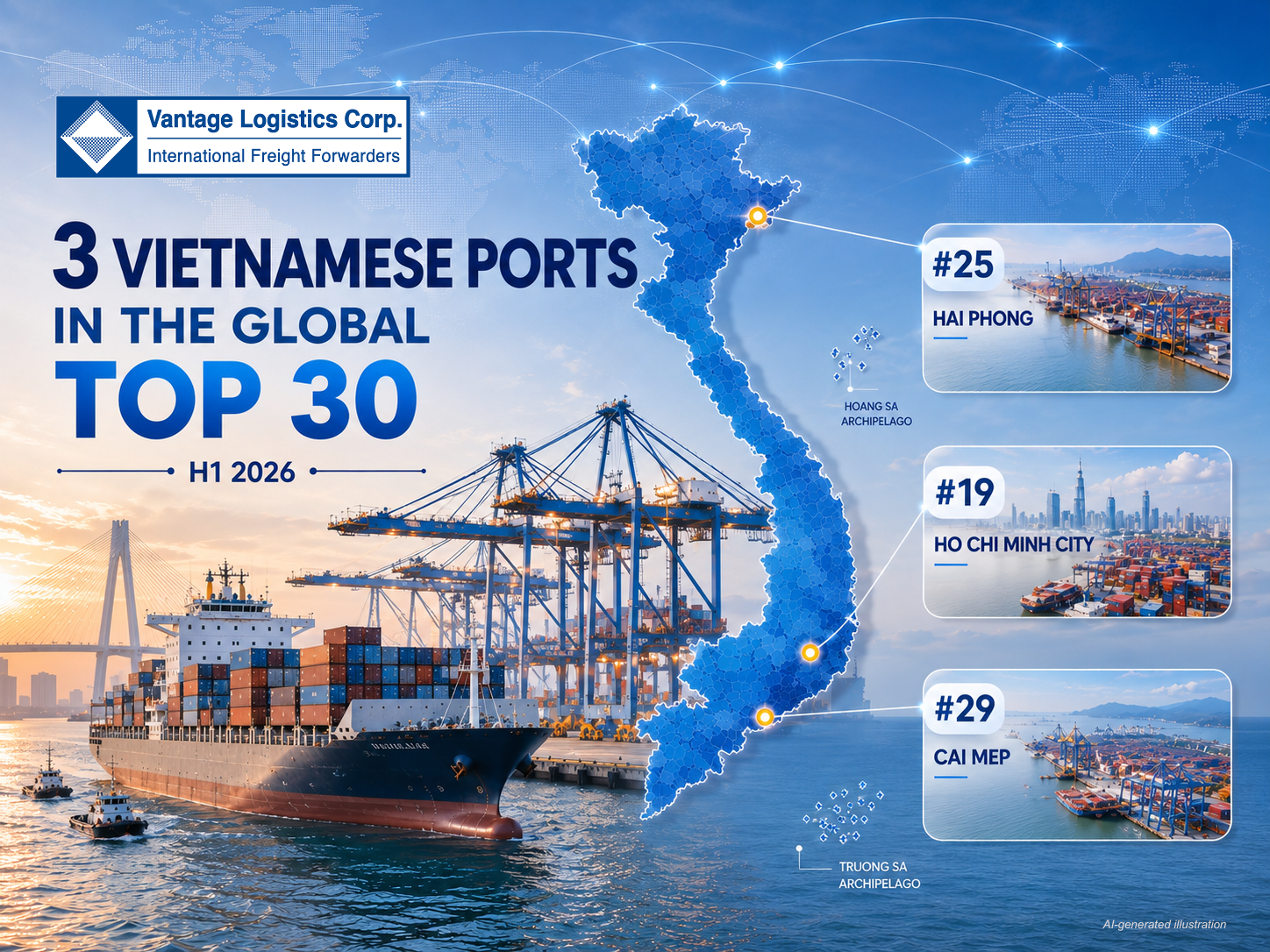
TOP 30 WORLD’S BUSIEST CONTAINER PORTS IN H1/2026: VIET NAM SECURES 3 SPOTS

Ho Chi Minh City, Hai Phong, and Cai Mep continue to strengthen Vietnam’s presence on the global logistics map, each earning a spot in the Top 30 container ports worldwide for the first half of 2026, according to Container News. This triple presence highlights a key strength of Vietnam’s maritime infrastructure: throughput capacity is not constrained by a single bottleneck, but is strategically distributed across major economic zones. 3 Gateways Powering Vietnam’s Multi-Hub Logistics Network Ho Chi Minh City (Ranked 19th): Anchors the southern supply chain with an annual volume of approximately 8.92 million TEUs (2025 baseline). Its seaports and inland container depots (ICDs) remain the busiest cargo consolidation and distribution hub for surrounding industrial clusters Hai Phong (Ranked 25th): Serves as Northern Vietnam’s primary import-export powerhouse, reaching 8.32 million TEUs in 2025. In the first six months of 2026 alone, total cargo throughput via Hai Phong’s port system reached an estimated 96 million tons, up an impressive 11.4% year-on-year Cai Mep (Ranked 29th): The standout performer of the period, handling 3.9 million TEUs in H1/2026 – a 9.2% increase year-on-year. It is also the only Vietnamese port in the mid-year rankings with direct first-half growth data published Direct Mother Vessel Calls Fuel Cai Mep’s Surge Cai Mep’s 9.2% growth places it among Asia’s fastest-growing container hubs, closely trailing regional ports like Jakarta (+10.3%), Colombo (+11.9%), and Nhava Sheva (+13.6%). This momentum is driven by 53 direct international ocean liner services currently calling at the Cai Mep – Thi Vai port complex. With deep-water berths capable of handling ultra-large container vessels (ULCVs), cargo from Southern Viet Nam can ship directly to the US East/West Coast and Europe. This eliminates the need for regional feeder connections via Singapore or Malaysia, cutting both transit times and intermediate feeder costs. Regional Port Rankings Shift: Ningbo Surpasses Singapore The H1/2026 rankings also reflect major shifts among key transshipment centers: Shanghai holds the top spot with 28.74 million TEUs (+6.2%). Ningbo-Zhoushan posted 22.9 million TEUs (+8.8%), overtaking Singapore (22.74 million TEUs, +4.7%) to claim the world’s No. 2 position. The steady ascent of ports across South and Southeast Asia indicates that ocean carriers are restructuring service loops to optimize operational costs and diversify away from traditional transshipment hubs Choosing the Right Gateway to Cut Costs and Lead Times With multi-hub port coverage in both the North and South, shippers have greater flexibility to streamline supply chain operations: Optimize Inland Logistics: Shippers in Northern Viet Nam can capitalize on expanding capacity at Hai Phong. In the South, businesses can balance cargo between Ho Chi Minh City’s river ports/ICDs (ideal for intra-Asia lanes) and Cai Mep’s deep-water terminals (for long-haul routes). Shorten Lead Times: For shipments bound for the US or Europe, booking direct mainline services via Cai Mep removes transshipment risks, schedule delays, and extra container handling fees at intermediary hubs Looking to optimize your shipping routes, reduce transit times, and lower overall freight costs? Contact Vantage Logistics today for tailored, end-to-end supply chain solutions.   Contact Vantage Logistics for tailored transport solutions and competitive quotations. Please provide details on cargo type, market, origin, destination, and estimated timeline. Vantage Logistics Corp – South East Asia (S.E.A) Logistics Provider One-Stop Shop For Integrated Logistics Services Head Office Viet Nam – Suite 6.01, Floor 6th, Block A, RiverGate Residence, 151-155 Ben Van Don, Khanh Hoi Ward, HCMC, Viet Nam Branch Thailand, Laos, Cambodia, Malaysia, Indonesia, Singapore Contact Us Email in**@*****om.vn Hotline +84-909-026-261 Website https://vantage-logistics.com Send your shipment enquiry today and receive a tailored transport plan from the Vantage Logistics team....

03/09/2026

View More

Market updates

Global Seafood Market Update: Key Developments in Early September 2026

The global seafood market has continued to see notable developments in shrimp prices, supply, international trade, and demand across major markets in early September 2026. Ecuador has continued to adjust shrimp export prices to China, while shrimp prices in several producing countries have shown signs of greater stability. In the U.S., domestic shrimp supply has yet to gain a significant share of the market despite higher import tariffs, while traceability requirements continue to receive greater attention. In the salmon segment, Norway’s seafood exports reached a record high in August, with salmon remaining the main driver. Global Shrimp Market: Stable Raw Material Prices as Ecuador Strengthens Its Position Global shrimp prices show greater stability as Ecuador strengthens supply Shrimp prices have been one of the most notable developments in the global seafood market in early September. According to Week 36 data, shrimp prices in several major producing countries have shown less volatility than in previous weeks, while China has recorded a more positive trend. In Thailand, the price of vannamei shrimp at a count of 70 shrimp per kilogram was around THB 140/kg. This suggests that the shrimp market is becoming more balanced following recent fluctuations in prices and demand. However, there is not yet enough evidence to confirm that shrimp prices have entered a new upward cycle. Purchasing power in importing markets, inventory levels, and the ability of farming regions to adjust production will remain key factors shaping the market outlook. Ecuador raises shrimp prices to China and expands processing capacity Ecuador continued to raise its shrimp export offers to China on September 2, following positive signals at the Shanghai International Fisheries & Seafood Exhibition. The move indicates that Ecuadorian suppliers have become more confident about consumption demand in the world’s most populous market. Given Ecuador’s large supply base, higher prices could create additional opportunities for other suppliers, including Vietnam, particularly in the larger-size shrimp segment. However, actual competitiveness will still depend on product quality, specifications, delivery times, and overall logistics costs. Alongside higher selling prices, Ecuador continues to strengthen its processing capacity. Santa Priscila Group plans to invest approximately USD 70 million in a new facility, bringing the group’s total processing capacity to around 1,500 metric tons of whole shrimp per day, equivalent to more than 540,000 metric tons per year once completed. This move shows that global shrimp competition has moved beyond farming output alone, with greater emphasis on automation, value-added processing, and supply chain capabilities. Mixed developments in Asian shrimp supply In contrast to the expansion taking place in South America, shrimp supply in Asia is showing a more mixed picture: Bangladesh: Disease outbreaks have affected around 250 of the 324 shrimp farms in the Batiaghata area of Khulna, causing estimated losses of more than 150 million taka. While this development is not large enough to alter the global supply balance, it highlights the continued presence of biosecurity risks in intensive farming areas Malaysia: Farmed shrimp supply has begun to stabilize following localized shortages in the second quarter and is expected to show a clearer recovery in the third quarter U.S. Market: Import Tariffs, Supply Constraints, and Traceability Standards Import tariffs have yet to reshape the shrimp supply structure In the U.S., shrimp harvested in the Gulf of Mexico has not recorded a significant increase in market share, despite the higher import tariffs imposed on many foreign sources. According to views shared at the Global Shrimp Forum 2026, held in early September in Utrecht, the Netherlands, limited domestic production capacity, higher costs, product specifications, and seasonality are among the factors that allow imported shrimp to retain a position that is difficult to replace. This shows that changes in tariff policy do not necessarily mean domestic production can quickly fill market demand. U.S. importers continue to base purchasing decisions on cost, actual inventory levels, and reliable delivery schedules. Traceability and supply chain transparency under FSMA 204 Alongside tariffs, the ability to trace and share supply chain data is becoming a mandatory technical requirement. The accelerated integration of data systems by technology platforms such as Wholechain and iFoodDS indicates that U.S. distributors are actively preparing infrastructure for the Food Safety Modernization Act (FSMA 204) Food Traceability Rule. This requirement sets a new standard: traceability is no longer limited to maintaining internal records and documentation. Data covering farms, processing facilities, refrigerated container (reefer) transportation, and distribution must be standardized, digitized, and capable of being exchanged seamlessly across supply chain links. For Vietnamese seafood exporters, this is a critical factor that should be integrated into supply chain operations for shipments to the U.S. market. Chinese Market: Consumer Segmentation and Pressure from Domestic Fishing Seasons China continues to reinforce its role as a major trading hub for multiple seafood categories. Following the Shanghai International Fisheries & Seafood Exhibition, the market has shown clear differentiation across segments: Premium and convenience seafood: Ecuadorian shrimp prices have increased; imported salmon trading remains positive; and demand for convenient processed surimi products has recorded solid growth Crustacean segment: Lobster demand continues to support firm prices, while king crab prices have seen a downward adjustment On the other hand, China officially ended its summer fishing moratorium in the Yellow Sea–Bohai Sea area on September 1, bringing significant volumes of domestically caught seafood back into circulation. In Qingdao alone, more than 3,400 fishing vessels set out to sea, quickly bringing fresh hairtail, mackerel, and pomfret into distribution channels across northern and eastern China. This additional domestic supply is expected to create short-term competitive pressure on demand for imported frozen seafood in overlapping categories. Norwegian Salmon Exports Hit a Record: The Role of Cold Chain Logistics One of the most notable figures in early September comes from Norway. According to the Norwegian Seafood Council (NSC), Norway’s seafood exports reached NOK 16 billion in August 2026, up 14% year over year and marking the highest monthly level on record. Salmon volume and value: Salmon exports reached 153,602 metric tons, worth NOK 12.3 billion, representing a 19% increase in value and a 7% increase in volume. Salmon was the main growth driver for the Nordic seafood industry. Growth in key markets: Exports to China recorded a sharp increase to NOK 1.4 billion (+34%), while the U.S. market remained at NOK 1.13 billion (+4%). Cold chain requirements: Notably, 78% of salmon volume was exported as whole fresh and frozen fish, while farmed seafood accounted for 4% of total export value. The strong growth of Norwegian salmon demonstrates that global demand for premium seafood remains substantial. It also comes with stringent cold chain logistics requirements, from strict temperature control and fast transit times to close coordination between air and sea freight. Vietnamese Seafood Businesses: Competing on Value and Supply Chain Performance The developments above show that competition for Vietnamese seafood in international markets is becoming increasingly complex and multidimensional: In the shrimp segment: Ecuador’s expanding scale and processing technology continue to put pressure on costs. Vietnamese businesses need to move further toward value-added products while meeting stringent quality control standards. In the U.S. market: Tariff barriers, trade defense risks, and digital data requirements under FSMA 204 call for export processes with greater transparency and connectivity. In the Chinese market: Market segmentation creates opportunities for high-quality niche products, but shipment timing needs to be carefully planned to avoid periods of peak domestic seafood harvesting. Seafood competitiveness is no longer determined solely by the cost of raw materials at the farm gate. It increasingly depends on supply stability, finished-product quality, digital traceability, and the efficiency of end-to-end logistics operations. Key Factors to Watch in September 2026 In the coming weeks, seafood businesses should closely monitor three key areas: Prices and supply: Raw shrimp price trends in major exporting countries after Week 36, production recovery in Southeast Asia, and disease alerts in farming areas. Trade policies and barriers: Developments in U.S. tariff reviews, sanitary requirements, and preparations for infrastructure supporting supply chain traceability data transmission. Cold chain efficiency: Optimizing reefer transportation costs, maintaining stable temperature control throughout the journey, and ensuring delivery schedules meet year-end consumption demand. Vantage Logistics continues to monitor and provide updates on market developments, trade policies, and international supply chains.   Contact Vantage Logistics for tailored transport solutions and competitive quotations. Please provide details on cargo type, market, origin, destination, and estimated timeline. Vantage Logistics Corp – South East Asia (S.E.A) Logistics Provider One-Stop Shop For Integrated Logistics Services Head Office Viet Nam – Suite 6.01, Floor 6th, Block A, RiverGate Residence, 151-155 Ben Van Don, Khanh Hoi Ward, HCMC, Viet Nam Branch Thailand, Laos, Cambodia, Malaysia, Indonesia, Singapore Contact Us Email in**@*****om.vn Hotline +84-909-026-261 Website https://vantage-logistics.com Send your shipment enquiry today and receive a tailored transport plan from the Vantage Logistics team....

03/09/2026

View More
vlc-news-iso-9001-2026-set-to-release-31082026

Market updates

ISO 9001:2026 Set for Release: Key Changes Businesses Need to Know

Nearly a decade after the release of ISO 9001:2015, the next edition of the international quality management standard is expected to be published on September 16, 2026. ISO 9001:2026 will provide greater clarity around risk and opportunity management, leadership, quality culture, and meeting the expectations of customers and other interested parties. Why Is ISO 9001:2015 Being Updated? According to ISO, the decision to revise the standard followed an international consultation process to ensure that it continues to meet the current needs of organizations and interested parties. As business needs and stakeholder expectations continue to evolve, quality management systems must also help organizations maintain consistency, manage risks, and improve operational performance. What Will ISO 9001:2026 Focus On? The revision is intended to keep ISO 9001 aligned with today’s business environment and evolving stakeholder expectations. While the 2026 edition retains the foundation of ISO 9001:2015, it provides greater clarity and stronger emphasis in several areas, including: Clearer guidance on managing risks and opportunities, helping organizations respond more proactively to changes in their operations. Stronger emphasis on leadership and quality culture, reinforcing that quality is an organization-wide responsibility. Greater focus on operational consistency and meeting the expectations of customers, partners, and other interested parties. Improved alignment with other ISO management system standards, supporting greater consistency across integrated management systems. Importantly, ISO 9001:2026 does not fundamentally change the foundation established by the 2015 edition. Instead, the updates are intended to clarify requirements and make the standard more relevant to the current needs of organizations and their stakeholders. What Should Businesses Consider Before the Transition? For organizations currently certified to ISO 9001:2015, this is a good time to review their existing quality management systems, particularly how they manage risks, maintain process consistency, and meet the expectations of customers and other interested parties. ISO 9001:2026 is expected to be published on September 16, 2026. Organizations using ISO 9001:2015 should follow official transition guidance and begin assessing where their quality management systems may need to be updated. ISO 9001:2026 does not fundamentally change the foundation of the quality management system. Instead, it provides greater clarity on how organizations maintain quality, manage risks and opportunities, and respond to evolving stakeholder expectations. Follow Vantage Logistics for updates on standards, market developments, and industry issues that may impact supply chain operations.   Contact Vantage Logistics for tailored transport solutions and competitive quotations. Please provide details on cargo type, market, origin, destination, and estimated timeline. Vantage Logistics Corp – South East Asia (S.E.A) Logistics Provider One-Stop Shop For Integrated Logistics Services Head Office Viet Nam – Suite 6.01, Floor 6th, Block A, RiverGate Residence, 151-155 Ben Van Don, Khanh Hoi Ward, HCMC, Viet Nam Branch Thailand, Laos, Cambodia, Malaysia, Indonesia, Singapore Contact Us Email in**@*****om.vn Hotline +84-909-026-261 Website https://vantage-logistics.com Send your shipment enquiry today and receive a tailored transport plan from the Vantage Logistics team...

31/08/2026

View More
1 … 6 7 8 9 10 … 43