RESOURCE

Market updates

SINGAPORE STRENGTHENS PRODUCT SAFETY CONTROLS: WHAT VIETNAMESE EXPORTERS NEED TO KNOW

Singapore is strengthening its product safety controls through two key regulations: the Consumer Protection (Safety Requirements) Regulations (CPSR) and the Consumer Goods (Safety Requirements) Regulations (CGSR). For exporters, these requirements go beyond product compliance. They can also affect delivery schedules, logistics costs, and supply chain reliability. 1. Singapore Strengthens Product Safety Requirements According to information published by Vietnam’s Ministry of Industry and Trade, Singapore applies two main regulatory frameworks for product safety. – CPSR: Covers 33 categories of controlled goods, including electrical and electronic products, household appliances, and gas appliances. Products within scope must meet applicable safety requirements, complete registration, and carry the SAFETY Mark before being supplied or sold in Singapore. – CGSR: Covers general consumer goods such as toys, clothing, furniture, and sports equipment, which must comply with the relevant safety standards. Non-compliant products may be subject to sales restrictions or recalls. Businesses that violate applicable requirements may also face penalties. For exporters, checking compliance requirements before shipment is essential. Addressing documentation or registration issues early can help avoid costly adjustments after cargo has already left the port of origin. 2. Potential Impact on Southeast Asia’s Trade and Logistics Singapore plays an important role in Southeast Asia’s trade and logistics network. Tighter product safety controls may require exporters, importers, and distributors to review their procedures for placing goods on the Singapore market. Several potential risks deserve attention: – Delivery delays: Incomplete documentation or missing certificates may affect cargo acceptance and delivery schedules. – Additional logistics costs: Delays in resolving compliance issues may lead to storage, port handling, or additional transportation costs. – Disrupted distribution plans: Late deliveries can affect inventory planning, distribution schedules, and commitments to business partners. These requirements do not automatically apply across all ASEAN markets. However, they highlight the importance of understanding the specific regulations of each destination country when planning regional trade and distribution. 3. What Should Vietnamese Exporters Prepare? For Vietnamese businesses exporting to Singapore, compliance checks should take place before shipment arrangements are finalized. Exporters should determine whether their products fall under CPSR or CGSR, verify the applicable safety standards and registration requirements, and clarify responsibilities with their Singaporean importers. Documentation preparation should also be factored into the shipping schedule. If an issue is discovered only after cargo arrives at the destination port, businesses may need to manage several challenges simultaneously, including delivery delays, additional costs, and changes to distribution plans. A reliable shipping plan therefore involves more than selecting the right route or sailing schedule. It also requires anticipating potential obstacles before the cargo reaches its destination. 4. Managing Risks Through Early Planning Not every risk in international shipping can be eliminated, but many disruptions can be reduced through early preparation. Reviewing cargo information, documentation, shipping schedules, and destination requirements helps all parties make better-informed decisions. For shipments to Singapore, close coordination among exporters, importers, agents, and logistics providers helps maintain visibility over shipment readiness, address changes, and adjust plans when necessary. At Vantage Logistics, international transportation planning takes into account the practical requirements of each shipment and the coordination needed among relevant parties. This approach helps businesses manage potential disruptions and maintain better control over delivery schedules. As market requirements evolve, careful preparation does more than protect an individual shipment. It also helps businesses maintain reliable supply chains and build lasting partnerships across international markets.

15/10/2026

View More
vlc-news-shipping-container-guide-13102026

Logistics

A GUIDE TO SHIPPING CONTAINER TYPES: DIMENSIONS, CAPACITY AND TECHNICAL SPECIFICATIONS

Choosing the right shipping container depends on the cargo’s dimensions, characteristics, weight and handling requirements. Understanding container specifications helps businesses determine the most suitable equipment and plan cargo loading more effectively. This guide provides a quick reference to 12 container types, covering their dimensions, internal volume and key weight specifications. Key Considerations When Selecting a Shipping Container Check the internal dimensions: Use the container’s internal dimensions to calculate the available loading space. Compare the cargo’s length, width and height against the usable internal dimensions, allowing for the clearance needed for loading and unloading Understand payload and gross weight limits: Payload refers to the maximum cargo weight a container is designed to carry, while maximum gross weight includes both the container’s tare weight and the cargo. For inland transportation, also check the applicable vehicle weight limits and road regulations along the planned route Inspect the container before loading: Check the container’s exterior, floor and doors for damage or signs of water ingress. For refrigerated containers, verify that the refrigeration unit is operating properly and that the required temperature can be maintained for the cargo Note: Specifications may vary by container model and manufacturer. Always check the equipment plate on the assigned container before loading.   Contact Vantage Logistics for tailored transport solutions and competitive quotations. Please provide details on cargo type, market, origin, destination, and estimated timeline. Vantage Logistics Corp – South East Asia (S.E.A) Logistics Provider One-Stop Shop For Integrated Logistics Services Head Office Viet Nam – Suite 6.01, Floor 6th, Block A, RiverGate Residence, 151-155 Ben Van Don, Khanh Hoi Ward, HCMC, Viet Nam Branch Thailand, Laos, Cambodia, Malaysia, Indonesia, Singapore Contact Us Email in**@*****om.vn Hotline +84-909-026-261 Website https://vantage-logistics.com Send your shipment enquiry today and receive a tailored transport plan from the Vantage Logistics team.

13/10/2026

View More
vlc-news-cross-border-logistics-10102026

Vantage News

VANTAGE LOGISTICS – INTEGRATED CROSS-BORDER TRANSPORT SOLUTIONS IN THE MEKONG REGION

Connecting supply chains across Viet Nam, Cambodia, Laos, and Thailand through synchronized maritime-road corridors and cross-border transit customs. In manufacturing and international trade, moving raw materials, components, and finished goods across Mekong countries requires a balance between delivery speed and logistics costs. Compared to sea freight, cross-border trucking reduces transit times significantly. However, the most critical operational challenges involve transit customs procedures and differing axle-load regulations across jurisdictions. A minor documentation discrepancy at the border or an axle-load calculation error can cause border congestion and incur substantial truck demurrage fees. Vantage Logistics delivers integrated Cross-Border Logistics solutions, combining multimodal connectivity, strict regulatory compliance, and localized operational management: 1. Flexible Transport Configurations Tailored to project budgets, delivery schedules, and vehicle circulation regulations across each market, Vantage Logistics deploys adaptable transport options: Border Transshipment (Back-to-Back Trucking): Coordinating cargo transfers or prime mover swaps at key border checkpoints (such as Moc Bai / Bavet and Lao Bao / Dansavanh) to optimize operating costs when vehicles are restricted from operating deep into the destination country Direct Cross-Border Trucking: Providing vehicles with valid international road transport permits and logbooks, ensuring seamless door-to-door delivery from dispatch facility to consignee warehouse Cross-Border Axle-Load Compliance: Calculating and distributing cargo weight in strict accordance with national regulations across Viet Nam, Cambodia, and Laos, preventing fines or forced offloading at border weigh stations Bonded Trucking: Managing cargo transit under customs supervision with intact customs seals from seaports to export border checkpoints or designated bonded facilities 24/7 GPS Tracking: Delivering real-time vehicle positioning to monitor route progress, milestone checkpoints, and actual on-site delivery 2. Transit Customs Clearance & GMS Framework Expertise Synchronizing documentation workflows to maintain uninterrupted cross-border cargo flow: Multilateral Transport Frameworks (GMS & Bilateral Agreements): Assisting clients in completing applications for cross-border transport permits and logbooks under the Greater Mekong Subregion (GMS) Cross-Border Transport Agreement and bilateral road transport pacts between Viet Nam, Cambodia, and Laos Pre-Arrival Document Synchronization: Closely coordinating between documentation teams in Viet Nam and our Phnom Penh branch office / localized partner networks to cross-check transit declarations and commercial invoices before vehicles arrive at the border, minimizing wait times at border checkpoints Transit Customs Clearance via Viet Nam: Managing customs transit declarations for international shipments moving through Viet Nam’s major seaports (Cat Lai, Cai Mep, Hai Phong, Da Nang) to Cambodia, Laos, and vice versa Quarantine & Tariff Consultation: Representing cargo owners in specialized inspections (phytosanitary and veterinary quarantine) at international border gates; advising on HS code classification and verifying the validity of Certificate of Origin (C/O Form D) under the ATIGA framework to ensure applicable tariff preferences Proof of Delivery (POD) Management: Collecting, reviewing, and delivering official POD documents endorsed by customs authorities at both borders for tax finalization, while providing advisory support on local road tolls and regional fiscal requirements 3. Multimodal Transport Connectivity Beyond road transport, Vantage Logistics bridges cross-border corridors with international ocean freight loops to expand regional reach: Regional Export Gateway Support: Facilitating overland cargo movement from Cambodia and Laos to Viet Nam’s major seaport hubs, connecting regional exports with mainline ocean carriers bound for global destinations Project Cargo & Heavy Machinery Coordination: Mobilizing specialized equipment in coordination with our in-house Project Logistics technical team for oversized/overweight machinery, industrial plant equipment, and temporary import/re-export shipments 4. Commercial Value for Businesses Transit Time Optimization: Reducing transit time on key corridors – such as Viet Nam to Cambodia within 1–2 days (compared to 5–8 days by sea) – securing continuous raw material flow for manufacturing lines Cost Efficiency: Delivering substantial cost savings compared to air freight while meeting rapid delivery requirements across diverse cargo categories Direct Localized Presence: Backed by 5 branch offices in Viet Nam (Ho Chi Minh City, Ha Noi, Hai Phong, Da Nang, Qui Nhon) and an established branch office in Phnom Penh, Cambodia, Vantage Logistics ensures rapid problem resolution and on-site support without reliance on third-party intermediaries Looking for an optimal transport solution between Viet Nam, Cambodia, Laos, and Thailand? Contact Vantage Logistics for routing advice and tailored quotations.   Contact Vantage Logistics for tailored transport solutions and competitive quotations. Please provide details on cargo type, market, origin, destination, and estimated timeline. Vantage Logistics Corp – South East Asia (S.E.A) Logistics Provider One-Stop Shop For Integrated Logistics Services Head Office Viet Nam – Suite 6.01, Floor 6th, Block A, RiverGate Residence, 151-155 Ben Van Don, Khanh Hoi Ward, HCMC, Viet Nam Branch Thailand, Laos, Cambodia, Malaysia, Indonesia, Singapore Contact Us Email in**@*****om.vn Hotline +84-909-026-261 Website https://vantage-logistics.com Send your shipment enquiry today and receive a tailored transport plan from the Vantage Logistics team.

10/10/2026

View More
vlc-news-swift-logistics-Tiktok-(1)

Market updates

TIKTOK ECOSYSTEM COMMITS NEARLY $1B TO LOGISTICS IN HO CHI MINH CITY: A CATALYST FOR SUPPLY CHAINS AND US MARKET EXPANSION FOR VIETNAMESE ENTERPRISES

TikTok’s expanding direct investment footprint in Ho Chi Minh City marks a major turning point for Vietnam’s logistics infrastructure and cross-border e-commerce landscape. From the perspective of an integrated logistics service provider, Vantage Logistics delivers an in-depth breakdown of the project’s scope alongside actionable supply chain solutions tailored for domestic e-commerce sellers. 1/ Inside the $980M Swift Logistics Project in Ho Chi Minh City Following the licensing of TikTok Shop Vietnam ($125M) in early 2026, the People’s Committee of Ho Chi Minh City officially granted an Investment Registration Certificate to Tokgistic Pte. Ltd. (Singapore) to execute the Swift Logistics Co., Ltd. project. Total Registered Capital: VND 25,850.44 billion (approx. USD 980 million). Capital Structure: Investor equity contribution stands at USD 196 million (20%), with the remaining USD 784 million (80%) to be mobilized according to project development milestones. Operational Term: 50 years, with commercial operations scheduled to commence in November 2026. Ecosystem Footprint: Total registered investment by the TikTok-affiliated ecosystem in HCMC now exceeds USD 1.105 billion (combining TikTok Shop and Swift Logistics). Operating Model: Swift Logistics is licensed for postal services, express delivery, market research, and management consultancy. The company will function as a contract manager and solution integrator, outsourcing physical transportation and warehousing operations to domestic third-party logistics (3PL) partners. The project aligns with the broader development strategy of the Vietnam International Financial Centre in Ho Chi Minh City (VIFC-HCMC), designed to handle an annual volume of 1 to 2 billion parcels and support digital trade transactions surpassing USD 10 billion per year. 2/ Impact on the Logistics Market and B2B Digital Commerce The emergence of Swift Logistics introduces a dual catalyst to Vietnam’s supply chain ecosystem: Accelerated Order Fulfillment: Strategic partnerships with established 3PLs optimize first-mile consolidation and last-mile delivery, substantially curbing cancellation rates and delivery delays. Data Standardization & Infrastructure Upgrades: A scalable e-commerce supply chain requires deep tech integration between digital platforms and carriers to safeguard buyer-facing Service Level Agreements (SLAs). Ecosystem Synergy: Harmonizing digital commerce, logistics orchestration, and digital payments (TikTok Payment) creates a closed-loop ecosystem, reducing hidden operational overhead for merchants. 3/ Vantage Logistics: End-to-End Solutions for TikTok Shop US & Global Sellers Capitalizing on the rapid evolution of cross-border e-commerce, Vantage Logistics delivers a comprehensive logistics ecosystem engineered to help Vietnamese enterprises scale sustainably on TikTok Shop US and global online marketplaces: International Freight (Ocean & Air): Flexible multi-modal options (LCL/FCL, Air Express, Air Cargo) designed to optimize freight costs and transit times across peak shopping seasons. Dedicated Vietnam–US trade lanes (serving US main ports and inland hubs) ensure secured space allocations and reliable capacity commitments. Warehousing & Fulfillment Services: High-standard domestic warehouse facilities seamlessly connected to US and regional fulfillment hubs. Value-added services include labeling, kitting, and strict quality control (QC) compliant with rigid TikTok Shop US operational standards. Customs Brokerage & Cross-Border Compliance: Expert consultancy on HS code classification, tariff valuation, and fast-track formal customs clearance for high-demand product categories, including FMCG, textiles, wooden furniture, and handicrafts. Integrated return merchandise authorization (RMA) management mitigates reverse logistics costs for online sellers. Vantage Logistics remains committed to providing transparent, data-driven, and cost-optimized supply chain solutions – empowering Vietnamese businesses to build a durable competitive edge in global digital trade.   Contact Vantage Logistics for tailored transport solutions and competitive quotations. Please provide details on cargo type, market, origin, destination, and estimated timeline. Vantage Logistics Corp – South East Asia (S.E.A) Logistics Provider One-Stop Shop For Integrated Logistics Services Head Office Viet Nam – Suite 6.01, Floor 6th, Block A, RiverGate Residence, 151-155 Ben Van Don, Khanh Hoi Ward, HCMC, Viet Nam Branch Thailand, Laos, Cambodia, Malaysia, Indonesia, Singapore Contact Us Email in**@*****om.vn Hotline +84-909-026-261 Website https://vantage-logistics.com Send your shipment enquiry today and receive a tailored transport plan from the Vantage Logistics team....

16/09/2026

View More
vlc-news-vn-import-policy

Market updates

Viet Nam Import Policies 2026: Key Regulations Businesses Should Review Before Importing Goods

Vietnam’s import policies in 2026 have seen several important updates covering foreign trade management, customs procedures, specialized inspections and taxation. Notably, a number of new regulations effective from September 2026 directly affect prohibited imports, used goods, and second-hand machinery and production lines. Businesses should review import requirements before signing contracts and booking transportation. Early checks help ensure the right documentation is prepared, tax liabilities are estimated in advance, and the risk of container detention and demurrage (DEM/DET) costs is reduced when goods arrive in Viet Nam. 1/ Import Management Framework Changes from September 2026 Effective 05/09/2026, Decree No. 292/2026/ND-CP officially replaces Decree No. 69/2018/ND-CP and provides detailed guidance on the implementation of the Law on Foreign Trade Management. It serves as a key legal basis for determining whether goods are prohibited from import, subject to licensing requirements, tariff quotas or other foreign trade management measures. On the same date, Circular No. 48/2026/TT-BCT also came into effect, specifying lists of prohibited used consumer goods and vehicles, goods subject to tariff quotas, and several related procedures. Practical recommendation: Before importing, businesses should correctly identify the HS code and review the applicable import policy, particularly for product lists and procedures updated from 05/09/2026. 2/ Customs: New Regulations on Goods Classification from 15/09/2026 Customs procedures, inspection and supervision of imported and exported goods continue to be governed by Decree No. 167/2025/ND-CP (effective from 15/08/2025). Key areas include: Electronic processing of customs documents and records Application of risk management in customs inspection and supervision Regulations applicable to Authorized Economic Operators Procedures for processing, export production and export processing enterprises (EPEs) Effective 15/09/2026, Circular No. 85/2026/TT-BTC on the classification and analysis of imported and exported goods for classification purposes officially takes effect. HS classification should be based on the actual nature of the goods, their characteristics, composition, function and technical documentation, rather than relying solely on the commercial product name. Discrepancies in HS codes, customs value, origin or declared information may result in requests for clarification, additional documentation, physical inspection or adjustments to tax liabilities, depending on the specific case. 3/ Import Duties: Check HS Codes, Origin and FTA Preferences There is no single import duty rate applicable to all goods. The applicable rate depends on the HS code, actual origin and relevant tariff schedule: New FTA opportunity (CEPA): 2026 marks the implementation of the Vietnam–UAE Comprehensive Economic Partnership Agreement under Decree No. 143/2026/ND-CP, which sets out the special preferential import tariff schedule for 2026–2027. Businesses should note that goods purchased from or shipped from the UAE are not automatically considered UAE-origin goods. To qualify for CEPA preferential tariff rates, the goods must satisfy the applicable rules of origin and origin documentation requirements under the Agreement. 8% VAT reduction policy: The reduced VAT rate continues to apply until 31/12/2026 under Decree No. 174/2025/ND-CP for eligible goods and services. 4/ Specialized Inspections: Identify Requirements Before Goods Arrive in Vietnam Goods permitted for import are not necessarily eligible for immediate customs clearance if they are subject to specialized inspections: For imported food products: Decree No. 46/2026/ND-CP is currently suspended under Resolution No. 15/2026/NQ-CP. During this period, Decree No. 15/2018/ND-CP and related guidance remain applicable. Food safety inspection list under the Ministry of Industry and Trade: Circular No. 28/2026/TT-BCT (effective from 17/07/2026) applies to products such as alcoholic beverages, soft drinks, processed milk and vegetable oils. Practical recommendation: The required documentation and processing time for specialized inspections depend on the type of goods and the applicable inspection method. Businesses should identify the requirements and prepare the necessary documents before the goods arrive in Vietnam to reduce waiting time and potential port-related costs. 5/ New Regulations for Used Machinery and Equipment Used machinery imported for production purposes is not assessed solely based on its used condition but must also meet applicable technical requirements: Prohibited goods: Circular No. 48/2026/TT-BCT specifies certain used consumer goods and vehicles that are prohibited from import. Regulations for used production machinery: Governed by Circular No. 56/2026/TT-BKHCN of the Ministry of Science and Technology (effective from 05/09/2026). Equipment age: Calculated from the year of manufacture to the year of import, with a general limit of no more than 10 years. Certain types of equipment are subject to different age limits under Appendix I of the Circular. Technical requirements: The goods must also comply with applicable requirements on safety, energy efficiency and environmental protection. Practical recommendation: Before purchasing used machinery, businesses should request the seller to provide the year of manufacture, model, serial number, technical specifications and manufacturer documentation to support equipment age verification and inspection where required. 6/ Note for Import Plans from 2027 On 23/08/2026, the National Assembly issued Law No. 11/2026/QH16, amending and supplementing a number of provisions of the Law on Customs. The Law will take effect on 01/03/2027. Therefore, shipments handled during 2026 will continue to follow the current customs legal framework. Businesses with long-term import plans extending into 2027 should continue monitoring implementing Decrees and Circulars to prepare for upcoming changes in customs procedures and management. 7/ Integrated Import Solutions with Vantage Logistics Coordinating international transportation, customs procedures and domestic delivery through a single point of contact helps businesses reduce coordination steps, limit information discrepancies and gain better control over their delivery plans: Licensed Customs Brokerage Agent (Decision No. 2314/QD-TCHQ): Vantage Logistics supports HS code review, import policy checks and import documentation, while acting on behalf of cargo owners to complete customs procedures within the authorized scope. Multimodal International Freight: Through a global agency network across major manufacturing markets in Asia, Europe and North America, Vantage Logistics provides stable space availability even during peak seasons. Specialized Inspections: Support in preparing documentation and coordinating procedures for goods subject to complex specialized management requirements. Warehousing & Domestic Trucking: Warehousing, bonded warehousing and dedicated trucking services connect ports and airports with warehouses, factories and major industrial zones nationwide based on each customer’s delivery plan. Is your business preparing to import goods into Vietnam and looking to review import requirements before signing a contract? Send your Packing List, Commercial Invoice or Technical Catalogue to Vantage Logistics for support in reviewing HS codes, import policies and suitable transportation options. Sources: Government of Vietnam, Ministry of Industry and Trade, Ministry of Finance, Ministry of Science and Technology. Information is updated based on regulations effective as of September 2026.   Contact Vantage Logistics for tailored transport solutions and competitive quotations. Please provide details on cargo type, market, origin, destination, and estimated timeline. Vantage Logistics Corp – South East Asia (S.E.A) Logistics Provider One-Stop Shop For Integrated Logistics Services Head Office Viet Nam – Suite 6.01, Floor 6th, Block A, RiverGate Residence, 151-155 Ben Van Don, Khanh Hoi Ward, HCMC, Viet Nam Branch Thailand, Laos, Cambodia, Malaysia, Indonesia, Singapore Contact Us Email in**@*****om.vn Hotline +84-909-026-261 Website Send your shipment enquiry today and receive a tailored transport plan from the Vantage Logistics team....

15/09/2026

View More
vlc-news-hs-code-compliance-15092026 (4)

Market updates

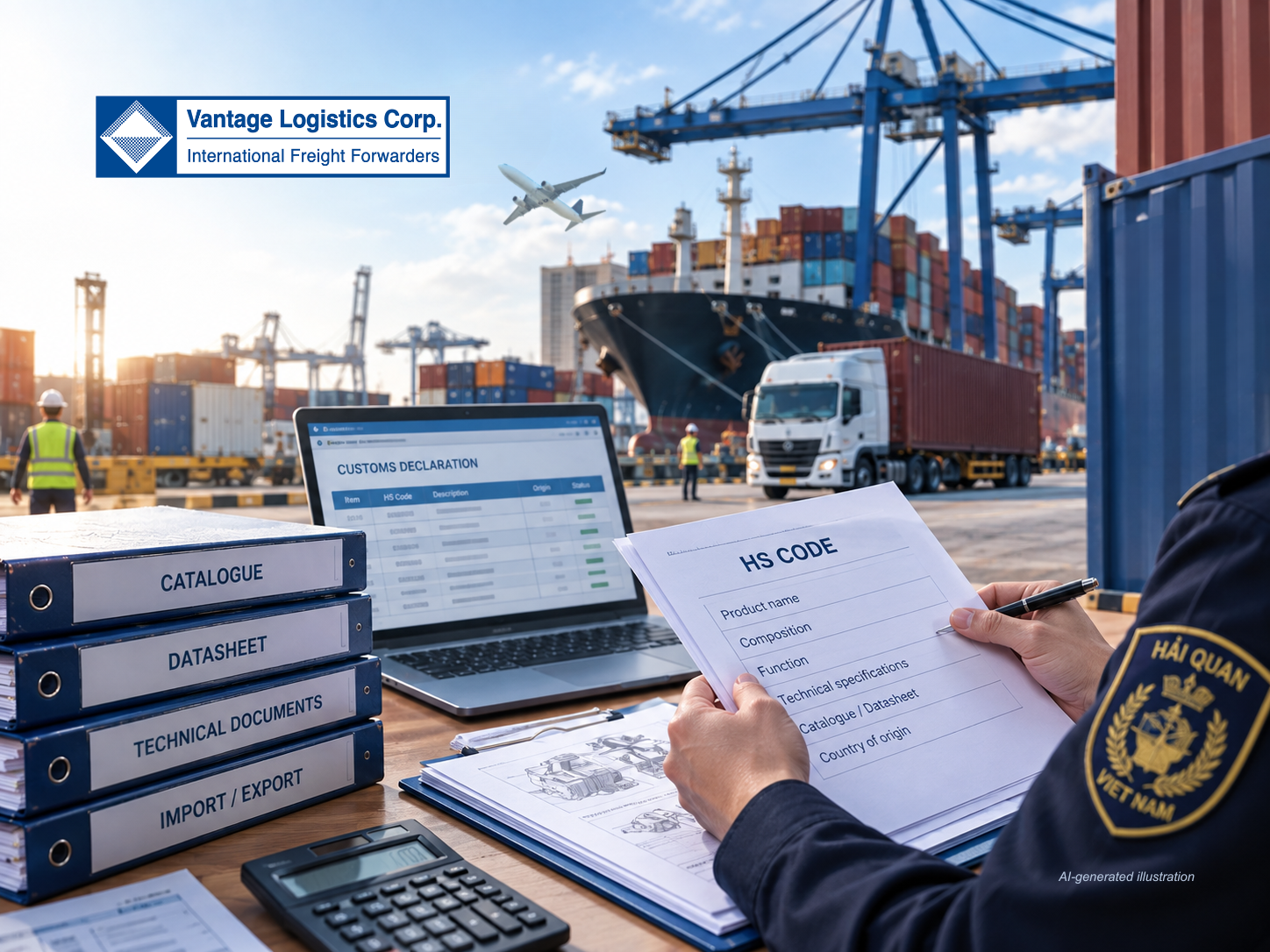
CIRCULAR 85/2026/TT-BTC TAKES EFFECT: BUSINESSES MUST STANDARDISE PRODUCT DATA AND MASTER HS CODE COMPLIANCE

Effective 15 September 2026, Circular 85/2026/TT-BTC officially replaces Circulars 14/2015/TT-BTC and 17/2021/TT-BTC. The updated regulation introduces stricter requirements for the analysis, classification, and HS code determination of import and export cargo in Viet Nam. To mitigate customs clearance delays and avoid extra operational costs, traders should focus on three critical requirements: 1/ Standardise Technical Data at the Sourcing Stage Look beyond commercial names: HS code classification must reflect the actual physical and technical characteristics of the goods, rather than relying solely on invoice descriptions. Maintain complete technical documentation: Importers and exporters must systematically archive catalogues, datasheets, chemical compositions, structural specifications, intended uses, and manufacturing processes. These records are essential for determining correct HS codes and presenting evidence during customs audits. Align internal workflows: Synchronise communication across procurement, technical, and logistics teams, as well as overseas suppliers, to ensure consistent data declaration prior to customs filing. 2/ Key Updates for Machinery and Equipment (Chapters 84, 85, and 90) Streamlined administrative procedures: Circular 85 abolishes the requirement to register equipment lists and deductibility tracking sheets for combination machines and functional units imported synchronously in a single shipment. Flexibility for unassembled machinery: For complete machinery imported in knocked-down or disassembled states, businesses can submit classification dossiers up until the time of filing the customs declaration for the first consignment. 3/ Essential Rules for Sampling and Analysis Results Flexible sampling protocol: If the declarant is absent, customs officers may draw samples in the presence of representatives from the shipping line, port operator, or local authority, reducing waiting times. Extended sample retention: The retention period for samples subject to appeals or disputes is extended up to a maximum of 120 days from the notification date of results. Scope of classification results: Analytical and classification results under Circular 85 are used exclusively for HS code determination. They cannot serve as grounds for quality control or food safety inspections. Partnering with Vantage Logistics Incorrect HS classification can lead to clearance delays, administrative fines, and unnecessary demurrage fees. Vantage Logistics provides professional customs consultancy to help businesses review technical dossiers, standardise commodity data, and ensure full compliance under the latest regulatory framework.   Contact Vantage Logistics for tailored transport solutions and competitive quotations. Please provide details on cargo type, market, origin, destination, and estimated timeline. Vantage Logistics Corp – South East Asia (S.E.A) Logistics Provider One-Stop Shop For Integrated Logistics Services Head Office Viet Nam – Suite 6.01, Floor 6th, Block A, RiverGate Residence, 151-155 Ben Van Don, Khanh Hoi Ward, HCMC, Viet Nam Branch Thailand, Laos, Cambodia, Malaysia, Indonesia, Singapore Contact Us Email in**@*****om.vn Hotline +84-909-026-261 Website https://vantage-logistics.com Send your shipment enquiry today and receive a tailored transport plan from the Vantage Logistics team....

15/09/2026

View More
vlc-news-vn-import-sourcing-map-14092026 (3)

Market updates

VIETNAM’S 2025 IMPORT SOURCING MAP: CHINA LEADS, ASIA REMAINS THE REGIONAL BACKBONE

In 2025, Vietnam’s merchandise imports totaled approximately USD 455 billion, climbing nearly 20% year-on-year. Asia remained the predominant supplying region, accounting for 82.6% of national inbound turnover. Capital flows remained heavily concentrated in machinery, electronic components, and production inputs feeding export manufacturing. The 2025 sourcing landscape reflected clear supply chain specialization: China sustained its dominant leadership, Northeast Asian hubs anchored high-tech segments, and intra-ASEAN partners fulfilled specialized industrial inputs and energy commodities. I. China: The Primary Engine for Industrial Machinery and Manufacturing Inputs China remained Vietnam’s largest trading partner, supplying USD 186.0 billion in goods – up 29.0% year-on-year and representing 40.8% of aggregate national imports. Inbound flows from China played a decisive role across processing and assembly sectors: Machinery, Equipment, and Technology: China served as the primary supplier of industrial machinery, mechanical equipment, and tooling molds for manufacturing plants across Viet Nam Electronic Components: China held an overwhelming share of computer parts, printed circuit boards (PCBs), semiconductor devices, and telecommunications components feeding tech export assembly lines Industrial Intermediates: China supplied high volumes of rolled fabrics, garment and footwear accessories, virgin plastic resins, and baseline chemicals Consistent material flows originating from key industrial clusters in Guangdong, Zhejiang, Jiangsu, and Shanghai remained essential to sustaining uninterrupted operations across northern and southern industrial parks. II. Northeast Asian Partners: High-Tech Integration and Advanced Materials Alongside China, Northeast Asian economies supplied critical high-precision components and specialized industrial materials: South Korea (USD 60.5B – 13.3% Share): Vietnam’s second-largest import source, expanding 12.8%. Shipments centered on high-value components, including memory chips, display panels, semiconductor components, and optical equipment feeding major multinational tech campuses Taiwan (USD 33.0B – 7.3% Share): Posted notable 28.9% growth, driven by virgin plastic polymers, specialty chemicals, precision machine tools, and high-spec technical fabrics for export apparel lines Japan (USD 24.7B – 5.4% Share): Increased 15.2% year-on-year. Procurement focused on precision machinery, industrial electrical equipment, automotive components, and high-grade alloy steel plates and coils servicing precision engineering, construction, and shipbuilding III. Intra-ASEAN Supply Chains: Specialization in Raw Materials and Energy Imports from ASEAN reached USD 52.6 billion, up 19.5% and capturing 11.6% of Vietnam’s total inbound trade. Despite operating within a single regional free trade framework, individual member states demonstrated distinct sourcing roles: Indonesia: Served as an anchor for heavy industrial inputs and power generation. Coal represented the single largest commodity by value (supplying thermal power plants and cement manufacturing), followed by iron, steel, and base metals Singapore: Functioned as the primary regional refined fuel gateway. Inbound shipments centered on petroleum products and refined oil derivatives feeding domestic transport networks and industrial utilities Malaysia and Thailand: Supplied manufacturing raw materials alongside consumer-packaged goods. Shipments centered on plastic polymers, industrial chemicals, automotive/motorcycle spare parts, processed foods, dairy products, and confectionery Cambodia: Provided cross-border raw agricultural commodities. Trade was dominated by in-shell raw cashews for domestic shelling and re-export, supplemented by natural rubber and dried cassava IV. Corridor Logistics and Customs Transit Dynamics Optimizing freight operations across major inbound corridors requires aligning transport modes with commodity characteristics: 1/ China – Viet Nam Corridors: Balancing Cost and Velocity Ocean Freight: Transit times from Shanghai or Ningbo to Hai Phong range from 2 to 4 days, and to Ho Chi Minh City (Cat Lai and Cai Mep ports) from 4 to 6 days. Ocean transport offers optimal unit economics for raw materials, heavy machinery, and high-volume containerized freight Cross-Border Trucking: Linehaul trucking via Huu Nghi, Tan Thanh (Lang Son), or Mong Cai (Quang Ninh) reaches industrial zones across Bac Ninh, Bac Giang, Vinh Phuc, and Hai Phong within 24 to 48 hours. This channel is suited for urgent semiconductor parts and precision molds, though shippers must coordinate border clearance schedules to avoid bottleneck delays during peak inspection cycles 2/ Northeast Asia Corridors (South Korea, Taiwan, Japan): High-Value Handling Containerized ocean freight from Busan, Incheon, or Kaohsiung requires 5 to 8 days, while sailings from Tokyo or Yokohama take 7 to 10 days For semiconductors, integrated circuits, and sensitive electronics, scheduled air freight via Noi Bai (HAN) or Tan Son Nhat (SGN) remains the standard routing to mitigate vibration risks, maintain temperature-controlled environments, and meet tight assembly lead times 3/ Intra-ASEAN Routes: Leveraging Short-Sea Corridors and Preferential Tariffs Feeder sailings from Singapore, Port Klang (Malaysia), or Laem Chabang (Thailand) to Vietnam offer short ocean transit times of 3 to 5 days Regulatory compliance centers on verifying Certificate of Origin documents (C/O Form D) to secure 0% preferential tariffs. Inaccurate documentation risks customs holds, triggering port storage and container demurrage/detention charges V. Supply Chain Management Priorities For 2026 Trade and sourcing patterns in 2025 point toward three operational priorities for inbound supply chains: Maintain Multimodal Routing Flexibility: Establish standby routing protocols across short-sea, cross-border trucking, and international rail to pivot cargo when primary lanes experience rate spikes or space crunches Audit Upstream Traceability at Procurement: Expanding supply chain due diligence and green frameworks in destination markets (such as the EU and US) require importers to mandate emission metrics and origin verification from overseas suppliers at the initial contracting phase Secure Advance Equipment and Space Commitments: Plan shipping schedules 1 to 2 weeks ahead on Northeast Asian routes to buffer against container equipment shortages and peak-season general rate increases Data Sources: Ministry of Industry and Trade, Vietnam Import-Export Report 2025; General Department of Vietnam Customs.   Contact Vantage Logistics for tailored transport solutions and competitive quotations. Please provide details on cargo type, market, origin, destination, and estimated timeline. Vantage Logistics Corp – South East Asia (S.E.A) Logistics Provider One-Stop Shop For Integrated Logistics Services Head Office Viet Nam – Suite 6.01, Floor 6th, Block A, RiverGate Residence, 151-155 Ben Van Don, Khanh Hoi Ward, HCMC, Viet Nam Branch Thailand, Laos, Cambodia, Malaysia, Indonesia, Singapore Contact Us Email in**@*****om.vn Hotline +84-909-026-261 Website https://vantage-logistics.com Send your shipment enquiry today and receive a tailored transport plan from the Vantage Logistics team....

14/09/2026

View More

Market updates

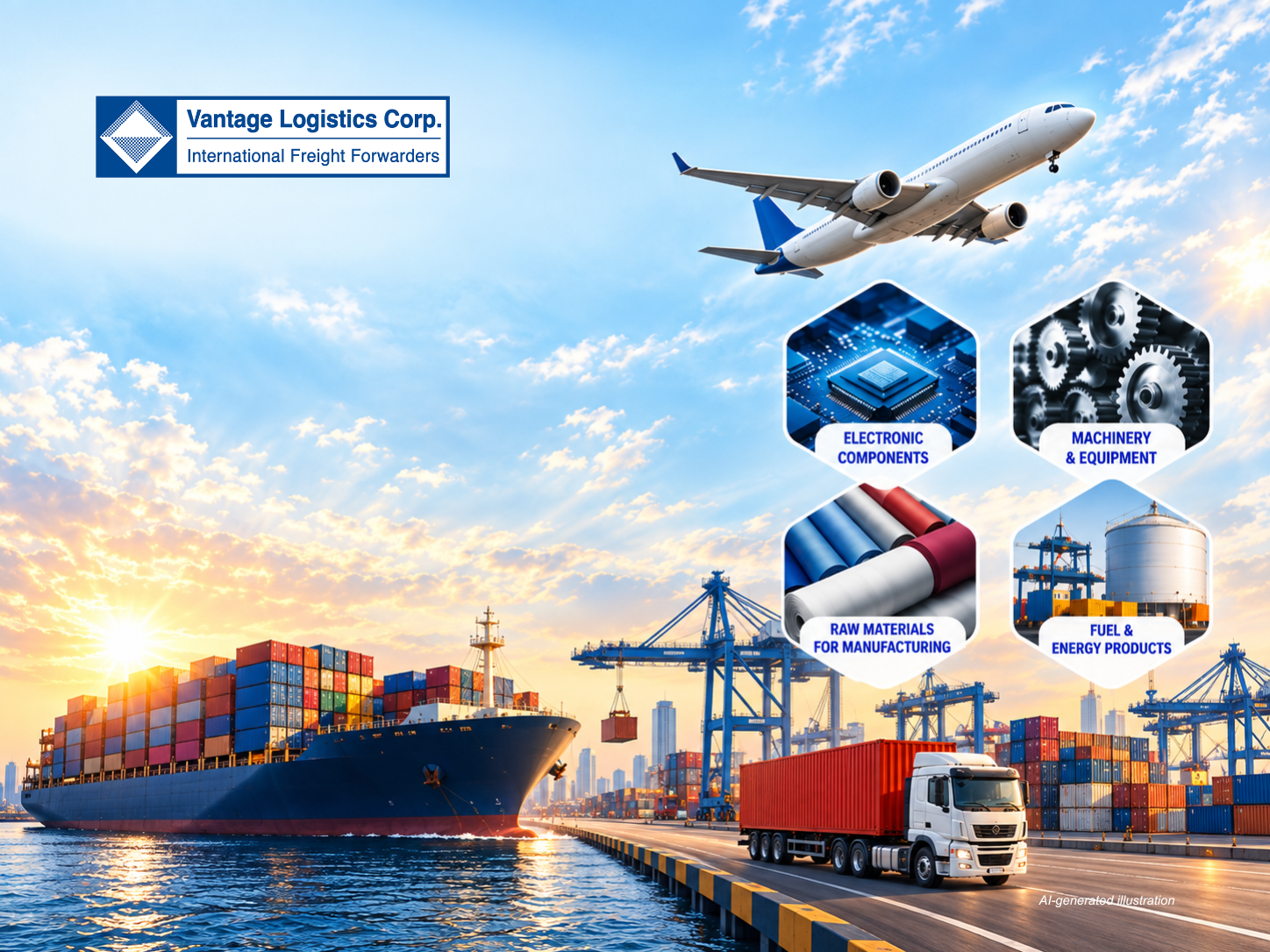
Vietnam’s Import Landscape: Production Materials & Supply Chain Outlook 2026

Vietnam’s merchandise imports reached $455.01 billion in 2025, up 19.4% year-on-year. Production materials –encompassing machinery, equipment, components, and industrial raw materials – accounted for 93.6% of total inbound turnover. This dynamic accelerated through the first eight months of 2026, with total imports climbing 35.3% and the share of production inputs widening to 94.1%. As import flows remain overwhelmingly concentrated in manufacturing inputs, lead-time precision, regulatory compliance, and domestic freight execution have become decisive operational priorities across the supply chain. 1/ 2025 Import Turnover Surpasses $455 Billion Vietnam’s total merchandise trade reached $930.05 billion in 2025. Exports totaled $475.04 billion (+17.0% YoY), while imports reached $455.01 billion (+19.4% YoY), maintaining a merchandise trade surplus of $20.03 billion. Import growth outpaced export growth by 2.4 percentage points. However, this acceleration must be interpreted alongside cargo composition: the vast majority of import expenditure was allocated not to finished consumer goods, but to critical industrial inputs required to sustain factory output, capital expansion, and downstream export commitments. 2/ Production Materials Account for 93.6% of Total Imports According to data from the General Statistics Office (GSO), imports of production materials reached $426.11 billion, representing 93.6% of total import turnover in 2025. The structural breakdown reveals two dominant pillars: Machinery, equipment, tools, and spare parts: Accounted for 52.7% of total imports Raw materials, fuels, and intermediate inputs: Accounted for 40.9% of total imports Consumer goods: Accounted for the remaining 6.4% High-tech inputs served as the primary growth engine. The computers, electrical products, and components category led all imports at $150.7 billion, surging 40.7% YoY and contributing 33.1% to total national imports. This product mix reflects Vietnam’s position within global processing, assembly, and high-tech manufacturing networks: inbound supply flows directly drive outbound finished goods. Heavy reliance on foreign-sourced capital equipment and components makes procurement schedules and inbound freight predictability critical to plant continuity. 3/ FDI Expansion Drives Inbound Demand & 8M 2026 Performance FDI Sector Commands Nearly 70% of Import Value A distinct operational divergence characterized the market in 2025: Foreign-Invested Enterprise (FDI) sector: Imports totaled $317.63 billion, up 31.9% YoY, accounting for 69.8% of the national total Domestic economic sector: Imports reached $137.38 billion, a slight contraction of 2.0% YoY Inbound freight mirrored capital deployment trends. Realized FDI in Vietnam reached a record $27.62 billion in 2025, with processing and manufacturing securing $22.88 billion (82.8%). Sustained capital expenditure by multinational manufacturers generated immediate demand for initial capital machinery installations and recurring intermediate assembly components. 4/ 8M 2026: Production Input Share Widens to 94.1% Through the first eight months of 2026, demand for industrial inputs intensified: Total merchandise imports: Reached $395.3 billion, up 35.3% compared to the same period in 2025. FDI imports: Reached $290.23 billion, increasing 40.1% YoY. Production materials: Reached $372.04 billion, expanding their share to 94.1% of total imports. Key sourcing origin: China remained the largest supplier of raw materials and machinery, totaling $161.9 billion. Sustained import volume growth has placed elevated operational pressure on national deep-water ports, air cargo terminals, and intermodal transport corridors. 5/ Supply Chain Outlook: Transitioning from Cargo Availability to Precision Timing Expanding import volumes inherently increase complexity for inbound supply chains. An incoming consignment of raw materials or industrial machinery requires seamless handoffs across international transit, customs clearance, terminal handling, drayage, and warehousing. For manufacturers, the critical operational risk is rarely absolute cargo availability; it is lead-time volatility. Late arrivals, customs inspection bottlenecks, or misaligned transport schedules trigger plant downtime, demurrage and detention (Dem/Det) charges, and buffer inventory costs. With imports expanding faster than exports and over 94% dedicated to factory inputs, supply chain managers must actively mitigate exposure across key operational nodes: International ocean and air freight transit reliability Carrier space allocations and feeder connectivity Regulatory compliance and tariff classification accuracy Customs clearance turnaround times at ports and airports Port-to-factory linehaul trucking capacity Inventory buffers calibrated to just-in-time production schedules 6/ Inbound Supply Chain Solutions by Vantage Logistics Vantage Logistics provides integrated inbound logistics solutions designed to stabilize supply lines from overseas origin points directly to manufacturing floors across Vietnam: Multimodal International Freight (Air & Ocean): Global partner networks coordinate cargo collection across major industrial centers in Asia, Europe, and North America, securing dedicated allocations on key trade lanes with predictable transit schedules. Licensed Customs Brokerage: Operating under official Customs Brokerage License No. 2314/QD-TCHQ issued by the General Department of Vietnam Customs, in-house customs specialists manage declarations, tariff consulting, HS code determinations, and specialized technical inspections to accelerate border clearance for machinery and high-tech components. Contract Logistics & Domestic Transport (Trucking & Warehousing): Standard, bonded, and cross-dock facilities, paired with dedicated linehaul fleets, link primary port clusters (Cat Lai, Cai Mep, Hai Phong) directly to industrial parks nationwide, supporting strict Just-In-Time (JIT) production requirements. Consolidating cross-border freight, customs brokerage, and inland drayage under a single logistics partner reduces administrative overhead, minimizes communication handoffs, and delivers end-to-end milestone visibility. The trade data of 2025 and performance indicators throughout 2026 reaffirm that production materials are the structural core of Vietnam’s import economy. As production input volumes scale, disciplined lead-time management and resilient logistics partnerships remain essential to maintaining operational continuity. Planning inbound shipments of industrial materials, electronic components, or machinery into Viet Nam? Contact Vantage Logistics to consult with our specialists on optimal routings, trade compliance, and end-to-end logistics solutions tailored to your operational schedule.   Contact Vantage Logistics for tailored transport solutions and competitive quotations. Please provide details on cargo type, market, origin, destination, and estimated timeline. Vantage Logistics Corp – South East Asia (S.E.A) Logistics Provider One-Stop Shop For Integrated Logistics Services Head Office Viet Nam – Suite 6.01, Floor 6th, Block A, RiverGate Residence, 151-155 Ben Van Don, Khanh Hoi Ward, HCMC, Viet Nam Branch Thailand, Laos, Cambodia, Malaysia, Indonesia, Singapore Contact Us Email in**@*****om.vn Hotline +84-909-026-261 Website https://vantage-logistics.com Send your shipment enquiry today and receive a tailored transport plan from the Vantage Logistics team....

14/09/2026

View More
vlc-news-vn-food-safety-compliance-14092026

Market updates

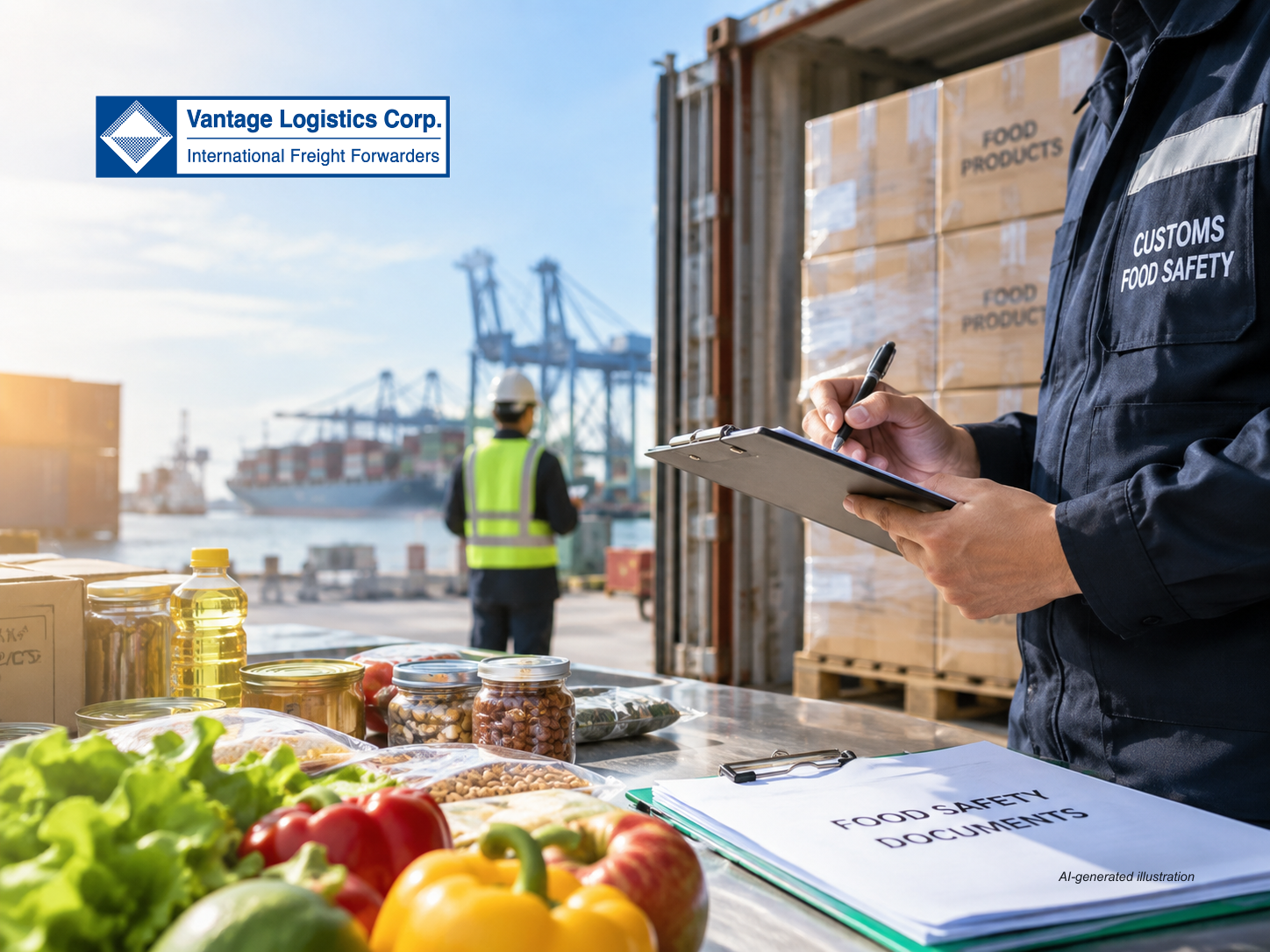
Viet Nam Food Safety Compliance: Stricter Import Inspections from September 2026

Effective September 2026, Vietnamese authorities are tightening food safety compliance checks for imported food and food-related products. Importers and overseas suppliers should take note of key regulatory shifts, associated operational risks, and essential pre-shipment checks. 1/ Key Regulatory Updates Automated and Rigorous Document Audits: Regulatory bodies are implementing more automated, in-depth checks on Self-Declaration files. All data across the Self-Declaration, Certificate of Analysis (COA/CA), product labels, and traceability records must match perfectly. Any discrepancy or missing data will lead to immediate rejection Tougher Lab Testing Criteria: Testing reports (COA/CA) must be issued by a designated or accredited laboratory compliant with ISO/IEC 17025 standards. The analysis must cover every mandatory safety parameter specified under the corresponding National Technical Regulation (QCVN) Accurate Product Classification: Certain commodities – such as dietary supplements, health foods, and new or mixed food additives – require Product Declaration Registration rather than the standard Self-Declaration. Filing under the incorrect category will result in application failure 2/ Operational & Financial Risks If food safety documentation is non-compliant or rejected after shipments arrive in Vietnam, importers face severe disruptions, including: Substantial demurrage, detention, and warehouse storage costs caused by clearance delays Cargo holds at terminal yards or bonded warehouses pending inspections or document amendments Administrative penalties, with extreme cases resulting in mandatory re-export or destruction of goods Missed delivery timelines and potential downstream contractual liabilities 3/ Recommended Actions: Pre-Shipment Document Audit To prevent border delays and unexpected overhead, importers and suppliers should review and verify the following documents prior to cargo departure: A valid Self-Declaration or Product Declaration Registration, as applicable A compliant COA/CA from a qualified laboratory meeting all required QCVN testing parameters Fully compliant product labels Consistent shipping documents, ensuring seamless alignment between the Commercial Invoice and Packing List Advisory: We strongly encourage partners to share documentation with our team for a preliminary audit well before cargo dispatch to ensure swift, trouble-free customs clearance upon arrival.   Contact Vantage Logistics for tailored transport solutions and competitive quotations. Please provide details on cargo type, market, origin, destination, and estimated timeline. Vantage Logistics Corp – South East Asia (S.E.A) Logistics Provider One-Stop Shop For Integrated Logistics Services Head Office Viet Nam – Suite 6.01, Floor 6th, Block A, RiverGate Residence, 151-155 Ben Van Don, Khanh Hoi Ward, HCMC, Viet Nam Branch Thailand, Laos, Cambodia, Malaysia, Indonesia, Singapore Contact Us Email in**@*****om.vn Hotline +84-909-026-261 Website https://vantage-logistics.com Send your shipment enquiry today and receive a tailored transport plan from the Vantage Logistics team....

14/09/2026

View More
vlc-news-nationwide-automated-customs-11092026

Market updates

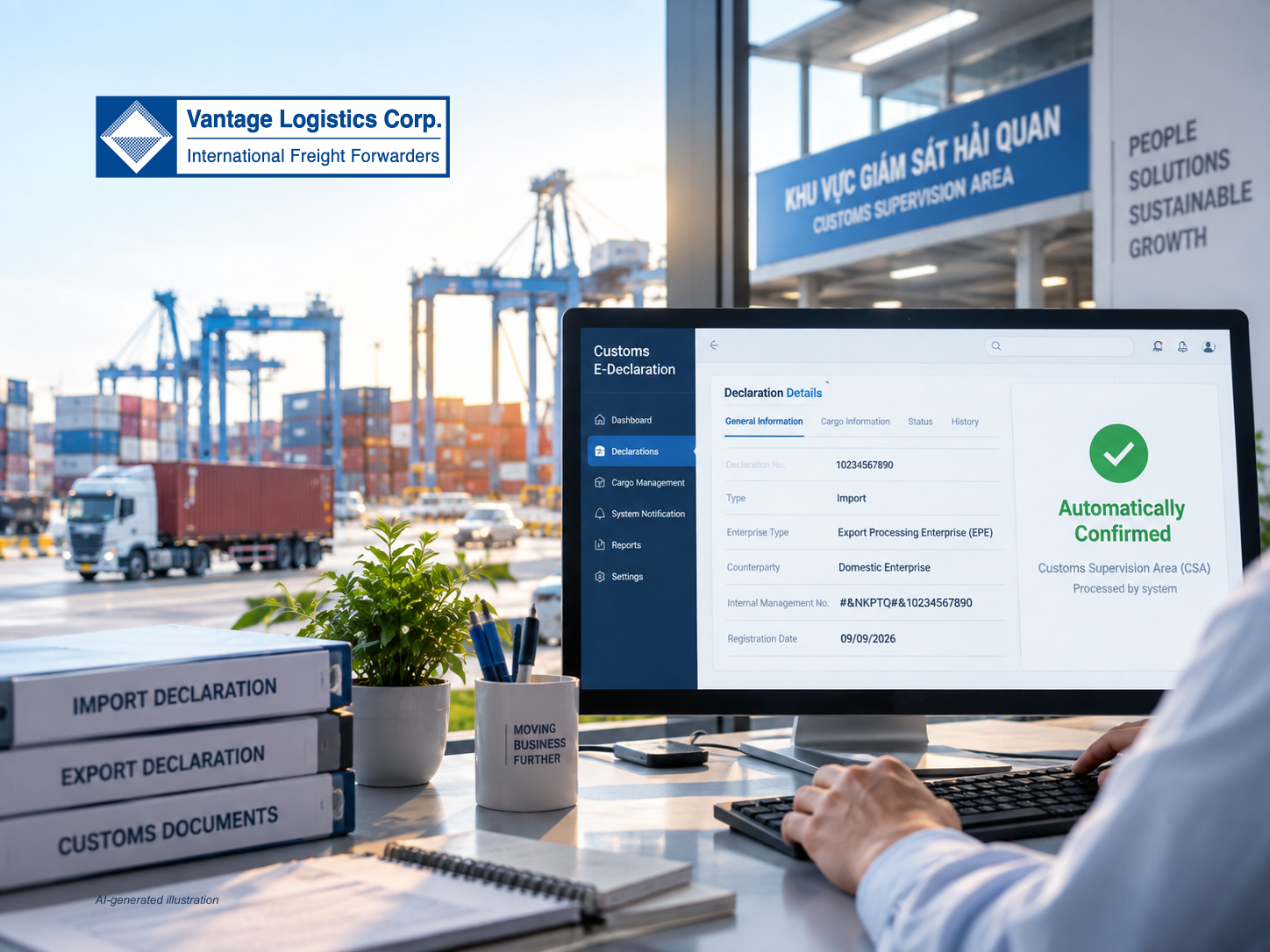
Effective September 9, 2026: Nationwide Automated Customs Supervision Confirmation for EPE Declarations

As of September 9, 2026, the Customs Authority officially activated the automated customs supervision confirmation function nationwide under Official Letter No. 20991/CHQ-GSQL. This update eliminates the need for manual cross-checking for declarations between Export Processing Enterprises (EPEs) and domestic companies, other EPEs, or their branches. To ensure successful automated matching, enterprises must accurately declare the “Enterprise Internal Management Number” field following the Customs Authority’s guidelines: Standard EPE transactions: Export declaration: #&XKPTQ Corresponding import declaration: #&NKPTQ#& + first 11 characters of the export declaration number Designated delivery transactions: Export declaration: #&XKTC Corresponding import declaration: #&NKTC#& + first 11 characters of the export declaration number Important: Missing the #& separator or entering an incorrect declaration number will prevent automatic approval, resulting in manual processing. Enterprises should promptly align documentation workflows and review customs procedures to ensure seamless clearance. Businesses are advised to review their customs declaration procedures and update internal instructions to ensure smooth processing under the new system.   Contact Vantage Logistics for tailored transport solutions and competitive quotations. Please provide details on cargo type, market, origin, destination, and estimated timeline. Vantage Logistics Corp – South East Asia (S.E.A) Logistics Provider One-Stop Shop For Integrated Logistics Services Head Office Viet Nam – Suite 6.01, Floor 6th, Block A, RiverGate Residence, 151-155 Ben Van Don, Khanh Hoi Ward, HCMC, Viet Nam Branch Thailand, Laos, Cambodia, Malaysia, Indonesia, Singapore Contact Us Email in**@*****om.vn Hotline +84-909-026-261 Website https://vantage-logistics.com Send your shipment enquiry today and receive a tailored transport plan from the Vantage Logistics team....

11/09/2026

View More
vlc-news-vietnam-port-vargo-throughput-1H2026-10092026

Market updates

VIETNAM’S PORT CARGO THROUGHPUT SURGES 18.3% TO 687.4 MILLION TONS IN 1H 2026

Vietnam’s maritime and inland waterway port system handled a total of 687.4 million tons of cargo in the first half of 2026, marking an 18.3% year-on-year increase compared to the same period in 2025. Dry bulk cargo remained the primary volume contributor, while container throughput reached a notable milestone of over 18 million TEUs. 1/ Total Cargo Throughput and Full-Year Target Progress According to data released by the Viet Nam Maritime Administration and Inland Waterways Authority, cumulative cargo throughput across the country’s port system reached 687.4 million tons in the first six months of 2026, up 18.3% YoY from 581.3 million tons recorded in 1H 2025. With this performance, the port sector has achieved approximately 52.9% of its full-year 2026 target by the end of June. 2/ Throughput Breakdown by Cargo Flow Domestic cargo emerged as the fastest-growing segment and continued to dominate total throughput: Domestic cargo: Reached 405.4 million tons, surging 25.2% YoY Import cargo: Reached 162.9 million tons, up 9.6% YoY Export cargo: Reached 115.8 million tons, up 8.6% YoY 3/ Throughput Breakdown by Commodity Type Dry bulk cargo accounted for the largest share of total traffic, while specialized cargo categories sustained steady growth: Dry bulk cargo: Reached 460.2 million tons, up 22.7% YoY, representing approximately 66.9% of total port volume Liquid bulk cargo: Reached 47.4 million tons, up 5.1% YoY Transit cargo (aggregate): Reached 56.8 million tons, reflecting a 15.6% YoY increase 4/ Container Throughput Tops 18 Million TEUs Containerized cargo reached 176.5 million tons in tonnage terms, rising 11.0% YoY. Measured in Twenty-foot Equivalent Units (TEUs), container volume climbed to 18.03 million TEUs, reflecting a 12.2% YoY increase compared to 16.07 million TEUs in 1H 2025. Broad-based growth was recorded across all three segments: Domestic containers: Stood at 6.75 million TEUs (holding the largest share at 37.4%) Import containers: Totaled 5.71 million TEUs (31.7%) Export containers: Handled 5.57 million TEUs (30.9%) The strong performance in the first half of 2026 highlights sustained double-digit growth across Vietnam’s port network, largely anchored by robust domestic transport demand and heavy dry bulk shipments.   Contact Vantage Logistics today for tailored freight forwarding and multimodal logistics solutions suited to your cargo needs. Source: Viet Nam Maritime Administration and Inland Waterways Authority – Data through June 2026.   Contact Vantage Logistics for tailored transport solutions and competitive quotations. Please provide details on cargo type, market, origin, destination, and estimated timeline. Vantage Logistics Corp – South East Asia (S.E.A) Logistics Provider One-Stop Shop For Integrated Logistics Services Head Office Viet Nam – Suite 6.01, Floor 6th, Block A, RiverGate Residence, 151-155 Ben Van Don, Khanh Hoi Ward, HCMC, Viet Nam Branch Thailand, Laos, Cambodia, Malaysia, Indonesia, Singapore Contact Us Email in**@*****om.vn Hotline +84-909-026-261 Website https://vantage-logistics.com Send your shipment enquiry today and receive a tailored transport plan from the Vantage Logistics team....

11/09/2026

View More
vlc-news-vietnam-port-cargo-throughput-10092026

Market updates

VIETNAM’S PORT CARGO THROUGHPUT TOPS 1.18 BILLION TONS IN 2025

Vietnam’s maritime and inland waterway port system handled a record 1,182.45 million tons of cargo in 2025, marking an 11.67% increase year-on-year and outperforming its annual target by 11.04%. Container volumes reached 34.46 million TEUs (+12.73%), driven by sustained double-digit growth at key deep-water gateway hubs, including Cai Mep – Thi Vai and Hai Phong. 1/ Total Cargo Throughput Up 11,67% Cumulative cargo throughput across the country’s maritime and inland waterway network reached 1,182.45 million tons in 2025 – an increase of 123.60 million tons over the 1,058.85 million tons recorded in 2024. Against the annual projection of 1,064.88 million tons, full-year throughput reached 111.04% of the target, delivering an excess of approximately 117.57 million tons. Performance by cargo stream: Domestic cargo: Handled 659.75 million tons, accounting for 55.80% of total system volume and climbing 15.17% YoY Import cargo: Reached 299.87 million tons, representing a 25.36% share and advancing 9.68% YoY Export cargo: Stood at 217.70 million tons (18.41% of total volume), up 4.78% YoY Transit cargo handled at berths: Reached 5.14 million tons (0.43% share), up 5.94% YoY 2/ Breakdown by Commodity Classification Under standard maritime classification guidelines, port volumes are categorized into four major segments: dry bulk, containerized cargo, liquid bulk, and transit cargo. Dry bulk cargo: Totaled 749.15 million tons, up 11.78% YoY and completing 114.91% of its annual target. Dry bulk remains the single largest volume driver across the nationwide system Containerized cargo: Handled 333.88 million tons (equivalent to 34.46 million TEUs), advancing 12.19% in tonnage and 12.73% in TEU terms Liquid bulk cargo: Reached 94.30 million tons, rising 9.37% YoY and achieving 104.21% of the full-year plan Transit cargo (aggregate): Reached 101.63 million tons, a 21.15% YoY increase, delivering 113.14% of the annual projection 3/ Container Traffic Surpasses 34 Million TEUs Total container throughput stood at 34.46 million TEUs in 2025, up 3.89 million TEUs (+12.73% YoY) from 30.57 million TEUs in 2024. Growth measured in TEUs outpaced tonnage growth (+12.19%), reflecting broader containerization and rising volumes across all trade lines: Domestic containers: Represented the largest share at 12.51 million TEUs (accounting for 36.30% of total box traffic), up 11.55% YoY Import containers: Led all sectors in growth rate, expanding 14.89% YoY to 11.20 million TEUs Export containers: Handled 10.75 million TEUs, reflecting an 11.93% YoY increase 4/ Overview of Dry Bulk and Liquid Bulk Shipments Dry Bulk (749.15 Million Tons) Dry bulk represented 63.36% of gross port throughput, catering to industrial manufacturing, energy generation, and construction supply chains: Domestic dry bulk: Stood at 489.22 million tons, making up 65.30% of the sector’s total volume Import dry bulk: Reached 152.64 million tons (20.38%) Export dry bulk: Accounted for 107.28 million tons (14.32%) Liquid Bulk (94.30 Million Tons) Liquid bulk traffic served key refineries, petrochemical facilities, and national energy reserves: Domestic liquid bulk: Handled 54.15 million tons (57.43% of total liquid cargo) Import liquid bulk: Reached 35.70 million tons (37.86%) Export liquid bulk: Logged 4.44 million tons (4.71%) 5/ Gateway Port Operations and Deep-Water Capacity International container volume growth remained heavily concentrated in the two strategic deep-water maritime gateways: Cai Mep – Thi Vai Gateway Mother vessel container throughput: Exceeded 6.30 million TEUs over the first 10 months of 2025, an 18% increase over the same period in 2024 Cai Mep International Terminal (CMIT): Handled more than 1.10 million TEUs on mother vessels in the first 11 months (+28%), accommodating over 350 direct mother vessel calls and 8,000 feeder/barge connections while operating 8 weekly direct services to the US and Europe Berth and channel capability: The Cai Mep terminal cluster maintained safe handling capabilities for ultra-large container vessels (ULCVs) of up to 24,000 TEUs (~232,000 DWT) Hai Phong Gateway Regional container volume: Throughput across Hai Phong port terminals surpassed 8.20 million TEUs in 2025, rising roughly 16% YoY Hai Phong Port: Single-handedly topped the 2 million TEU mark for the year Deep-water expansion: Dedicated container berths 3 and 4 at the Lach Huyen deep-water terminal are engineered to accommodate container ships up to 165,000 DWT fully laden, and up to 200,000 DWT under draft-reduced conditions Vietnam’s waterway and port transportation system closed 2025 with total throughput comfortably crossing the 1.18-billion-ton mark. Strong, balanced gains across both international and domestic flows – reinforced by rising deep-water handling capacity – continue to anchor the country’s direct access to global ocean trade lanes. Source: Viet Nam Maritime Administration and Inland Waterways Authority (2025 Data).   Contact Vantage Logistics for tailored transport solutions and competitive quotations. Please provide details on cargo type, market, origin, destination, and estimated timeline.   Vantage Logistics Corp – South East Asia (S.E.A) Logistics Provider One-Stop Shop For Integrated Logistics Services Head Office Viet Nam – Suite 6.01, Floor 6th, Block A, RiverGate Residence, 151-155 Ben Van Don, Khanh Hoi Ward, HCMC, Viet Nam Branch Thailand, Laos, Cambodia, Malaysia, Indonesia, Singapore Contact Us Email in**@*****om.vn Hotline +84-909-026-261 Website https://vantage-logistics.com   Send your shipment enquiry today and receive a tailored transport plan from the Vantage Logistics team....

11/09/2026

View More
1 … 5 6 7 8 9 … 43