RESOURCE

vlc-news-philippines-cancels-rice-import-permit-15102026

Market updates

Philippines Cancels Permit for Controversial 12,480-Metric-Ton Rice Shipment from Viet Nam

The Philippine Department of Agriculture (DA) said it had ordered the cancellation of the Sanitary and Phytosanitary Import Clearance (SPSIC) for a 12,480-metric-ton rice shipment from Viet Nam before the vessel arrived. The case involves reported discrepancies in rice specifications and an expired import contract, highlighting the risks that can arise when shipping schedules do not align with import requirements in the destination market. 1. Developments at the Port of Arrival According to the Philippine Department of Agriculture (DA) and the Philippine News Agency (PNA), the vessel MV Tay Son 2, carrying 12,480 metric tons of rice from Viet Nam, arrived at the Port of Davao on September 14, 2026. According to these sources, the vessel’s captain refused to submit the shipment for inspection by the Philippine Bureau of Plant Industry (BPI). On September 17, 2026, the vessel departed Davao before the matter had been resolved. Philippine authorities subsequently prevented the cargo from being unloaded at another location and brought the vessel to the Port of General Santos before ordering it to return to Davao for further handling. 2. Rice Specifications and Import Requirements The case involves two issues: reported discrepancies in rice specifications and the status of the import contract and permit. 2.1. Reported Discrepancy in Rice Specifications The importer, Planters Product, Inc. (PPI), reported a discrepancy between the purchase order and the specifications communicated for the shipment: Specifications under the purchase order: 25% broken rice Reported specifications for the shipment: 5% broken rice In agricultural trade, the percentage of broken grains is an important commercial specification. However, the discrepancy remains based on information reported by the importer and has not been confirmed by an official inspection, as the physical inspection process was not completed. 2.2. Expired Contract and Canceled Import Permit In addition to the rice specifications, the delivery timeline and the status of the import documentation were also highlighted by the DA: Estimated time of arrival (ETA): July 2026 Actual arrival: Mid-September 2026 According to the DA, the import contract had expired and the SPSIC had been canceled before the vessel arrived. The vessel’s arrival also coincided with the period when the Philippines was preparing for the wet-season rice harvest. According to published information, import policy during this period was also linked to efforts to limit downward pressure on domestic palay prices. Operational Note: Even when goods meet quality requirements, a shipment may still face customs clearance difficulties if it fails to meet import requirements or if the relevant permit is no longer valid. 3. Proposed Measures for Handling the Shipment According to published information, the Bureau of Customs of the Philippines (BOC) was still considering the final course of action for the shipment. The proposed measures included: Proposed Measure Proposing Authority / Status Return to the Country of Origin The BPI was reported to have recommended returning the shipment to Viet Nam. Seizure and Penalties The DA proposed considering seizure of the shipment and the application of penalties under relevant regulations, subject to the competent authority’s findings and decision. Final Decision The BOC was reviewing the official course of action for the shipment. 4. Conclusion The controversial rice shipment in the Philippines highlights how international trade depends not only on product quality and contractual terms but also on shipping schedules, the validity of import documentation, and regulatory requirements in the destination market. When these elements are no longer aligned, shipments already in transit may face unexpected complications during arrival and customs clearance. Vantage Logistics will continue to provide updates on notable developments in logistics, import-export activities, and international supply chains, offering businesses additional insight into factors that may affect global trade. Contact Vantage Logistics for tailored transport solutions and competitive quotations. Please provide details on cargo type, market, origin, destination, and estimated timeline.   Vantage Logistics Corp – South East Asia (S.E.A) Logistics Provider One-Stop Shop For Integrated Logistics Services Head Office Viet Nam – Suite 6.01, Floor 6th, Block A, RiverGate Residence, 151-155 Ben Van Don, Khanh Hoi Ward, HCMC, Viet Nam Branch Thailand, Laos, Cambodia, Malaysia, Indonesia, Singapore Contact Us Email in**@*****om.vn Hotline +84-909-026-261 Website https://vantage-logistics.com Send your shipment enquiry today and receive a tailored transport plan from the Vantage Logistics team.

15/10/2026

View More
vlc-news-asean-east-asia-trade-15102026

Market updates

ASEAN–East Asia Trade Reaches USD 1.4 Trillion, Up 13.7% in 2025

According to preliminary data from the ASEAN Secretariat, two-way trade between ASEAN and its three East Asian partners (China, Japan, and South Korea) reached USD 1.4 trillion in 2025, representing a 13.7% year-on-year increase. Notably, China–ASEAN trade continued its upward trajectory in the first seven months of 2026, underscoring a sustained expansion in cross-regional trade volumes worth monitoring. 1. Regional Trade Volume and Foreign Direct Investment (ASEAN+3) Trade and investment flows between ASEAN and its three East Asian partners maintain a substantial footprint. In 2025, Foreign Direct Investment (FDI) inflows from China, Japan, and South Korea into ASEAN totaled USD 44.8 billion. Key ASEAN–East Asia Trade & Investment Indicators Indicator Value Growth / Share ASEAN – (China, Japan, South Korea) Trade in 2025 USD 1.4 Trillion Up 13.7% vs 2024 FDI from 3 East Asian Partners into ASEAN in 2025 USD 44.8 Billion Accounted for 18.2% of total ASEAN FDI China – ASEAN Trade (First 7 Months of 2026) USD 744.41 Billion Up 24.7% year-on-year The scale of merchandise trade and investment capital highlights the vital economic linkage between East Asia and Southeast Asia. However, assessing actual freight demand requires a granular evaluation of specific commodity structures, export-import markets, and active transport corridors. 2. Direct Impacts on Transport Networks and Logistics Infrastructure Expanding trade volumes underscore the critical role of regional transport connections. Depending on industry-specific cargo characteristics and delivery requirements, flexible logistics solutions are being actively deployed: Intra-Asia Ocean Freight Connections: For multi-leg shipments, vessel schedule reliability, transit times, and feeder network connectivity are pivotal factors for supply chain managers. Major gateway hubs such as Shanghai, Ningbo, Busan, and Yokohama maintain dense feeder linkages with Southeast Asian ports within ocean carrier networks Integrated Logistics and Multimodal Transport: Depending on lead-time sensitivity, combining ocean freight, Cross-Border Trucking, and inland warehousing offers expanded routing options. Real-world operational efficiency hinges heavily on border crossing clearance times, transit schedules, and the coordination capability of the logistics operator Rules of Origin (C/O) and Customs Compliance: When leveraging Free Trade Agreements such as RCEP, AKFTA, or AJCEP, enterprises must accurately determine rules of origin and prepare compliant documentation to qualify for preferential tariffs. Duty exemption eligibility depends on the specific conditions of each product line and destination market 3. Monitoring Southeast Asian Trade Dynamics and Logistics Connectivity Expanding trade and investment flows reflect an increasingly integrated economic relationship between East Asia and Southeast Asia. This growth in cross-border trade creates momentum for expanding logistics connectivity, helping strengthen supply chain coverage across the region.   Contact Vantage Logistics for tailored transport solutions and competitive quotations. Please provide details on cargo type, market, origin, destination, and estimated timeline. Vantage Logistics Corp – South East Asia (S.E.A) Logistics Provider One-Stop Shop For Integrated Logistics Services Head Office Viet Nam – Suite 6.01, Floor 6th, Block A, RiverGate Residence, 151-155 Ben Van Don, Khanh Hoi Ward, HCMC, Viet Nam Branch Thailand, Laos, Cambodia, Malaysia, Indonesia, Singapore Contact Us Email in**@*****om.vn Hotline +84-909-026-261 Website https://vantage-logistics.com Send your shipment enquiry today and receive a tailored transport plan from the Vantage Logistics team.

15/10/2026

View More

Market updates

SINGAPORE STRENGTHENS PRODUCT SAFETY CONTROLS: WHAT VIETNAMESE EXPORTERS NEED TO KNOW

Singapore is strengthening its product safety controls through two key regulations: the Consumer Protection (Safety Requirements) Regulations (CPSR) and the Consumer Goods (Safety Requirements) Regulations (CGSR). For exporters, these requirements go beyond product compliance. They can also affect delivery schedules, logistics costs, and supply chain reliability. 1. Singapore Strengthens Product Safety Requirements According to information published by Vietnam’s Ministry of Industry and Trade, Singapore applies two main regulatory frameworks for product safety. – CPSR: Covers 33 categories of controlled goods, including electrical and electronic products, household appliances, and gas appliances. Products within scope must meet applicable safety requirements, complete registration, and carry the SAFETY Mark before being supplied or sold in Singapore. – CGSR: Covers general consumer goods such as toys, clothing, furniture, and sports equipment, which must comply with the relevant safety standards. Non-compliant products may be subject to sales restrictions or recalls. Businesses that violate applicable requirements may also face penalties. For exporters, checking compliance requirements before shipment is essential. Addressing documentation or registration issues early can help avoid costly adjustments after cargo has already left the port of origin. 2. Potential Impact on Southeast Asia’s Trade and Logistics Singapore plays an important role in Southeast Asia’s trade and logistics network. Tighter product safety controls may require exporters, importers, and distributors to review their procedures for placing goods on the Singapore market. Several potential risks deserve attention: – Delivery delays: Incomplete documentation or missing certificates may affect cargo acceptance and delivery schedules. – Additional logistics costs: Delays in resolving compliance issues may lead to storage, port handling, or additional transportation costs. – Disrupted distribution plans: Late deliveries can affect inventory planning, distribution schedules, and commitments to business partners. These requirements do not automatically apply across all ASEAN markets. However, they highlight the importance of understanding the specific regulations of each destination country when planning regional trade and distribution. 3. What Should Vietnamese Exporters Prepare? For Vietnamese businesses exporting to Singapore, compliance checks should take place before shipment arrangements are finalized. Exporters should determine whether their products fall under CPSR or CGSR, verify the applicable safety standards and registration requirements, and clarify responsibilities with their Singaporean importers. Documentation preparation should also be factored into the shipping schedule. If an issue is discovered only after cargo arrives at the destination port, businesses may need to manage several challenges simultaneously, including delivery delays, additional costs, and changes to distribution plans. A reliable shipping plan therefore involves more than selecting the right route or sailing schedule. It also requires anticipating potential obstacles before the cargo reaches its destination. 4. Managing Risks Through Early Planning Not every risk in international shipping can be eliminated, but many disruptions can be reduced through early preparation. Reviewing cargo information, documentation, shipping schedules, and destination requirements helps all parties make better-informed decisions. For shipments to Singapore, close coordination among exporters, importers, agents, and logistics providers helps maintain visibility over shipment readiness, address changes, and adjust plans when necessary. At Vantage Logistics, international transportation planning takes into account the practical requirements of each shipment and the coordination needed among relevant parties. This approach helps businesses manage potential disruptions and maintain better control over delivery schedules. As market requirements evolve, careful preparation does more than protect an individual shipment. It also helps businesses maintain reliable supply chains and build lasting partnerships across international markets.

15/10/2026

View More
vlc-news-global-sales-logistics-1

Market updates

Global Sales Logistics: Helping E-Commerce Businesses Maintain Inventory Flow from Viet Nam to Fulfillment Centers

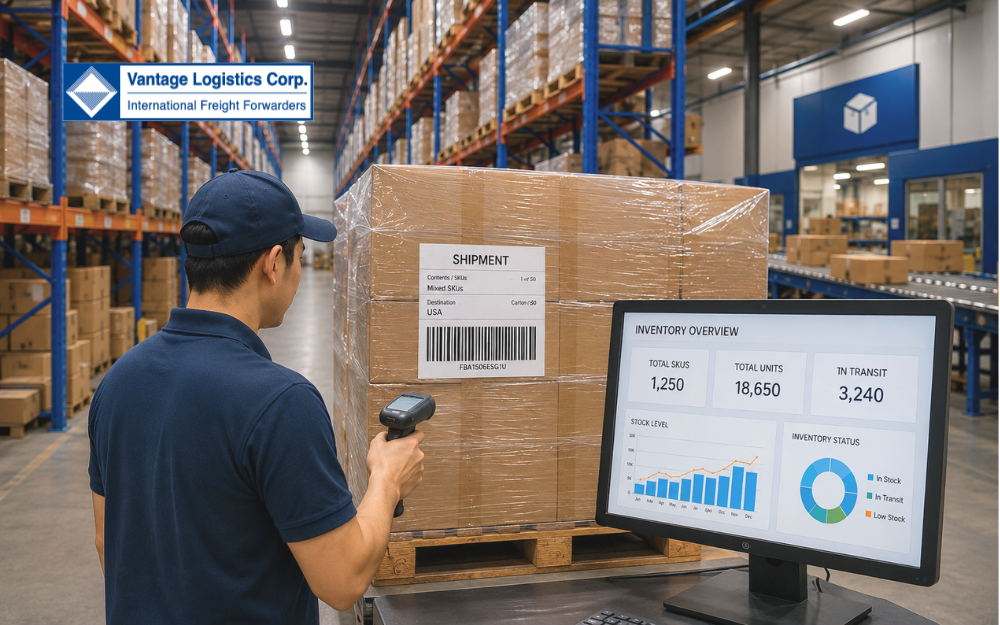
For Vietnamese e-commerce exporters, logistics is not merely the step of transporting goods after an order is placed. It is a strategic element embedded throughout the entire operational chain, ensuring efficiency, reliability, and readiness for global market expansion. Recent cross-border e-commerce export reports indicate that an increasing number of Vietnamese businesses are selling directly to international consumers through marketplace platforms. As sales volumes and SKU counts grow, the challenge shifts from acquiring orders to maintaining a reliable inventory pipeline, managing stock levels effectively, and replenishing inventory at the right time. Inventory at Fulfillment Centers Directly Impacts Sales Performance For businesses selling through cross-border e-commerce channels, inventory availability in destination markets directly affects order fulfillment, product visibility, and overall sales performance. A high-performing product can quickly face stock shortages if replenishment is delayed. Conversely, sending excessive inventory without sufficient visibility into sales velocity can increase storage costs and place additional pressure on working capital. As a result, logistics for e-commerce sellers involves far more than simply shipping products overseas. Businesses need an integrated operational plan that connects manufacturing, export warehousing, international transportation, customs procedures, inventory management, and fufillment center delivery. Stock-Outs Can Disrupt Revenue and Marketing Plans For sellers running active sales and marketing campaigns, inventory shortages at fulfillment centers can create multiple challenges simultaneously. Businesses may lose sales opportunities, experience reduced advertising effectiveness, struggle to maintain sales momentum, and face greater uncertainty when planning future replenishment cycles. In many cases, the issue is not caused by a single operational step. Delays can result from peak-season capacity constraints, limited space on vessels or aircraft, incomplete documentation, customs clearance bottlenecks, incorrect packaging or labeling, or scheduling mismatches between transportation plans and fufillment center receiving windows. As sellers expand into multiple markets or manage larger SKU portfolios, these risks become increasingly significant. A disruption at any point in the supply chain can affect the entire sales operation. Inventory Should Be Managed Based on Sales Velocity and Fulfillment Requirements To reduce the risk of stock-outs, some businesses choose to maintain higher inventory levels in destination markets. While this approach may provide short-term protection, it can also increase storage costs, inventory handling expenses, and cash flow pressure. For cross-border e-commerce sellers, inventory management should be aligned with SKU performance, market demand, sales channels, sales velocity, and fulfillment requirements. An effective replenishment strategy requires visibility into which products should be shipped first, which markets face potential inventory shortages, whether ocean or air freight is more appropriate, whether inventory should be stored at intermediate warehouses or shipped directly to fulfillment centers, and when bookings should be secured to support sales schedules. With better inventory visibility and coordination, businesses can replenish inventory proactively rather than reacting after sales have already been affected or storage costs have increased. Fragmented Logistics Makes End-to-End Control More Difficult Many businesses work with separate providers for domestic transportation, international freight forwarding, customs brokerage, warehousing, packaging, fufillment center delivery, and destination-market logistics services. While this model may be manageable at smaller scales, it often becomes increasingly difficult to coordinate as order volumes, SKU counts, and market coverage expand. Without a central point of coordination, businesses may struggle to maintain visibility, respond quickly to disruptions, and optimize overall logistics costs. In e-commerce operations, every logistics activity influences sales outcomes. Incomplete documentation may delay customs clearance. Incorrect packaging or labeling may lead to receiving delays or compliance issues at fulfillment centers. Poor synchronization between transportation schedules and inventory plans can result in stock shortages in one market while excess inventory accumulates in another. For this reason, many e-commerce sellers are seeking logistics partners capable of coordinating international transportation, customs clearance, warehousing, inventory management, and fulfillment activities through a unified operational plan rather than managing multiple independent service providers. Vantage Logistics Connects Operations from Factory to Fulfillment Center Through its Global Sales Logistics service and cross-border logistics capabilities, Vantage Logistics supports businesses in building end-to-end operational flows from Viet Nam to international markets through a range of integrated services, including: International transportation by ocean freight, air freight, and other suitable transport modes Export and import customs clearance Warehousing and inventory management Cargo monitoring throughout the transportation process Packaging, labeling, and delivery to designated fulfillment centers Fulfillment support and last-mile delivery services based on operational requirements Additional logistics activities required to maintain uninterrupted inventory flow from origin to destination markets By integrating every stage of the supply chain into a single operational framework – from factories and export warehouses to international transportation, customs clearance, storage, FBA delivery, and B2B fulfillment channels – businesses can reduce management complexity, improve coordination between operational functions, and optimize inventory movement. This approach helps businesses maintain tighter inventory control, proactively mitigate stock-out risks, and reduce operational costs associated with delays and disruptions. With offices across Viet Nam, Cambodia, and Southeast Asia, supported by international partner networks, Vantage Logistics works alongside businesses to design logistics solutions aligned with sales velocity, fulfillment requirements, and long-term export growth objectives. Signs It May Be Time to Review Your Logistics Strategy Businesses should evaluate their current logistics model if they are experiencing one or more of the following situations: Frequent emergency air shipments to address inventory shortages Inventory arriving at fulfillment centers later than planned Expansion into new marketplaces or international markets Rapid SKU growth without corresponding inventory visibility High inventory levels alongside recurring stock-outs for certain products Dependence on multiple logistics providers with limited end-to-end operational visibility For Vietnamese manufacturers transitioning from traditional export models to direct-to-consumer sales through international e-commerce platforms, logistics should be designed as an integral part of the sales strategy rather than a shipping function activated only after orders are received. The continued growth of international marketplaces is creating new opportunities for Vietnamese businesses to build brands and sell directly to global consumers.   Contact Vantage Logistics for tailored transport solutions and competitive quotations. Please provide details on cargo type, market, origin, destination, and estimated timeline. Vantage Logistics Corp – South East Asia (S.E.A) Logistics Provider One-Stop Shop For Integrated Logistics Services Head Office Viet Nam – Suite 6.01, Floor 6th, Block A, RiverGate Residence, 151-155 Ben Van Don, Khanh Hoi Ward, HCMC, Viet Nam Branch Thailand, Laos, Cambodia, Malaysia, Indonesia, Singapore Contact Us Email in**@*****om.vn Hotline +84-909-026-261 Website https://vantage-logistics.com Send your shipment enquiry today and receive a tailored transport plan from the Vantage Logistics team....

08/06/2026

View More
vlc-news-vietnam-trade-reaches-usd-445-bilion-in-the-first-five-months

Market updates

VIETNAM’S TRADE REACHES USD 445 BILLION IN THE FIRST FIVE MONTHS OF 2026, WITH TRADE DEFICIT AT USD 13.8 BILLION

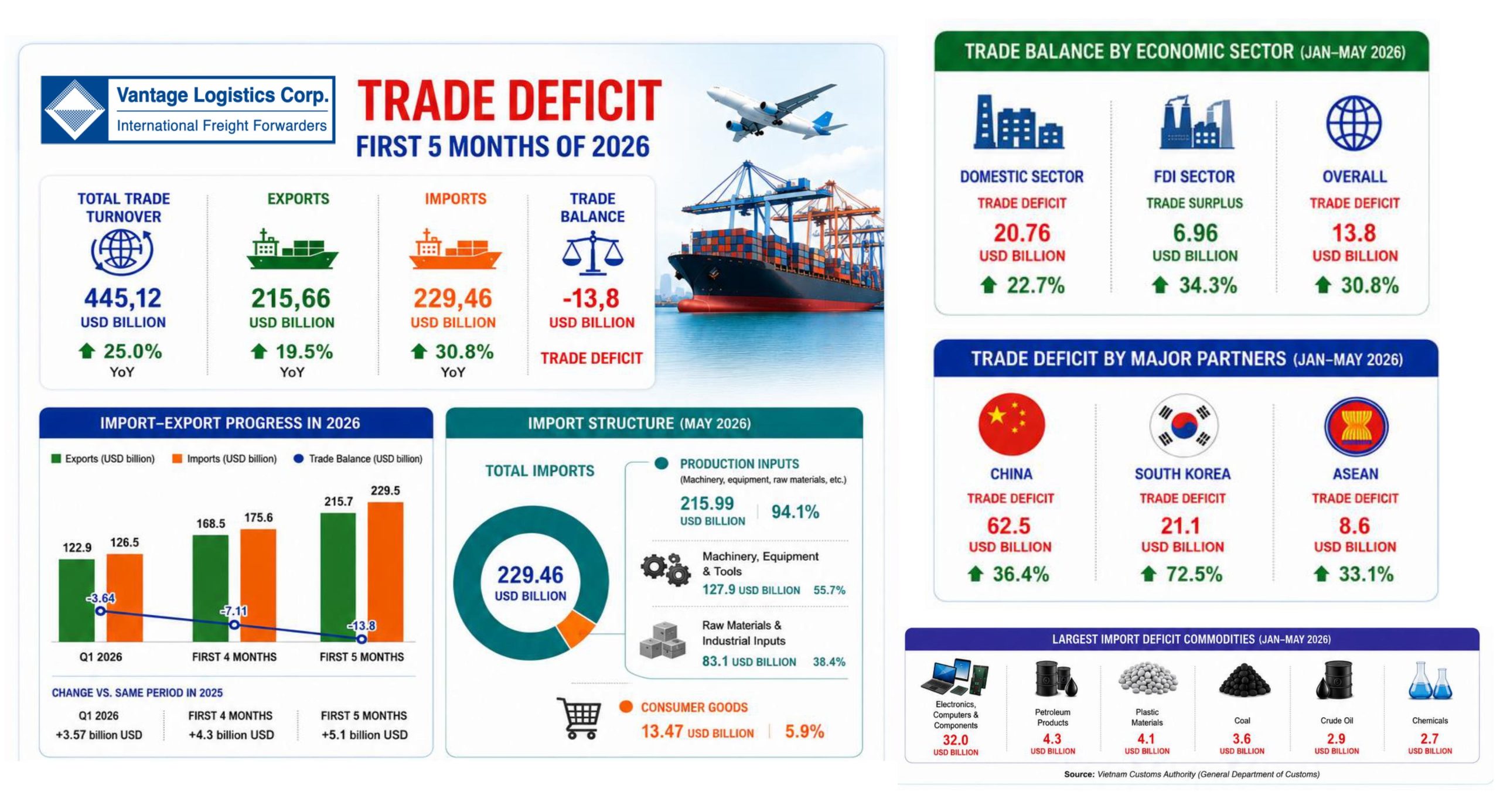
Vietnam’s total import-export turnover reached USD 445.12 billion during the first five months of 2026, up 25% year-over-year. The strong growth reflects continued momentum in international trade activity while driving greater demand for logistics, transportation, and supply chain management services. Trade Activity Maintains Strong Growth According to the General Statistics Office under the Ministry of Finance, Vietnam’s total merchandise trade value reached USD 445.12 billion between January and May 2026, representing a 25% increase compared to the same period in 2025. Exports totaled USD 215.66 billion, up 19.5% year-over-year, while imports reached USD 229.46 billion, increasing 30.8%. As a result, Vietnam recorded a trade deficit of USD 13.8 billion during the period. In May alone, total trade turnover amounted to USD 99.07 billion, rising 3.2% from April and 25.8% compared to May 2025. The United States and China Remain Key Trading Partners The United States continued to be Vietnam’s largest export market, with export value reaching USD 69.6 billion in the first five months of the year. On the import side, China remained Vietnam’s largest supplier, accounting for USD 92.6 billion in import value. Viet Nam recorded a trade surplus of USD 60.4 billion with the United States and USD 18.1 billion with the European Union. Meanwhile, trade deficits with China and South Korea reached USD 62.5 billion and USD 21.1 billion, respectively. Manufacturing Growth Drives Logistics Demand Import data shows that production inputs accounted for 94.1% of total imports, with machinery, equipment, and raw materials continuing to represent the largest share. On the export side, processed industrial products generated USD 193.71 billion in export revenue, accounting for nearly 90% of total exports. These figures indicate that Vietnam’s manufacturing and export sectors continue to expand, increasing demand for international transportation, customs brokerage, warehousing, and cross-border supply chain management services.   Contact Vantage Logistics for tailored transport solutions and competitive quotations. Please provide details on cargo type, market, origin, destination, and estimated timeline. Vantage Logistics Corp – South East Asia (S.E.A) Logistics Provider One-Stop Shop For Integrated Logistics Services Head Office Viet Nam – Suite 6.01, Floor 6th, Block A, RiverGate Residence, 151-155 Ben Van Don, Khanh Hoi Ward, HCMC, Viet Nam Branch Thailand, Laos, Cambodia, Malaysia, Indonesia, Singapore Contact Us Email in**@*****om.vn Phone +84-28 382 67312 Hotline +84-909-026-261 Website https://vantage-logistics.com Send your shipment enquiry today and receive a tailored transport plan from the Vantage Logistics team....

08/06/2026

View More
vlc-news-us-section-232-tariffs-2

Market updates

US Adjusts Section 232 Tariffs on Select Imported Metal Products Effective June 8, 2026

Effective June 8, 2026, the US will implement several new adjustments to the Section 232 tariff mechanism for items related to steel, aluminum, and copper. These changes are expected to remain in effect until December 31, 2027. This round of adjustments is not a sweeping change across all imported metal products. Instead, it primarily expands the list of product groups eligible for lower tariff rates and relaxes the requirements regarding the percentage of US-origin metal in specific cases. Key Adjustments to the Section 232 Tariff Mechanism According to information released by the White House, a 15% tariff rate will apply to certain agricultural equipment groups, such as combine harvesters and reaping machinery, as well as select residential HVAC equipment. The US has also expanded the category of industrial equipment eligible for the 15% rate to include certain mobile industrial machinery, such as forklifts and bulldozers, provided they meet the applicable conditions. Another significant modification is the threshold for a product to be considered as utilizing US-origin metal, which has been lowered from 95% to 85% by weight. This adjustment could enable certain products to qualify for a preferred 10% tariff rate, provided they satisfy the statutory requirements for steel or aluminum melted, cast, or metallurgically processed within the US. Direct Impact on Businesses Exporting to the US For businesses exporting to the US – particularly in sectors such as mechanical engineering, industrial equipment, agricultural machinery, steel structures, and fabricated metal products – this update highlights that raw material origin and metal composition percentages are increasingly exerting a direct impact on import costs and product competitiveness. Beyond the tariffs themselves, businesses must better prepare their certificates of origin, production documentation, and supply chain data. These areas are likely to face stricter verification during the US import process. Recommended Preparations for the Upcoming Period As US trade policies continue to undergo sector-specific adjustments, businesses should: Review product portfolios containing steel, aluminum, or copper destined for export to the US. Verify the percentage and origin of raw materials within the product composition. Standardize certificates of origin, production documentation, and supply chain data. Assess tariff impacts during the quotation process and long-term export planning. Engage early with logistics partners and customs brokers to stay updated on new compliance requirements. The Role of Logistics in Managing Trade Risk As trade regulations become more deeply intertwined with origin data and supply chain transparency, logistics is no longer confined to transport operations. It also plays a vital role in helping businesses manage documentation, track cargo origin, and mitigate risks during the customs clearance process. With extensive experience in supporting export shipments to the US, Vantage Logistics stands ready to assist businesses in developing appropriate transport plans, optimizing documentation, and updating the latest regulatory changes to minimize potential risks in export operations. Contact Vantage Logistics to receive the latest trade policy updates and to develop tailored logistics solutions for the US market. Note: Actual applicable tariff rates may vary depending on the specific commodity code (HS code), metal composition, origin criteria, and enforcement guidelines in effect at the time of import.   Contact Vantage Logistics for tailored transport solutions and competitive quotations. Please provide details on cargo type, market, origin, destination, and estimated timeline. Vantage Logistics Corp – South East Asia (S.E.A) Logistics Provider One-Stop Shop For Integrated Logistics Services Head Office Viet Nam – Suite 6.01, Floor 6th, Block A, RiverGate Residence, 151-155 Ben Van Don, Khanh Hoi Ward, HCMC, Viet Nam Branch Thailand, Laos, Cambodia, Malaysia, Indonesia, Singapore Contact Us Email in**@*****om.vn Hotline +84-909-026-261 Website https://vantage-logistics.com Send your shipment enquiry today and receive a tailored transport plan from the Vantage Logistics team....

05/06/2026

View More
vlc-news-custom-clearance-delay-reasons

Market updates

5 DOCUMENTATION MISTAKES THAT CAN DELAY CUSTOMS CLEARANCE

Learn about five common documentation mistakes in international trade that can delay customs clearance, trigger storage and detention charges, and increase operational costs. Cargo Has Arrived at Port – So Why Hasn’t It Cleared Customs? The container has arrived on schedule, yet the cargo still cannot be released. Meanwhile, storage and detention clocks continue running, delivery timelines are disrupted, and internal teams are scrambling to review the shipment documentation. In many cases, the root cause is not vessel schedules or transportation capacity. Instead, it comes down to errors within the documentation package. An incorrect HS code, inconsistent information across documents, or a minor issue with a Certificate of Origin (C/O) can all extend the customs clearance process beyond expectations. Below are five common documentation mistakes that businesses encounter in import and export operations, the risks they create, and practical steps to reduce unnecessary costs and delays. Why Do Documentation Errors Continue to Occur in International Trade? An import or export shipment often involves multiple stakeholders, including suppliers, buyers, documentation teams, logistics providers, carriers, and regulatory authorities. When information is generated from multiple sources without a standardized process, discrepancies become difficult to avoid. Many companies also prioritize procurement, transportation, and delivery activities while leaving document preparation until the final stages of the shipment cycle. As a result, there is limited time available to identify and correct errors before submission. In practice, most documentation issues are not caused by a lack of technical knowledge. They are often the result of insufficient cross-checking procedures and inconsistent internal data management. Incorrect HS Code Classification For many importers, incorrect HS classification is one of the most common reasons customs documentation must be reviewed after submission. This issue frequently occurs with technically complex products such as electronic components, multi-functional machinery, industrial materials, and products with multiple applications. When a product’s composition, function, or specifications change, the HS code used in previous shipments may no longer be appropriate. Many companies rely on historical classifications or supplier-provided information without fully verifying the product’s actual characteristics. If customs authorities request clarification, businesses may need to provide product catalogs, technical specifications, datasheets, or supporting documentation to justify the classification. Reviewing HS codes during the document preparation stage can significantly reduce the risk of amendments and clearance delays later in the process. Inconsistent Product Descriptions Across Documents For frozen seafood, agricultural products, and processed food shipments, inconsistent product descriptions between the Commercial Invoice, Packing List, and Bill of Lading are common when multiple parties participate in document preparation. For example, a frozen shrimp shipment may be described as “Frozen Shrimp” on the Commercial Invoice, “Seafood Product” on the Packing List, and “Frozen Food” on the Bill of Lading. Although all descriptions refer to the same cargo, inconsistencies can trigger additional reviews or requests for clarification. One practical way to reduce this risk is to establish standardized product descriptions for each product category and use them consistently across all shipping documents. Missing or Incorrect Certificate of Origin (C/O) Issues involving Certificates of Origin are often discovered only when documentation is about to be submitted or after the cargo has already arrived at the destination port. By that stage, corrections may become more complicated because multiple parties are involved. The risk increases when companies change suppliers, switch manufacturing facilities, or begin utilizing a different free trade agreement (FTA). Many importers discover errors in the Certificate of Origin only during customs processing. In such situations, shipments may not qualify for preferential duty treatment while authorities review supporting documentation or corrections. For this reason, confirming origin requirements and reviewing Certificate of Origin information early in the shipment planning process can help prevent unexpected costs and delays. Incorrect Shipper or Consignee Information Shipper and Consignee details are often viewed as the simplest part of the documentation package. However, they remain one of the most common sources of documentation errors. Typical mistakes include incorrect legal company names, addresses, tax identification numbers, or inconsistent abbreviations across documents. These issues often result from using outdated records, copying information from emails or booking confirmations, or failing to verify information against official company registration documents. The consequences may include document amendments, delays in Bill of Lading issuance, and longer processing times for cargo release procedures. A practical solution is to maintain a centralized master data system for customers and business partners and verify critical information before issuing shipping documents. Late Submission of Documentation This is fundamentally a timing issue, but it often results in the highest costs. Many companies do not finalize their documentation until cargo is close to arrival or until a processing requirement emerges. As a result, even minor mistakes can become costly because there is little time available for correction. This issue commonly affects urgent shipments, cargo subject to regulatory inspections, and transactions heavily dependent on documents provided by overseas suppliers. When documentation is not ready on time, businesses may face storage charges, detention and demurrage fees (DEM/DET), delayed deliveries, and disruptions to production schedules. Rather than treating documentation as a final administrative task, companies should prepare documents alongside transportation planning and manage progress through a structured checklist. The Costs of Delayed Documentation Processing When documentation problems occur, businesses immediately notice costs such as storage charges, detention and demurrage fees, document amendment costs, and other administrative expenses. However, the larger impact is often operational. A delayed inbound shipment may disrupt manufacturing schedules. A delayed export shipment may cause a business to miss delivery commitments to customers. In many situations, the most significant cost is not the direct fee itself but the need to adjust production plans, sales commitments, or supply chain operations. This is why documentation should not be viewed solely as an administrative function. It should be treated as a key component of supply chain risk management. Four Recommendations to Reduce Documentation Risks To minimize documentation-related issues in import and export operations, businesses can start with the following practices: Standardize product descriptions and use them consistently across all documentation. Implement a cross-check process before issuing or submitting documents. Prepare Certificates of Origin, permits, and specialized documentation well before cargo arrival deadlines. Manage documentation as part of the overall logistics process, aligned with vessel schedules, delivery commitments, and operational planning. Documentation Review Checklist Before Customs Declaration Before submitting customs documentation, businesses can use the following checklist as a final review step: ☐ HS Code has been verified ☐ Product descriptions are consistent across the Commercial Invoice, Packing List, and Bill of Lading ☐ Certificate of Origin is complete and uses the correct format ☐ Shipper and Consignee information is accurate ☐ Declared customs value has been verified ☐ Quantities and units of measure are correct ☐ Required permits and regulatory approvals are available ☐ Documentation has been submitted on time This checklist can serve as an internal control tool to help reduce documentation-related risks before customs filing. Reducing Customs Clearance Risks Starts with Documentation Standardization Many businesses assume customs delays are primarily caused by vessel schedules, regulatory inspections, or external factors. In reality, relatively small documentation errors remain one of the most common reasons customs processing takes longer than expected. A well-prepared documentation package helps reduce unexpected costs, maintain delivery schedules, and improve operational efficiency throughout the supply chain. Reducing documentation errors does not begin at the moment customs declarations are filed. It begins with establishing a consistent internal process for document preparation, review, and coordination from the earliest stages of the shipment. Businesses can use the checklist in this article as part of their internal review process before customs submission. For shipments involving complex documentation requirements or multiple stakeholders, early document verification can significantly reduce clearance and delivery risks. Frequently Asked Questions What risks can result from an incorrect HS code? Depending on the situation, businesses may be required to provide additional technical documentation, justify product classification, adjust duty calculations, or experience longer customs processing times. Can a Certificate of Origin be corrected after cargo arrives at port? This depends on the applicable regulations and the specific free trade agreement involved. Businesses should review the relevant requirements before initiating import procedures. When should shipment documentation be finalized? Documentation should be prepared and reviewed alongside transportation planning rather than waiting until cargo arrives at the destination port. Should the same documentation checklist be used for every shipment? Yes. Maintaining a standardized checklist helps reduce errors and supports a more consistent documentation control process across import and export operations.   Contact Vantage Logistics for tailored transport solutions and competitive quotations. Please provide details on cargo type, market, origin, destination, and estimated timeline. Vantage Logistics Corp – South East Asia (S.E.A) Logistics Provider One-Stop Shop For Integrated Logistics Services Head Office Viet Nam – Suite 6.01, Floor 6th, Block A, RiverGate Residence, 151-155 Ben Van Don, Khanh Hoi Ward, HCMC, Viet Nam Branch Thailand, Laos, Cambodia, Malaysia, Indonesia, Singapore Contact Us Email in**@*****om.vn Hotline +84-909-026-261 Website https://vantage-logistics.com Send your shipment enquiry today and receive a tailored transport plan from the Vantage Logistics team....

04/06/2026

View More
vlc-news-data-standardisation

Market updates

Data Standardization: A Core Requirement in Export Supply Chain Management

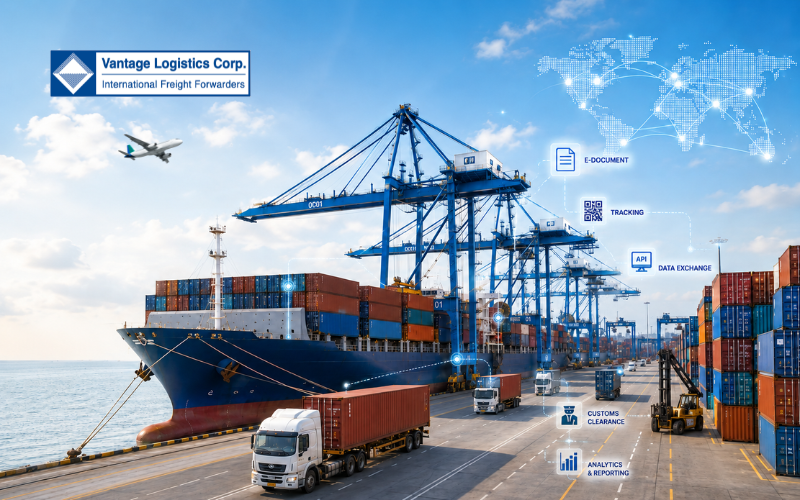
As major import markets like the United States, the EU, and Australia increase their requirements for traceability, supply chain transparency, and electronic records, data is becoming just as critical as product quality. For exporters, data standardization not only ensures compliance but also minimizes operational risks, controls logistics costs, and maintains competitiveness in the international market. Data: The Essential Driver of Modern Export Competitiveness For years, production capacity and pricing were considered the deciding factors for an exporter’s competitiveness. However, the global trade landscape is changing rapidly. Regulatory authorities and importers in the US, the EU, and Australia increasingly require businesses to provide continuous data across the entire supply chain – from raw material sourcing and manufacturing to transportation, warehousing, and electronic import documentation. This trend means data is no longer merely an internal management tool; it has become an integral part of international trade compliance. A single minor discrepancy between a commercial invoice, packing list, bill of lading, or customs declaration can lead to: Delayed customs clearance at the destination port Additional inspections by regulatory authorities Unexpected demurrage and detention (DEM/DET) charges Risk of fines or import rejections Supply chain disruptions and damaged credibility with trade partners In this environment, data processing speed and information accuracy are becoming just as vital as the physical speed of cargo transportation Risks Arising from Lack of Data Synchronization Many exporters have already implemented separate management systems for production, warehousing, and documentation. However, data often remains fragmented across different departments and stakeholders. Production details stay at the factory, transportation data rests with the freight forwarder, while customs declarations are handled by the import-export department or a customs broker. When these information flows are not synchronized, businesses face significant vulnerabilities: Information discrepancies between commercial documents and transport records Difficulties in retrieving data during unexpected audits by authorities Delays in resolving issues that arise at the port Increased operational and compliance costs For sectors such as seafood, food, agriculture, and consumer goods – where traceability requirements are exceptionally strict – these data gaps can directly impact market access. Operational Data Standardization: Key Business Benefits For exporters, investing in data standardization is no longer a long-term option; it is an immediate operational necessity. A standardized data system delivers tangible business value: Shortened customs clearance times due to accurate documentation from the start Reduced unexpected costs from document errors or non-compliance Mitigated DEM/DET risks and lower warehousing or storage fees Enhanced corporate reputation among international clients and partners Greater capability to expand into markets with high technical barriers to entry Vantage Logistics’ Solutions for Data Standardization In the modern trade environment, logistics is no longer just about moving goods from point A to point B. Vantage Logistics supports exporters in building transparent, synchronized logistics data platforms, turning strict compliance requirements into a distinct competitive advantage. Input Data Review: Verify consistency between commercial documents (Invoice, Packing List) and compliance requirements of the destination market (C‑TPAT, ISO, customs regulations). Document Digitalization: Convert paper records into electronic formats to ensure seamless, real‑time data flow among Shippers, Forwarders, Carriers, and regulatory authorities. Integrated Data Connectivity: Guarantee that information streams across all supply chain stakeholders remain consistent and transparent before customs clearance. Vantage Logistics – Accompanying Businesses in Building Transparent, Sustainable Supply Chains As traceability and data transparency become global trade standards, standardizing logistics data forms the foundation for sustainable export growth. With over 24 years of experience in international freight forwarding, customs clearance, document management, and supply chain coordination, Vantage Logistics helps businesses control their data from end to end, reducing operational risks and boosting export efficiency. Vantage Logistics does more than move cargo. We help businesses transport accurate, transparent, and reliable data throughout the entire supply chain   Contact Vantage Logistics for tailored transport solutions and competitive quotations. Please provide details on cargo type, market, origin, destination, and estimated timeline. Vantage Logistics Corp – South East Asia (S.E.A) Logistics Provider One-Stop Shop For Integrated Logistics Services Head Office Viet Nam – Suite 6.01, Floor 6th, Block A, RiverGate Residence, 151-155 Ben Van Don, Khanh Hoi Ward, HCMC, Viet Nam Branch Thailand, Laos, Cambodia, Malaysia, Indonesia, Singapore Contact Us Email in**@*****om.vn Phone +84-28 382 67312 Hotline +84-909-026-261 Website https://vantage-logistics.com Send your shipment enquiry today and receive a tailored transport plan from the Vantage Logistics team....

04/06/2026

View More
vlc-news-china-280-decree (3)

Market updates

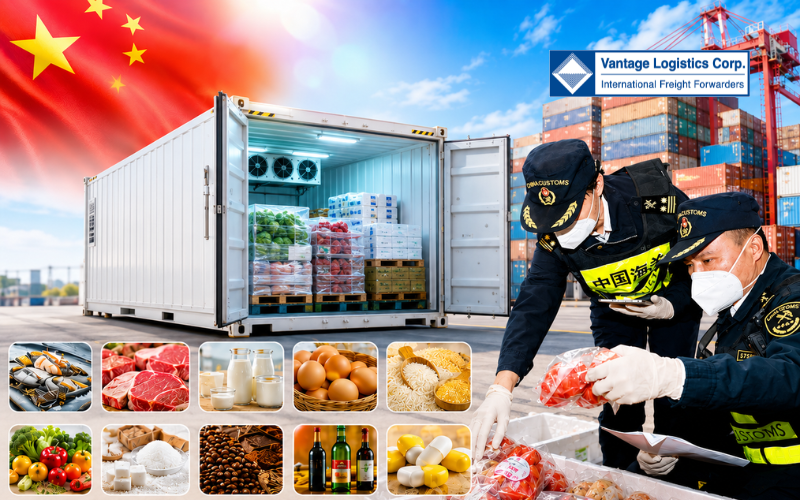
China Implements Decree 280 from June 1: Controls Tightened on 18 Imported Food Categories

Effective June 1, 2026, China officially implements Decree 280 of the General Administration of Customs of China (GACC), replacing Decree 248 on the registration management of foreign food manufacturers. This move reflects a growing trend toward stricter quality management, traceability, and food safety for imports, directly impacting several of Viet Nam’s major export commodities. Decree 280 Puts the Focus on Risk Management According to GACC guidelines, the management of overseas food manufacturing enterprises will shift toward a comprehensive risk assessment rather than focusing solely on static registration procedures. Factors such as product risk levels, compliance history, rejection rates of shipments, and safety incidents will be strictly reviewed as part of the regulatory process. Key Export Sectors Within the Regulatory Scope Notably, 17 out of the 18 imported food categories under GACC oversight must be registered through recommendation by the competent authority of the exporting country. This scope includes various sectors with significant export turnover for Viet Nam, such as seafood, meat products, edible bird’s nests, processed foods, and value-added agricultural products. Impacts on Viet Nam’s Exporters While Decree 280 is not entirely a new trade barrier, the regulation demonstrates that China is raising requirements across the entire import supply chain. This means exporters must ensure seamless alignment between production, quality control, documentation, and logistics operations. For enterprises exporting food, seafood, or processed agricultural products, this is an essential time to review: Registration profiles and the validity of GACC codes Product traceability systems from farms or processing facilities Quality control processes and declaration data on export documentation Shipping plans for cargo requiring specialized preservation conditions (cold chain, live, or fresh goods) Early preparation helps mitigate potential disruptions that could impact delivery schedules or customs clearance. Agile Supply Chains Mitigate Customs Clearance Risks With quarantine and customs regulations updated frequently, collaboration between manufacturers and logistics providers becomes a decisive factor in maintaining steady cargo flows. An appropriate transportation plan, accurate documentation from the outset, and end-to-end visibility throughout the journey will enable businesses to proactively handle unexpected scenarios at the border, safeguarding product quality and delivery timelines. Contact Vantage Logistics to explore comprehensive transportation and logistics solutions tailored to optimize your export operations between Viet Nam and China.   Contact Vantage Logistics for tailored transport solutions and competitive quotations. Please provide details on cargo type, market, origin, destination, and estimated timeline. Vantage Logistics Corp – South East Asia (S.E.A) Logistics Provider One-Stop Shop For Integrated Logistics Services Head Office Viet Nam – Suite 6.01, Floor 6th, Block A, RiverGate Residence, 151-155 Ben Van Don, Khanh Hoi Ward, HCMC, Viet Nam Branch Thailand, Laos, Cambodia, Malaysia, Indonesia, Singapore Contact Us Email in**@*****om.vn Hotline +84-909-026-261 Website https://vantage-logistics.com Send your shipment enquiry today and receive a tailored transport plan from the Vantage Logistics team....

03/06/2026

View More

Market updates

Optimizing Intra-Asia Supply Chains: Strategic Advantages for Vietnam’s Exporters

The expansion of direct maritime routes between North China and Vietnam, paired with the deployment of next-generation, high-capacity LNG vessels on global lanes, is reshaping logistics for businesses in Southeast Asia. These developments offer tangible improvements in operational efficiency and cost management for regional manufacturers. Enhancing Intra-Asia Connectivity The introduction of direct services between industrial hubs in North China (Qingdao, Tianjin, Dalian) and Vietnam’s gateway ports (Hai Phong, Ho Chi Minh City) significantly alters regional logistics parameters. Supply Chain Stability: Direct routing minimizes transshipment risks and increases sailing frequency. Operational Control: Reduced transit times allow for tighter control over inbound raw materials, essential for electronics, machinery, and industrial components. Inventory Efficiency: Reliable lead times enable manufacturers to optimize inventory levels and mitigate production disruptions. MSC’s launch of the OCHNA service linking Northern China with Viet Nam (Source: MSC) Sustainability and Cost Optimization on Long-Haul Routes The integration of ultra-large, LNG-powered container vessels on Asia–Europe lanes provides dual-value logistics: Green Compliance: Utilizing low-emission maritime transport helps exporters meet stringent ESG mandates and carbon-intensity requirements in European markets. Economies of Scale: Mega-vessels drive down unit transport costs, providing a competitive pricing structure for high-volume trade. CMA CGM’s deployment of a 24,212‑TEU LNG-powered vessel on the Asia–Europe lane (Image: MSC) Strategic Impact for Shippers These new shipping routes do more than just upgrade infrastructure; they deliver clear strategic benefits to shippers: Stability: Decreased risk of disruption via direct, high-frequency connections. Cost: Improved freight rate competitiveness through vessel economies of scale. Responsiveness: Lowered lead times, increasing agility in global consumption markets. Compliance: Seamless adherence to international environmental and ESG standards. Vantage Logistics: Integrated Solutions for Enhanced Performance Vantage Logistics translates these infrastructural advancements into actionable operational advantages through a comprehensive service ecosystem: Operational Flexibility: Leveraging direct contracts with major global carriers, we provide diverse scheduling options, allowing clients to balance transit time and cost for specific shipments Sustainability Support: We align your export requirements with eco-friendly, modern fleets on long-haul routes to ensure full compliance with international buyer demands End-to-End Handling: Our integrated service range – including expedited customs clearance, ASEAN cross-border trucking, and specialized Project Cargo (OOG) management – ensures the stability of sophisticated, high-value supply chains Vantage Logistics continuously monitors maritime trends to provide our partners with scalable, efficient, and compliant logistics solutions tailored to the evolving demands of the global market.   Contact Vantage Logistics for tailored transport solutions and competitive quotations. Please provide details on cargo type, market, origin, destination, and estimated timeline. Vantage Logistics Corp – South East Asia (S.E.A) Logistics Provider One-Stop Shop For Integrated Logistics Services Head Office Viet Nam – Suite 6.01, Floor 6th, Block A, RiverGate Residence, 151-155 Ben Van Don, Khanh Hoi Ward, HCMC, Viet Nam Branch Thailand, Laos, Cambodia, Malaysia, Indonesia, Singapore Contact Us Email in**@*****om.vn Phone +84-28 382 67312 Hotline +84-909-026-261 Website https://vantage-logistics.com Send your shipment enquiry today and receive a tailored transport plan from the Vantage Logistics team....

01/06/2026

View More
vlc-news-advanced-information-security-awareness-training

Vantage News

Vantage Logistics Conducts 2026 Information Security Awareness Training

May 29, 2026 – Vantage Logistics successfully conducted its 2026 Information Security Awareness Training Program for employees across the organization, reinforcing the company’s commitment to cybersecurity, operational resilience, and customer data protection. The training was delivered through a hybrid format, combining in-person participation with online attendance via Zoom. The program was led by Vantage Logistics’ Information Technology (IT) Department and focused on strengthening employees’ ability to identify, prevent, and respond to evolving cyber threats. Information Security: One of Vantage Logistics’ Core Service Commitments At Vantage Logistics, business operations are guided by five fundamental service commitments: Safety Regulatory Compliance Information Security and Confidentiality On-Time Execution Service and Cost Optimization As supply chains become increasingly digital and interconnected, information security has evolved beyond a technical requirement. It is a critical business priority that supports operational continuity, protects sensitive information, and strengthens trust between logistics providers, customers, and business partners. For companies that manage transportation data, customs documentation, commercial contracts, and international financial transactions, maintaining strong cybersecurity controls is essential to ensuring the integrity of global supply chain operations. Preparing for Growing Cybersecurity Risks Across the Logistics Industry Cybercrime continues to escalate worldwide. Industry forecasts estimate that global cybercrime damages will reach USD 10.5 trillion in 2025, with annual losses expected to rise to USD 12.2 trillion by 2031. In Viet Nam alone, approximately 156,000 systems were impacted by ransomware attacks in 2025, resulting in economic losses estimated in the tens of trillions of Vietnamese dong. These figures highlight the growing scale and sophistication of cyber threats facing businesses across all sectors. The logistics industry remains one of the most targeted sectors due to its reliance on interconnected systems, extensive email communications, financial transactions, and time-sensitive operational data. Cybercriminals increasingly employ tactics such as phishing, business email compromise, account takeover, payment fraud, and ransomware attacks. In 2025, 283 confirmed ransomware incidents targeted transportation and logistics companies worldwide, exceeding the combined total reported in 2023 and 2024. Several high-profile incidents demonstrate the potential impact of cybersecurity breaches on global supply chains. The 2017 NotPetya attack caused losses estimated between USD 200 million and USD 300 million for shipping giant Maersk and disrupted port operations worldwide, contributing to billions of dollars in broader economic losses. More recently, a ransomware attack on Japan’s Nagoya Port in 2023 forced operations to halt for two days, affecting approximately 10% of the country’s trade volume. Beyond operational disruption, data breaches carry significant financial consequences. The average data breach in the transportation sector is estimated to cost USD 4.18 million, while studies indicate that approximately 60% of small and medium-sized businesses may cease operations within six months of a major cyberattack or data breach. Strengthening Employee Awareness and Response Capabilities To address these challenges, Vantage Logistics designed the 2026 training program around practical, real-world scenarios relevant to the logistics industry. Key training areas included: Threat Recognition: Understanding malware, ransomware, phishing campaigns, and other cyber threats commonly targeting logistics and transportation businesses. Early Detection: Identifying suspicious emails, account compromise attempts, data theft activities, and other warning signs before incidents escalate. Rapid Response: Following standardized verification and reporting procedures to reduce security vulnerabilities and support timely incident response. The program also covered emerging fraud trends involving artificial intelligence, including deepfake technology, voice impersonation, and increasingly sophisticated social engineering techniques. Building a Company-Wide Security Culture  The training program is part of Vantage Logistics’ ongoing effort to build a culture of information security, where every employee plays a vital role in identifying risks and safeguarding data in their daily work. As cyber threats continue to evolve, we will keep updating and delivering advanced training programs to strengthen employee skills in information protection and risk management – ensuring resilience in serving customers and collaborating with partners. Information security is no longer the sole responsibility of the IT department; it is a core organizational value. By continuously investing in people, processes, and technology, Vantage Logistics is committed to maintaining a secure working environment, protecting customer and partner data, and enhancing service quality across our logistics operations. Check out some photos of our team focusing hard during this morning’s session!  ...

29/05/2026

View More
vlc-news-warehouse-distribution-2 (4)

Vantage News

VANTAGE LOGISTICS FLEXIBLE WAREHOUSING SOLUTIONS: REDUCING COST PRESSURE AND KEEPING EXPORT CARGO MOVING

In export operations, warehousing is no longer just a storage function. It has become a strategic component that helps businesses consolidate cargo efficiently, respond to vessel schedule fluctuations, and maintain tighter control over logistics costs. As a logistics solutions provider, Vantage Logistics operates through a flexible partner network rather than relying solely on fixed infrastructure. By connecting with warehousing partners across strategic logistics locations, the company provides adaptable storage solutions and integrated support services for exporters in Vietnam and across Southeast Asia serving international markets. Connected Warehouse Network Across Key Logistics Hubs Vantage Logistics coordinates warehousing capacity at major trade gateways to shorten cargo transfer time and improve shipment coordination. Port warehouses and container depots (Depot): Located near seaports, inland ports, and logistics centers, these facilities support cargo consolidation (CFS), short-term export storage, flexible container handling, and reduced port storage exposure during peak periods. Industrial zone warehouses: Partner facilities positioned within key industrial parks allow manufacturers and exporters to store cargo closer to production sites, making it easier to align factory output with actual vessel schedules and transport plans. Flexible Operations Designed Around Cargo Demand Beyond providing storage space, Vantage Logistics supports end-to-end warehouse coordination to improve cargo flow efficiency. Multiple storage models: Solutions include general warehouses, bonded warehouses, CFS facilities, and connections with inland container depots (ICDs), allowing businesses to scale storage capacity based on seasonal demand or short-term operational requirements. International-standard value-added services (VAS): Warehouse operations can include sorting, packing and repacking, labelling, cargo marking, inventory checks, and quality control (QC). These processes help improve shipment readiness and minimize operational disruption before export. Strategic Advantages for Export Businesses The flexible warehousing model offered by Vantage Logistics helps exporters improve operational control and cost efficiency in several areas: More efficient cost structure: Businesses can shift from fixed infrastructure investment to variable operating costs aligned with actual cargo volume and storage duration. Greater flexibility during market fluctuations: Storage space can be expanded or reduced depending on seasonal demand and changing vessel schedules, without long-term leasing commitments. Faster supply chain coordination: Improved synchronization between factories, warehouses, and export gateways helps reduce operational pressure during peak shipping periods. Vantage Logistics continues to support exporters in Viet Nam and Southeast Asia with warehousing strategies designed to improve operational flexibility, strengthen cost control, and support long-term competitiveness in global trade....

27/05/2026

View More
1 … 13 14 15 16 17 … 43