 LOGIN


 Sea Freight
 Air Freight
 Intermodal
 Customs Brokerage
 Project Logistics
 Warehouse Services
 Trucking
 Insurance
 Logistics Infrastructures
 Consulting & Assistance
 NVOCC
 Barge & Coastal Feeder
 GSA / PCSA Airlines
 Perishable / Refrigerated Logistics
 Dangerous Good Logistics
 Oil & Gas Logistics
 Offshore Services
 Rice Logistics
 Global Sales Logistics
 Parcel / Courier Logistics
 Cross-Docking & End-To-End Warehousing
 On Board Courier
 Buying Agent

The collision involving the bulk carrier Aquacharm at Dung Quat Port, Viet Nam, on October 18 highlights how risks can arise during the handling of large vessels. Similar incidents in Taiwan, Australia, and the UAE demonstrate that the consequences can extend beyond vessel damage to port infrastructure, cargo-handling equipment, and personnel safety. The key challenge is how to manage these risks while maintaining safe port operations when an incident occurs.
The Dung Quat Collision Raises Questions About Maritime Safety
On October 18, 2026, the bulk carrier Aquacharm collided with a section of wharf under construction at the extension connecting Berths 10 and 11 at the dedicated port of the Hoa Phat Dung Quat steel complex in Quang Ngai Province, Viet Nam.
The vessel is 292 metres long, has a deadweight tonnage of 182,309 tonnes, and was carrying more than 170,000 tonnes of iron ore from Australia to Viet Nam. The collision tore an approximately five-metre section of the bow and damaged the wharf. All 22 crew members were safe, and no oil spill had been reported.
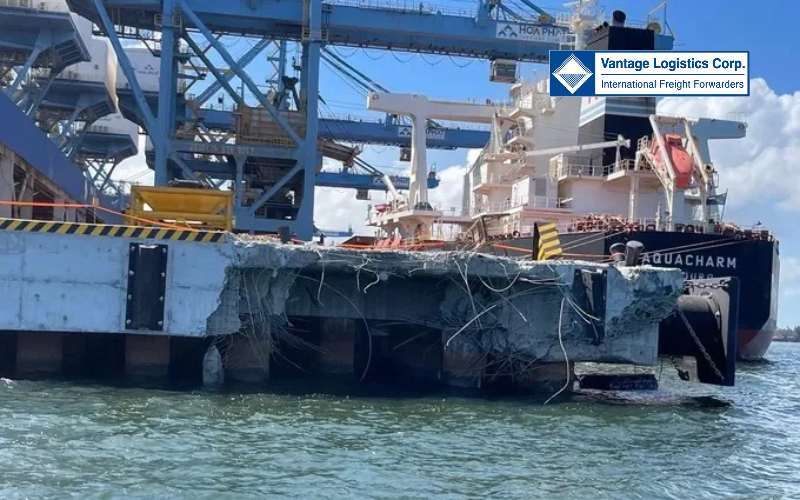
According to information released on October 20, Berth 10 was affected, while the port’s other 11 berths remained operational, with production continuing without disruption. The extent of the wharf damage was still awaiting formal assessment, and the cause of the incident remained under investigation.
The Quang Ngai Maritime Administration also required a tugboat to remain on standby near Aquacharm, ready to provide assistance in an emergency. The measure was intended to maintain the vessel’s safety while it was moving or berthed and reduce the risk of further incidents.
The collision illustrates how a single port incident can involve several interconnected issues: vessel manoeuvring, infrastructure conditions, and post-incident response. Other maritime accidents investigated by authorities at international ports offer further insight into these risks.
International Incidents Highlight Risks During Vessel Manoeuvring
Pacific Century: A Collision Can Affect Nearby Vessels
On June 9, 2025, the bulk carrier Pacific Century struck Berths 89 and 90 while departing Kaohsiung Port, Taiwan. The incident damaged the vessel’s rudder and the wharf infrastructure. A workboat moored alongside the wharf also capsized and sank after being affected by strong water currents generated by the bulk carrier’s propellers. No injuries or environmental pollution were reported.
In its final report, published in June 2026, Taiwan’s Transportation Safety Board examined issues related to the manoeuvre and coordination among those involved. The case demonstrates that risks are not limited to the direction in which a large vessel moves. Propeller wash, clearance from nearby vessels, and the timing of manoeuvres can also have significant consequences.
For port operations, managing the area around a vessel under manoeuvre is just as important as ensuring that the vessel can safely enter or leave its berth.
Maersk Shekou: Unclear Communication Can Increase Risk
On August 30, 2024, the container ship Maersk Shekou collided with the sailing training vessel STS Leeuwin II and the edge of the wharf while entering Fremantle Port, Australia. At the time, wind gusts in the inner harbour reached approximately 50 knots.
According to the Australian Transport Safety Bureau’s final report, published in November 2025, the pilot did not issue a course-alteration instruction when required. The helmsman continued to maintain the previously instructed heading, and the vessel did not turn as planned. Monitoring of the manoeuvre and communication among the parties involved were also inadequate. Maersk Shekou sustained minor damage, while STS Leeuwin II suffered substantial damage.
The incident demonstrates that a manoeuvring plan is only effective when everyone understands the actions required, monitors the vessel’s actual movements, and raises concerns promptly when something appears wrong. Weather conditions must also be assessed alongside the vessel’s controllability and the availability of support measures.
CMA CGM Centaurus: Consequences Can Extend to Port Infrastructure and Workers
On May 4, 2017, the container ship CMA CGM Centaurus made heavy contact with a quay and two shore cranes while arriving at Jebel Ali Port in the United Arab Emirates. One crane collapsed, injuring 10 shore workers, including one who was seriously injured.
The UK Marine Accident Investigation Branch’s investigation found that the pilot and bridge team had not sufficiently agreed on the manoeuvring plan. The pilot was unaware of the vessel’s speed, while the bridge team had not established a shared understanding of the speed required to complete the turn safely. The incident damaged not only the vessel and quay but also cargo-handling equipment, directly affecting the safety of personnel working ashore.
The case highlights the importance of agreeing on a manoeuvring plan before execution, maintaining effective coordination between the pilot and master, and controlling vessel speed during critical manoeuvres.
Three Areas of Focus for Reducing Port Risks
The incidents discussed above did not share a single cause. However, they highlight three areas that require attention when vessels enter, leave, or manoeuvre within a port.
- Clear coordination during manoeuvres
Pilots, masters, helmsmen, and tug crews need a shared understanding of the manoeuvring plan, intended course, speed, and response procedures if conditions change. Monitoring actual vessel movements and communicating promptly can help the parties identify developing problems earlier.
- Protection of port infrastructure and surrounding areas
Vessel handling must take into account infrastructure conditions, construction zones, nearby vessels and equipment, and operating conditions at the time of arrival or departure. If safety concerns arise, the manoeuvring plan should be reassessed rather than followed simply because it was agreed upon earlier.
- Emergency preparedness
Ports and relevant stakeholders need appropriate procedures for incidents involving vessel damage, unsafe wharf conditions, fire, or oil spills. Emergency response resources, communication channels, and coordination responsibilities should be clearly established to help contain the consequences when an incident occurs.
These measures cannot eliminate accidents entirely, but they can help reduce risks and support a more coordinated response when incidents happen.
Timely Information Helps Limit Supply Chain Disruptions
When an incident affects a port berth, the impact on cargo and transport schedules depends on several factors, including the location of the incident, remaining port capacity, vessel schedules, and alternative cargo-handling arrangements. Businesses should not assume that every port incident will cause widespread disruption. Instead, they should obtain updates from port operators, shipping lines, and relevant partners to identify which shipments may be affected, whether delivery schedules need to change, and whether practical alternative transport arrangements are available.
The maritime incidents at Dung Quat, Kaohsiung, Fremantle, and Jebel Ali demonstrate the close relationship between safe vessel manoeuvring, infrastructure protection, and continuity of port operations. Proactive risk management, effective emergency preparedness, and coordinated communication after an incident are all important to limiting the impact on maritime transport and wider supply chains.
Follow Vantage Logistics for the latest news, trends, and industry developments in logistics, transportation, and supply chains across Southeast Asia and international markets.
Contact Vantage Logistics for tailored transport solutions and competitive quotations.
Please provide details on cargo type, market, origin, destination, and estimated timeline.
| Vantage Logistics Corp – South East Asia (S.E.A) Logistics Provider
One-Stop Shop For Integrated Logistics Services |
|
| Head Office | Viet Nam – Suite 6.01, Floor 6th, Block A, RiverGate Residence,
151-155 Ben Van Don, Khanh Hoi Ward, HCMC, Viet Nam |
| Branch | Thailand, Laos, Cambodia, Malaysia, Indonesia, Singapore |
| Contact Us | |
| in**@*****om.vn | |
| Hotline | +84-909-026-261 |
| Website | https://vantage-logistics.com/ |
Send your shipment enquiry today and receive a tailored transport plan from the Vantage Logistics team.

 Vantage News


