RESOURCE

vlc-news-philippines-cancels-rice-import-permit-15102026

Market updates

Philippines Cancels Permit for Controversial 12,480-Metric-Ton Rice Shipment from Viet Nam

The Philippine Department of Agriculture (DA) said it had ordered the cancellation of the Sanitary and Phytosanitary Import Clearance (SPSIC) for a 12,480-metric-ton rice shipment from Viet Nam before the vessel arrived. The case involves reported discrepancies in rice specifications and an expired import contract, highlighting the risks that can arise when shipping schedules do not align with import requirements in the destination market. 1. Developments at the Port of Arrival According to the Philippine Department of Agriculture (DA) and the Philippine News Agency (PNA), the vessel MV Tay Son 2, carrying 12,480 metric tons of rice from Viet Nam, arrived at the Port of Davao on September 14, 2026. According to these sources, the vessel’s captain refused to submit the shipment for inspection by the Philippine Bureau of Plant Industry (BPI). On September 17, 2026, the vessel departed Davao before the matter had been resolved. Philippine authorities subsequently prevented the cargo from being unloaded at another location and brought the vessel to the Port of General Santos before ordering it to return to Davao for further handling. 2. Rice Specifications and Import Requirements The case involves two issues: reported discrepancies in rice specifications and the status of the import contract and permit. 2.1. Reported Discrepancy in Rice Specifications The importer, Planters Product, Inc. (PPI), reported a discrepancy between the purchase order and the specifications communicated for the shipment: Specifications under the purchase order: 25% broken rice Reported specifications for the shipment: 5% broken rice In agricultural trade, the percentage of broken grains is an important commercial specification. However, the discrepancy remains based on information reported by the importer and has not been confirmed by an official inspection, as the physical inspection process was not completed. 2.2. Expired Contract and Canceled Import Permit In addition to the rice specifications, the delivery timeline and the status of the import documentation were also highlighted by the DA: Estimated time of arrival (ETA): July 2026 Actual arrival: Mid-September 2026 According to the DA, the import contract had expired and the SPSIC had been canceled before the vessel arrived. The vessel’s arrival also coincided with the period when the Philippines was preparing for the wet-season rice harvest. According to published information, import policy during this period was also linked to efforts to limit downward pressure on domestic palay prices. Operational Note: Even when goods meet quality requirements, a shipment may still face customs clearance difficulties if it fails to meet import requirements or if the relevant permit is no longer valid. 3. Proposed Measures for Handling the Shipment According to published information, the Bureau of Customs of the Philippines (BOC) was still considering the final course of action for the shipment. The proposed measures included: Proposed Measure Proposing Authority / Status Return to the Country of Origin The BPI was reported to have recommended returning the shipment to Viet Nam. Seizure and Penalties The DA proposed considering seizure of the shipment and the application of penalties under relevant regulations, subject to the competent authority’s findings and decision. Final Decision The BOC was reviewing the official course of action for the shipment. 4. Conclusion The controversial rice shipment in the Philippines highlights how international trade depends not only on product quality and contractual terms but also on shipping schedules, the validity of import documentation, and regulatory requirements in the destination market. When these elements are no longer aligned, shipments already in transit may face unexpected complications during arrival and customs clearance. Vantage Logistics will continue to provide updates on notable developments in logistics, import-export activities, and international supply chains, offering businesses additional insight into factors that may affect global trade. Contact Vantage Logistics for tailored transport solutions and competitive quotations. Please provide details on cargo type, market, origin, destination, and estimated timeline.   Vantage Logistics Corp – South East Asia (S.E.A) Logistics Provider One-Stop Shop For Integrated Logistics Services Head Office Viet Nam – Suite 6.01, Floor 6th, Block A, RiverGate Residence, 151-155 Ben Van Don, Khanh Hoi Ward, HCMC, Viet Nam Branch Thailand, Laos, Cambodia, Malaysia, Indonesia, Singapore Contact Us Email in**@*****om.vn Hotline +84-909-026-261 Website https://vantage-logistics.com Send your shipment enquiry today and receive a tailored transport plan from the Vantage Logistics team.

15/10/2026

View More
vlc-news-asean-east-asia-trade-15102026

Market updates

ASEAN–East Asia Trade Reaches USD 1.4 Trillion, Up 13.7% in 2025

According to preliminary data from the ASEAN Secretariat, two-way trade between ASEAN and its three East Asian partners (China, Japan, and South Korea) reached USD 1.4 trillion in 2025, representing a 13.7% year-on-year increase. Notably, China–ASEAN trade continued its upward trajectory in the first seven months of 2026, underscoring a sustained expansion in cross-regional trade volumes worth monitoring. 1. Regional Trade Volume and Foreign Direct Investment (ASEAN+3) Trade and investment flows between ASEAN and its three East Asian partners maintain a substantial footprint. In 2025, Foreign Direct Investment (FDI) inflows from China, Japan, and South Korea into ASEAN totaled USD 44.8 billion. Key ASEAN–East Asia Trade & Investment Indicators Indicator Value Growth / Share ASEAN – (China, Japan, South Korea) Trade in 2025 USD 1.4 Trillion Up 13.7% vs 2024 FDI from 3 East Asian Partners into ASEAN in 2025 USD 44.8 Billion Accounted for 18.2% of total ASEAN FDI China – ASEAN Trade (First 7 Months of 2026) USD 744.41 Billion Up 24.7% year-on-year The scale of merchandise trade and investment capital highlights the vital economic linkage between East Asia and Southeast Asia. However, assessing actual freight demand requires a granular evaluation of specific commodity structures, export-import markets, and active transport corridors. 2. Direct Impacts on Transport Networks and Logistics Infrastructure Expanding trade volumes underscore the critical role of regional transport connections. Depending on industry-specific cargo characteristics and delivery requirements, flexible logistics solutions are being actively deployed: Intra-Asia Ocean Freight Connections: For multi-leg shipments, vessel schedule reliability, transit times, and feeder network connectivity are pivotal factors for supply chain managers. Major gateway hubs such as Shanghai, Ningbo, Busan, and Yokohama maintain dense feeder linkages with Southeast Asian ports within ocean carrier networks Integrated Logistics and Multimodal Transport: Depending on lead-time sensitivity, combining ocean freight, Cross-Border Trucking, and inland warehousing offers expanded routing options. Real-world operational efficiency hinges heavily on border crossing clearance times, transit schedules, and the coordination capability of the logistics operator Rules of Origin (C/O) and Customs Compliance: When leveraging Free Trade Agreements such as RCEP, AKFTA, or AJCEP, enterprises must accurately determine rules of origin and prepare compliant documentation to qualify for preferential tariffs. Duty exemption eligibility depends on the specific conditions of each product line and destination market 3. Monitoring Southeast Asian Trade Dynamics and Logistics Connectivity Expanding trade and investment flows reflect an increasingly integrated economic relationship between East Asia and Southeast Asia. This growth in cross-border trade creates momentum for expanding logistics connectivity, helping strengthen supply chain coverage across the region.   Contact Vantage Logistics for tailored transport solutions and competitive quotations. Please provide details on cargo type, market, origin, destination, and estimated timeline. Vantage Logistics Corp – South East Asia (S.E.A) Logistics Provider One-Stop Shop For Integrated Logistics Services Head Office Viet Nam – Suite 6.01, Floor 6th, Block A, RiverGate Residence, 151-155 Ben Van Don, Khanh Hoi Ward, HCMC, Viet Nam Branch Thailand, Laos, Cambodia, Malaysia, Indonesia, Singapore Contact Us Email in**@*****om.vn Hotline +84-909-026-261 Website https://vantage-logistics.com Send your shipment enquiry today and receive a tailored transport plan from the Vantage Logistics team.

15/10/2026

View More

Market updates

SINGAPORE STRENGTHENS PRODUCT SAFETY CONTROLS: WHAT VIETNAMESE EXPORTERS NEED TO KNOW

Singapore is strengthening its product safety controls through two key regulations: the Consumer Protection (Safety Requirements) Regulations (CPSR) and the Consumer Goods (Safety Requirements) Regulations (CGSR). For exporters, these requirements go beyond product compliance. They can also affect delivery schedules, logistics costs, and supply chain reliability. 1. Singapore Strengthens Product Safety Requirements According to information published by Vietnam’s Ministry of Industry and Trade, Singapore applies two main regulatory frameworks for product safety. – CPSR: Covers 33 categories of controlled goods, including electrical and electronic products, household appliances, and gas appliances. Products within scope must meet applicable safety requirements, complete registration, and carry the SAFETY Mark before being supplied or sold in Singapore. – CGSR: Covers general consumer goods such as toys, clothing, furniture, and sports equipment, which must comply with the relevant safety standards. Non-compliant products may be subject to sales restrictions or recalls. Businesses that violate applicable requirements may also face penalties. For exporters, checking compliance requirements before shipment is essential. Addressing documentation or registration issues early can help avoid costly adjustments after cargo has already left the port of origin. 2. Potential Impact on Southeast Asia’s Trade and Logistics Singapore plays an important role in Southeast Asia’s trade and logistics network. Tighter product safety controls may require exporters, importers, and distributors to review their procedures for placing goods on the Singapore market. Several potential risks deserve attention: – Delivery delays: Incomplete documentation or missing certificates may affect cargo acceptance and delivery schedules. – Additional logistics costs: Delays in resolving compliance issues may lead to storage, port handling, or additional transportation costs. – Disrupted distribution plans: Late deliveries can affect inventory planning, distribution schedules, and commitments to business partners. These requirements do not automatically apply across all ASEAN markets. However, they highlight the importance of understanding the specific regulations of each destination country when planning regional trade and distribution. 3. What Should Vietnamese Exporters Prepare? For Vietnamese businesses exporting to Singapore, compliance checks should take place before shipment arrangements are finalized. Exporters should determine whether their products fall under CPSR or CGSR, verify the applicable safety standards and registration requirements, and clarify responsibilities with their Singaporean importers. Documentation preparation should also be factored into the shipping schedule. If an issue is discovered only after cargo arrives at the destination port, businesses may need to manage several challenges simultaneously, including delivery delays, additional costs, and changes to distribution plans. A reliable shipping plan therefore involves more than selecting the right route or sailing schedule. It also requires anticipating potential obstacles before the cargo reaches its destination. 4. Managing Risks Through Early Planning Not every risk in international shipping can be eliminated, but many disruptions can be reduced through early preparation. Reviewing cargo information, documentation, shipping schedules, and destination requirements helps all parties make better-informed decisions. For shipments to Singapore, close coordination among exporters, importers, agents, and logistics providers helps maintain visibility over shipment readiness, address changes, and adjust plans when necessary. At Vantage Logistics, international transportation planning takes into account the practical requirements of each shipment and the coordination needed among relevant parties. This approach helps businesses manage potential disruptions and maintain better control over delivery schedules. As market requirements evolve, careful preparation does more than protect an individual shipment. It also helps businesses maintain reliable supply chains and build lasting partnerships across international markets.

15/10/2026

View More
vlc-news-banana-exports-solution

Vantage News

Banana Exports 2026: Cold Chain Under Pressure

Banana exports from Viet Nam are experiencing strong momentum as numerous enterprises expand cultivation areas, elevate production standards, and accelerate shipments to Asian markets. Dong Nai, Viet Nam’s leading banana-producing province, cultivates nearly 21,000 hectares yielding over 900,000 metric tons annually, with 80% bound for export. Key markets include China, Japan, South Korea, and Malaysia. In April 2026, Dong Nai began the new export season with 11 containers – 220 metric tons of fresh bananas – bound for international markets. However, behind these impressive figures lies mounting pressure on cold chain logistics. Viet Nam’s cold storage infrastructure is uneven, with facilities concentrated in urban areas but lacking in agricultural regions. This imbalance leaves the cold chain vulnerable to post-harvest disruptions. For bananas – highly sensitive to temperature – maintaining a stable 12–14°C (54–57°F) throughout export transit is critical. Cold Chain Logistics Under Pressure as Exports Accelerate For fresh bananas, product quality depends directly on storage temperature, transit time, customs clearance efficiency, and vessel schedule reliability. As export volumes surge, logistics operators face increasingly stringent operational requirements: Shortages of refrigerated (reefer) container equipment during peak harvest seasons Inland transportation coordination pressures from cultivation zones to ocean ports Stricter quarantine and traceability procedures enforced by importing countries Risks from volatile shipping schedules or port congestion at transshipment hubs High demands for real-time tracking and end-to-end visibility for every shipment A single delayed vessel or a lapse in temperature control does more than just cause direct financial loss; it severely damages a company’s commercial reputation. In the Chinese market, border gate congestion and supply-demand fluctuations mean a delay of just a few days can wipe out a shipment’s entire commercial value. Meanwhile, in highly demanding markets like Japan or South Korea, even a minor temperature deviation can lead to immediate rejection or mandatory re-handling at the destination port – resulting in massive unexpected costs and jeopardizing long-term partnerships. Cold Chain: The New Competitive Edge for Viet Nam’s Agriculture In a highly competitive international market, a sustainable advantage no longer relies solely on price or volume. The ability to maintain consistent product quality, guarantee delivery schedules, and mitigate transit risks dictates whether an exporter can successfully penetrate global distribution chains. Vantage Logistics: Partnering in the Agricultural Export Supply Chain Recognizing the time-sensitive and temperature-sensitive nature of fresh fruit, Vantage Logistics provides specialized logistics solutions for bananas and other agricultural products exported from Viet Nam to Asian markets, with a core focus on trade lanes to China, Japan, and South Korea. Our operational capabilities include: Consistent supply and coordination of refrigerated (reefer) containers, even during peak seasons Optimized multimodal transportation to minimize transit time from plantations to export ports Expedited customs clearance managed by a team specialized in phytosanitary procedures and agricultural export documentation Strong partnerships with major ocean carriers to secure stable vessel schedules and equipment space allocation. Modern warehousing systems supporting cargo consolidation and sorting under export-grade standards Leveraging extensive field experience and a deep understanding of cold chain risks, Vantage Logistics commits to helping businesses optimize operational costs, preserve agricultural quality, and enhance supply chain resilience. Discover tailored logistics solutions for agricultural exports with Vantage Logistics.   Contact Vantage Logistics for tailored transport solutions and competitive quotations. Please provide details on cargo type, market, origin, destination, and estimated timeline. Vantage Logistics Corp – South East Asia (S.E.A) Logistics Provider One-Stop Shop For Integrated Logistics Services Head Office Viet Nam – Suite 6.01, Floor 6th, Block A, RiverGate Residence, 151-155 Ben Van Don, Khanh Hoi Ward, HCMC, Viet Nam Branch Thailand, Laos, Cambodia, Malaysia, Indonesia, Singapore Contact Us Email in**@*****om.vn Phone +84-28 382 67312 Hotline +84-909-026-261 Website https://vantage-logistics.com Send your shipment enquiry today and receive a tailored transport plan from the Vantage Logistics team....

27/05/2026

View More
vlc-news-updated-customs-office-codes

Market updates

Effective 1 June 2026: Import-Export Businesses Required to Update Customs Office Codes to Ensure Smooth Clearance

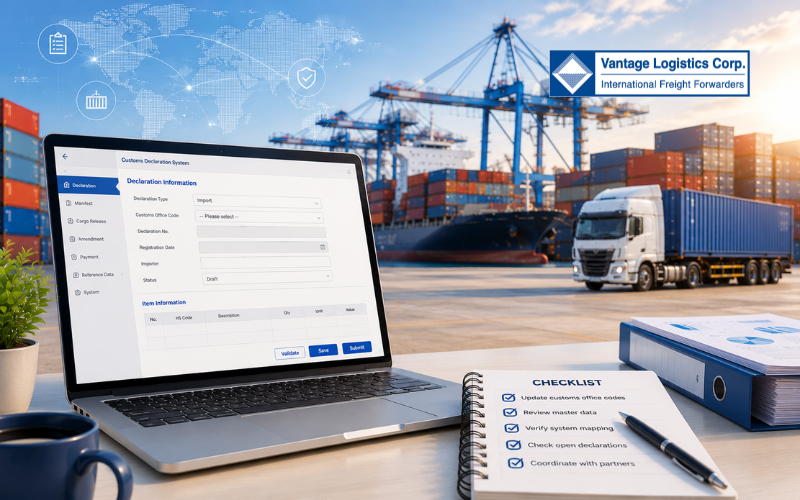
From 1 June 2026, the customs system in Viet Nam will officially apply updated customs office codes under Official Letter 489/CNTT-QLVH issued by the Customs IT and Statistics Department. Although the change is technical in nature, incorrect code usage may lead to declaration errors, customs clearance delays, extended document processing time, and disruption to delivery schedules. During the transition period, when both old and new codes remain active on the VNACCS/VCIS system, import-export businesses should review declaration data and internal procedures to minimise operational risk. Customs authorities to implement updated office codes nationwide from 1 June 2026 On 19 May 2026, the Customs IT and Statistics Department issued Official Letter 489/CNTT-QLVH regarding the update of customs office codes as part of a nationwide system standardisation programme. Key changes include: Adjustment of codes for Customs Teams merged into or reassigned to regional Customs Sub-Departments Consolidation of multiple office codes into a single standardised code Application of new codes for declarations registered from 1 June 2026 onward Key Changes to Note: Yen Bai Customs Sub-Department changing from code 01BT to 13BT, Linh Trung Export Processing Zone Customs previously using codes 02F1 and 02F2 being consolidated into a single code, 02F1 A technical update with direct operational impact on import-export activities Customs office codes are used throughout the entire customs declaration and processing workflow on the VNACCS/VCIS system. Errors at the declaration stage can affect subsequent customs procedures and cargo movement. These codes are applied across: Customs declaration registration Channel assignment Amended declarations Outstanding file processing Tax payment Liquidation procedures Customs clearance tracking Incorrect office codes may result in: Declarations being routed to the wrong processing unit Additional amendment procedures Longer customs clearance time Delays in cargo release and delivery Additional storage, detention, or transport rescheduling costs For businesses handling high declaration volumes, operating multiple factories, or clearing cargo through different ports and border gates, the likelihood of operational errors increases during the transition phase. The main risk lies in the parallel use of old and new codes Under Official Letter 489, legacy customs office codes will remain active alongside the new codes to support outstanding declarations, extended dossiers, and incomplete liquidation cases. However, customs authorities also noted that: The VNACCS/VCIS system does not automatically distinguish between new declarations and amended declarations submitted under legacy codes. As a result, businesses may unintentionally submit new declarations using outdated office codes if their systems and templates are not updated in time. In practice, this is a common operational risk during system transition periods, particularly for businesses relying on: Pre-saved declaration templates Legacy code databases Automated data integration between customs systems and erp platforms Centralised declaration processes across multiple branches or operating entities Without proper data synchronisation before the effective date, businesses may face amendment procedures while cargo is pending urgent clearance or approaching vessel cut-off time. Synchronize Customs Declaration Data: Must-Do Steps Before June 1 To reduce the risk of customs clearance disruption, businesses should review all systems and procedures related to customs declaration activities. Update customs office codes in declaration software Review office code lists stored in ECUS/VNACCS systems Verify auto-filled code fields in declaration templates Remove outdated codes no longer applicable to new declarations Review internal system data Update office code databases in ERP, WMS, or operational systems Check automated data connections linked to customs declaration platforms Revise internal document handling procedures where necessary Monitor ongoing declarations Classify shipments using old and new office codes Review declarations requiring amendments or pending liquidation Prepare contingency procedures for data mismatch cases Coordinate with logistics providers and customs brokers Confirm declaration procedures with logistics partners and customs brokers Verify updates across electronic data interchange systems Establish a clear escalation process for declaration errors during the transition period The transition period requires tighter operational data control The standardisation of customs office codes forms part of the broader restructuring and synchronisation of customs management systems in Viet Nam. However, in the short term, maintaining both legacy and updated codes within the system may increase the risk of declaration errors if businesses fail to update operational data promptly. For import-export businesses, this is not merely an administrative adjustment. It directly affects: Customs clearance timelines Supply chain continuity Document control Operational cost management During system transition periods, businesses that proactively review declaration data, cross-check transmission details, and coordinate closely with logistics and customs partners will be better positioned to avoid operational disruption.   Companies handling large declaration volumes or operating across multiple clearance points should complete all system and data updates before 1 June 2026 to minimise the risk of shipment delays and delivery interruptions. Contact Vantage Logistics for tailored transport solutions and competitive quotations. Please provide details on cargo type, market, origin, destination, and estimated timeline. Vantage Logistics Corp – South East Asia (S.E.A) Logistics Provider One-Stop Shop For Integrated Logistics Services Head Office Viet Nam – Suite 6.01, Floor 6th, Block A, RiverGate Residence, 151-155 Ben Van Don, Khanh Hoi Ward, HCMC, Viet Nam Branch Thailand, Laos, Cambodia, Malaysia, Indonesia, Singapore Contact Us Email in**@*****om.vn Phone +84-28 382 67312 Hotline +84-909-026-261 Website https://vantage-logistics.com Send your shipment enquiry today and receive a tailored transport plan from the Vantage Logistics team....

26/05/2026

View More
vlc-news-wsa-booking-turn-time (1)

Vantage News

OPTIMIZING SPEED AND COST WITH WHOLESALE FREIGHT BOOKING SOLUTIONS FROM VANTAGE LOGISTICS

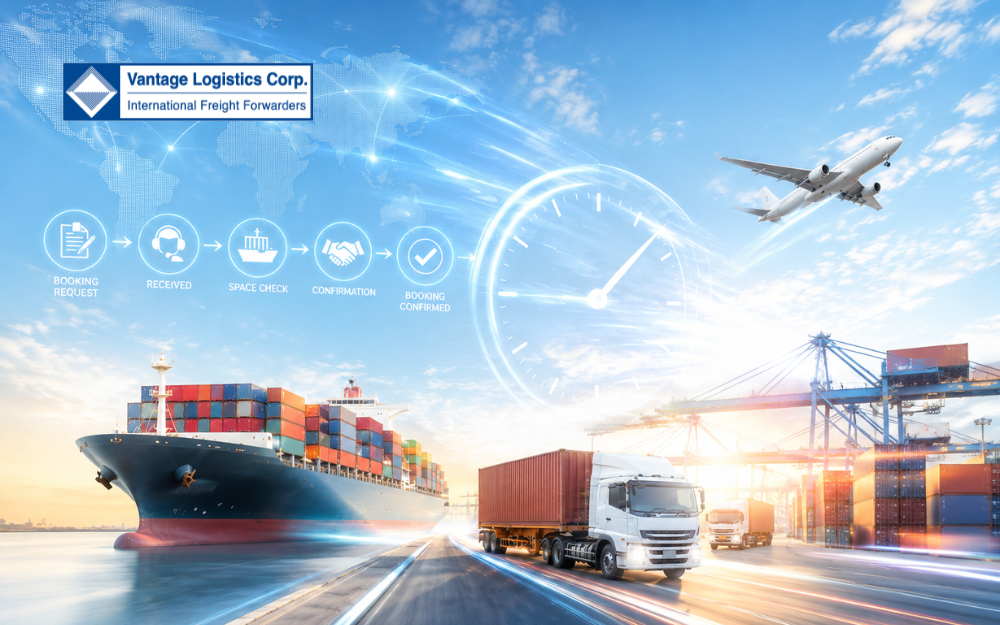
In the freight forwarding industry, fluctuating freight rates, space risks (such as rolled cargo or blank sailings), and delayed booking confirmations directly jeopardize a forwarder’s reputation with cargo owners. Understanding these operational pressures, Vantage Logistics offers a neutral, specialized Wholesale Freight Booking solution designed to help logistics enterprises effectively overcome scale-related cost barriers and operational speed bottlenecks. Wholesale Booking Services for Logistics Enterprises Vantage Logistics has developed a comprehensive, synchronized service portfolio focused on neutrality, precision, and cost efficiency to help partners streamline their supply chains: Wholesale Pricing & Confirmed Allocation: Leveraging the power of scale through extensive block space agreements (BSAs) with global ocean carriers and airlines. This ensures stable capacity allocations and highly competitive rates for forwarders, performing exceptionally well during peak seasons when space is tight. Strict Neutrality: Guaranteeing rigorous client data confidentiality through re-branded shipping documentation. Partners retain full control to manage and issue their own House Bills of Lading (HBL). Integrated Warehousing & Advanced Solutions: A network of modern warehouses offering scalable solutions, ranging from short- and long-term storage, sorting, and pick-and-pack services to rapid cross-docking at key logistics hubs. Dedicated Customs Brokerage: A specialized team ensuring precise HS code classification, seamless customs declarations, and compliance management, minimizing delays at international borders and marine terminals. Operational Commitment: Standardized SLA & Proven Performance A competitive tariff is only valuable when backed by prompt execution. Vantage measures operational efficiency through a strict, transparent Service Level Agreement (SLA): Guaranteed Booking Confirmation in Under 8 Working Hours: Upon receiving a booking request, the dedicated team at Vantage Logistics guarantees capacity verification and responds within 8 business hours. Compared to the market average of 24 to 48 hours, this workflow drastically minimizes wait times for partners. Proven Response Times of Under 4 Hours: Moving beyond standard SLAs, the operational capacity of our Wholesale Service Agent (WSA) team is backed by real-world case studies. During recent peak shipping rushes, Vantage Logistics completed processing, carrier coordination, and confirmed first-leg bookings for partners in less than 4 working hours. Seamless Communication & Transparent Updates: Providing proactive, crystal-clear updates at every stage of the booking pipeline. This responsiveness empowers logistics enterprises to align production timelines with factories, track estimated schedules (ETD/ETA), and efficiently organize port and yard operations. The Vantage Logistics Competitive Advantage Bulk Buying Power: Backed by committed space allocations and direct access to baseline contract rates from major carrier alliances, maintaining rate stability and space security even during high-demand disruptions. Global Mainline Network: An extensive routing network covering domestic lanes, cross-border Southeast Asian corridors, and major global trade lanes connecting the US, Europe, and Asia. Streamlined Supply Chain Touchpoints: Integrated end-to-end logistics solutions eliminate unnecessary intermediaries, helping partners reduce overall operational expenditures and mitigate systemic risk....

21/05/2026

View More
vlc-news-reverse-logistics-part2

Market updates

Part 2 – Reverse Logistics Demands an Integrated Warehouse and Fulfillment Infrastructure

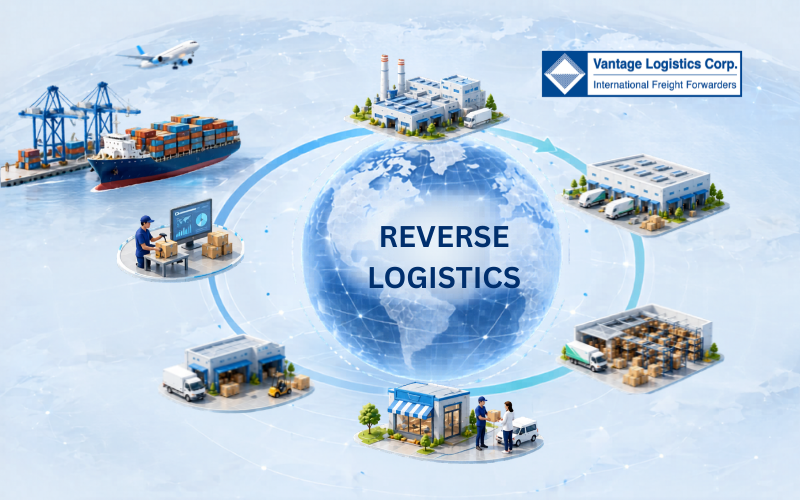
When return rates climb and inventory becomes scattered across multiple regions, reverse logistics can no longer operate efficiently using a traditional logistics setup. For the cross-border e-commerce sector, businesses now require a comprehensive, integrated fulfillment system – encompassing a local warehouse network, transparent order management software, and agile inventory coordination – to drive down operating costs and maintain processing speeds. Shifting Mindsets: Traditional Logistics Setups Are No Longer A Fit In traditional logistics models, most businesses pour all their resources into international freight, outbound shipping, and ocean freight rate optimization. Reverse logistics, however, demands a completely different operational workflow – one that simultaneously manages everything from quality inspection and re-packaging to updating refund timelines and managing restockable inventory. If all returned merchandise is forced to travel all the way back to the country of origin, operating costs skyrocket due to steep return shipping rates, extended processing times, and warehouse congestion back in Viet Nam. This significantly degrades the resale value of the products. This is why forward-thinking sellers are pivoting toward dynamic inventory management and multi-warehouse operations. Under this model, the warehouse is no longer just a storage facility; it functions as a central hub for coordination, quality control, and supply chain balancing. Multi-Warehouse Strategy: The Core Infrastructure For Return Handling The greatest hurdle in reverse logistics is the geographic distance between the customer and the warehouse location. When a returned order has to travel across multiple US states or navigate the journey back to Viet Nam, businesses face double logistics costs, trapped working capital, and an increase in customer complaints due to lengthy processing delays. To alleviate this pressure, deploying a multi-warehouse distribution model directly within the target market is the optimal approach. Within the Global Sales Logistics ecosystem, Vantage Logistics operates a certified warehouse network across strategic US regions, including: California, Texas, New Jersey, Savannah, Chicago, and Seattle. This layout allows sellers to: Shorten domestic return transit distances, bringing the receiving point closer to the customer. Accelerate quality inspections and the re-conditioning of product packaging and labels. Coordinate and redistribute inventory flexibly between regions, reducing dead stock storage times and preserving resale value. Vantage Logistics Warehouse in Ontario, California Synchronizing Fulfillment And Return Workflows For international sellers, return processing cannot be decoupled from daily fulfillment operations. If the return flow is not processed and updated in the system immediately, the database may flag stock shortages while actual physical inventory remains available. This triggers overselling errors or delays subsequent order shipments, directly harming the storefront’s reputation. When warehousing, packaging, last-mile parcel delivery, and return handling all run systematically on a single platform, businesses maximize warehouse utilization and eliminate unnecessary transportation expenses. The Global Sales Logistics system by Vantage Logistics offers full support for: Omnichannel fulfillment catering to both wholesale (B2B) and direct-to-consumer (B2C) retail models. Flexible freight coordination across ocean shipping (Full Container Load – FCL or Less than Container Load – LCL) and domestic over-the-road trucking (Less than Truckload – LTL). Small parcel delivery and standardized inbound preparation for Amazon fulfillment centers (FBA). This structural connectivity gives sellers the confidence to manage inspection, re-packaging, and re-labeling right at the destination market, returning products to the sales lifecycle swiftly without incurring the costs of shipping back to Viet Nam. Order Management Systems (OMS): The Command Center For Reverse Logistics Data Data fragmentation between warehouse software, e-commerce marketplaces, and transportation systems is the leading cause of reverse logistics bottlenecks. When data fails to sync in real time, businesses easily fall into a loop of delayed customer refunds, lost tracking of actual stock, and rising buyer disputes. To resolve this data challenge at its root, implementing a deeply integrated Order Management System (OMS) is essential. The proprietary technology platform from Vantage Logistics delivers core capabilities, including: Direct API integration: Automating data synchronization between major e-commerce marketplaces, Warehouse Management Systems (WMS), and Transportation Management Systems (TMS). Real-time monitoring: Tracking the precise status of every return parcel, managing sellable stock allocation, and shortening customer refund turnaround times. In today’s fast-moving e-commerce landscape, real-time data visibility is no longer just an added perk; it is an operational requirement to protect brand reputation and maintain high seller performance rankings on global platforms. Global Sales Logistics solutions by Vantage Logistics The Global Sales Logistics system by Vantage Logistics provides enterprises with a comprehensive international supply chain solution. This includes a strategic warehouse network across both Viet Nam and the US, a synchronized technology infrastructure (OMS/WMS/TMS), and professional value-added services tailored for return processing. This comprehensive approach helps businesses optimize working capital, alleviate operational strain, and scale their global commerce footprints with confidence. Contact Information & Solution Consulting: Hannah – Director of Global Sales Logistics Email: ha********@*****om.vn >> Read more: Part 1 – Reverse Logistics Emerges as a Major Cost Driver in Cross-Border E-Commerce   Contact Vantage Logistics for tailored transport solutions and competitive quotations. Please provide details on cargo type, market, origin, destination, and estimated timeline. Vantage Logistics Corp – South East Asia (S.E.A) Logistics Provider One-Stop Shop For Integrated Logistics Services Head Office Viet Nam – Suite 6.01, Floor 6th, Block A, RiverGate Residence, 151-155 Ben Van Don, Khanh Hoi Ward, HCMC, Viet Nam Branch Thailand, Laos, Cambodia, Malaysia, Indonesia, Singapore Contact Us Email in**@*****om.vn Phone +84-28 382 67312 Hotline +84-909-026-261 Website https://vantage-logistics.com Send your shipment enquiry today and receive a tailored transport plan from the Vantage Logistics team....

20/05/2026

View More
vlc-news-reverse-logistics

Market updates

Part 1 – Reverse Logistics Emerges as a Major Cost Driver in Cross-Border E-Commerce

As cross-border e-commerce continues to grow, many businesses focus heavily on accelerating outbound delivery speeds and expanding international sales channels. However, another puzzle is quietly draining operating budgets and squeezing margins: reverse logistics. With return rates in the United States holding at historic highs, the capacity to efficiently manage the return flow of goods is becoming a defining factor in operational efficiency for international sellers. When the real cost is not the “outbound order,” but the “returned goods” For years, the majority of exporters concentrated their efforts on outbound logistics – figuring out how to push inventory to international markets faster and cheaper to drive sales and gain a competitive edge. Yet, alongside the boom in cross-border e-commerce, a different kind of operational pressure has emerged, particularly in the US market: reverse logistics. According to data from the National Retail Federation (NRF), the return rate for online orders in the US reached approximately 19.3% in 2025. This means nearly 1 out of every 5 packages is sent back, representing a staggering total value of roughly $850 billion. This is no longer a minor back-office retail issue; it has evolved into a substantial financial burden for global sellers. Crucially, estimates show that at least one-third of these returns cannot be put back on shelves immediately. They require additional handling processes: Inspecting and assessing product quality. Re-packaging and re-labeling items. Coordinating and redistributing merchandise across domestic warehouses. These extensive steps mean reverse logistics is no longer just about “receiving returns.” Instead, it has become a core element of inventory management and cost optimization strategies. How reverse logistics reshapes the supply chain The surge in cross-border e-commerce is driving many businesses in Viet Nam to expand into direct-to-consumer (D2C) international sales. Brands are scaling up via major marketplaces like Amazon and Walmart Marketplace, independent storefronts built on Shopify, and social commerce platforms like TikTok Shop. However, as order volumes climb, the challenges of reverse logistics accelerate just as fast. For many global sellers, the pressure is no longer just about fast delivery; it is about the capability to resolve: Merchandise recovery costs: Return shipping rates within the US are exceptionally high, especially when goods travel across multiple states. Refund timelines: Slow processing times trigger buyer complaints and drag down store health scores on e-commerce marketplaces. Inventory redistribution: Strategically allocating returned goods so they can be re-listed for sale as quickly as possible, avoiding trapped working capital. Data transparency: Ensuring inventory data is synchronized in real time between e-commerce storefronts and warehouse management systems. Without a dedicated, integrated system in place, returned merchandise frequently sits idle in warehouses for extended periods, leading to inventory depreciation and shrinking profit margins. Direct impact on customer experience and sustainability strategies Driving customer retention in global markets In mature markets like the US, consumers set a very high bar for return convenience, refund processing speeds, and return tracking visibility. Resolving these back-end steps quickly directly influences repeat purchase rates, customer loyalty, and seller performance metrics on platforms like Amazon and Walmart Marketplace. These metrics are critical, as they dictate product search visibility and buy-box ownership. Integration into green supply chains and ESG goals Beyond the balance sheet, reverse logistics is now deeply tied to sustainable supply chain trends and ESG (Environmental, Social, and Governance) criteria. When returns are sorted, inspected, and re-packaged locally at the destination market instead of being shipped all the way back to the country of origin, companies eliminate unnecessary cross-border transit. This drastically cuts logistics-related carbon emissions, optimizes product lifecycles, and increases the reuse potential of both packaging and inventory. The new competitive advantage for international sellers In the early days of global e-commerce, businesses competed primarily on retail price, outbound shipping speed, or international freight rates. Today, however, the mastery of the reverse flow of goods determines margin stability, warehouse efficiency, and long-term scalability. Reverse logistics is no longer just a passive, back-end operation; it has become a central pillar of global sales operational strategy. >> Read next: “Part 2 – Reverse Logistics Demands an Integrated Warehouse and Fulfillment Infrastructure” to explore multi-warehouse infrastructure solutions and data-driven methods for lowering return costs. Contact Information & Solution Consulting: Ms Hannah Nguyen – Director of Global Sales Logistics Email: ha********@*****om.vn   Contact Vantage Logistics for tailored transport solutions and competitive quotations. Please provide details on cargo type, market, origin, destination, and estimated timeline. Vantage Logistics Corp – South East Asia (S.E.A) Logistics Provider One-Stop Shop For Integrated Logistics Services Head Office Viet Nam – Suite 6.01, Floor 6th, Block A, RiverGate Residence, 151-155 Ben Van Don, Khanh Hoi Ward, HCMC, Viet Nam Branch Thailand, Laos, Cambodia, Malaysia, Indonesia, Singapore Contact Us Email in**@*****om.vn Phone +84-28 382 67312 Hotline +84-909-026-261 Website https://vantage-logistics.com Send your shipment enquiry today and receive a tailored transport plan from the Vantage Logistics team....

20/05/2026

View More
vlc-news-Paris–Ha Noi Cargo-Route-Strengthens-Viet-Nam–Europe-Logistics-Connectivity

Market updates

Paris–Ha Noi Cargo Route Strengthens Viet Nam – Europe Logistics Connectivity

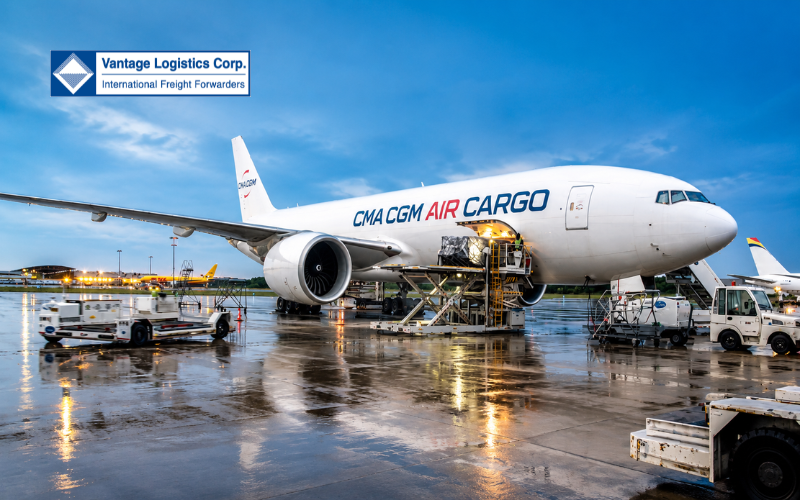
Demand for high-speed cargo transportation between Vietnam and Europe continues to rise alongside the growth of electronics exports, technology manufacturing, and industrial production. The launch of the Paris – Ha Noi cargo route reflects a broader trend toward stronger logistics connectivity, shorter transit times, and enhanced supply chain capacity between the two markets. CMA CGM Air Cargo Officially Launches Freighter Route To Viet Nam Recently, a direct cargo route between Paris Charles de Gaulle and Ha Noi has been launched, operated with Boeing 777F freighters offering around 100 tons of capacity per flight. This new service expands the Europe – Viet Nam air corridor, reflecting the rising demand for faster deliveries to major markets. Viet Nam’s inclusion in the global cargo network of a leading logistics group highlights how the country is increasingly seen not just as a low‑cost manufacturing base, but as a strategic hub for regional and global supply chains. Technology Export Growth Is Driving Air Cargo Demand CMA CGM Air Cargo’s expansion is not occurring by chance. Over recent years, Viet Nam has consistently recorded strong growth in electronics, computers, components, and technology equipment exports – sectors that rely heavily on air freight due to strict delivery timelines and supply chain reliability requirements. According to Viet Nam Customs data, computers, electronics, and components remain among Viet Nam’s largest export categories, generating tens of billions of dollars in annual export turnover. These product groups also maintain significantly higher air freight utilization rates compared to conventional consumer goods. At the same time, the ongoing “China+1” strategy continues to accelerate manufacturing relocation into Viet Nam. Many global technology companies are expanding production capacity or diversifying supply chains beyond China to reduce geopolitical risks and improve supply resilience. As manufacturing output expands, demand is also rising for faster delivery cycles, rapid inventory replenishment, urgent component shipments and direct connectivity to Europe and North America. This trend is one of the key reasons why international logistics and transportation providers continue to increase their presence in Viet Nam, particularly in air freight and integrated logistics services. Logistics Competition Is Shifting from Transportation to Supply Chain Coordination One of the most notable aspects of this development is that it reflects not only air cargo growth, but also the changing business models of global logistics groups. CMA CGM currently positions itself as an integrated logistics provider offering sea freight, air freight, Inland transportation, warehousing and end-to-end logistics solutions. This reflects a broader transformation within the global logistics industry. Competition is no longer centered solely on fleet size or standalone transportation capacity. Increasingly, it depends on the ability to connect the entire logistics chain through seamless and reliable coordination. For exporters, logistics capability is no longer measured only by freight rates. Factors such as processing speed, shipment visibility, schedule reliability and responsiveness to operational disruptions are becoming key criteria when selecting logistics partners. Air Cargo Growth Will Increase Pressure on Domestic Logistics Operations The expansion of international air cargo capacity will also create stricter operational requirements across Vietnam’s domestic logistics ecosystem. Unlike ocean freight, air cargo operations require shorter handling times, near-zero documentation errors, continuous coordination between warehouses, trucking networks, airports, and customs authorities, as well as real-time issue resolution capabilities. This is creating significant operational pressure on domestic logistics providers, particularly in critical areas such as: Airport trucking and cargo consolidation Customs clearance and document management Cut-off time control And multi-point cargo coordination In practice, even a minor trucking delay or documentation discrepancy can cause cargo to miss a scheduled flight, resulting in supply chain disruptions and substantial additional costs. As a result, importers and exporters are increasingly seeking logistics partners capable of managing multimodal coordination and synchronized operational workflows. Viet Nam Has an Opportunity to Strengthen Its Position in Regional Supply Chains CMA CGM Air Cargo’s network expansion into Viet Nam indicates that the country is being increasingly recognized for its export capacity, manufacturing connectivity, and deeper integration into regional supply chains. In the short term, the move could provide stronger support for industries requiring rapid delivery, particularly electronics, technology products, and high-value cargo. Over the longer term, it signals that Vietnam’s competitiveness will increasingly depend on its ability to develop efficient, flexible, and reliable logistics capabilities. For importers and exporters, selecting logistics partners capable of multimodal coordination, fast operational handling, and end-to-end shipment visibility will become increasingly important in maintaining supply chain stability amid a more competitive global trade environment.   Contact Vantage Logistics for tailored transport solutions and competitive quotations. Please provide details on cargo type, market, origin, destination, and estimated timeline. Vantage Logistics Corp – South East Asia (S.E.A) Logistics Provider One-Stop Shop For Integrated Logistics Services Head Office Viet Nam – Suite 6.01, Floor 6th, Block A, RiverGate Residence, 151-155 Ben Van Don, Khanh Hoi Ward, HCMC, Viet Nam Branch Thailand, Laos, Cambodia, Malaysia, Indonesia, Singapore Contact Us Email in**@*****om.vn Phone +84-28 382 67312 Hotline +84-909-026-261 Website https://vantage-logistics.com Send your shipment enquiry today and receive a tailored transport plan from the Vantage Logistics team....

19/05/2026

View More
vlc-news-tax-and-customs-procedures-removed

Market updates

Ministry of Finance Cuts Tax and Customs Procedures: A Catalyst for Supply Chain Digitalisation

The Ministry of Finance’s latest decision to revise, supplement and abolish multiple administrative procedures in taxation and customs is creating new momentum for supply chain digitalisation in Vietnam. For import-export businesses, these changes not only reduce paperwork burdens but also directly impact customs clearance speed, document management efficiency and real-time operational visibility. Multiple Tax and Customs Procedures Removed Under Decision 1109/QĐ-BTC issued on May 8, 2026, the Ministry of Finance has officially revised and supplemented seven procedures and abolished eight procedures in tax administration, while also abolishing one procedure in the customs sector, effective from the date of signing. The abolished procedures mainly relate to invoice and receipt management, invoice usage reporting, handling lost or damaged invoices, tax agent registration procedures, and the temporary suspension of customs enforcement measures. At the same time, the customs sector continues reviewing and removing intermediary processes, moving towards a shared electronic data processing model. Direct Impact on Logistics Operations In international trade, each shipment is associated with a complex documentation chain, including commercial invoices, packing lists, customs declarations, certificates of origin (C/O), and shipping instructions (SI). When declaration and reconciliation processes are synchronized electronically, businesses can significantly reduce manual data entry time, minimize errors and lower the risk of rejected documents. This is particularly important as exporters continue facing pressure related to: Delivery lead times Container storage and port detention costs Data transparency requirements from international partners Data processing speed is increasingly becoming a core competitive advantage. A delayed document set can lead to demurrage and storage charges, while also disrupting vessel schedules. From “Paper-Based Logistics” to Digital Data Management Under the ongoing reform roadmap, the amended Law on Tax Administration aims to reduce more than 44% of administrative procedures – from 219 current procedures to approximately 120 – helping businesses cut at least 30% of compliance time and costs. This digitalization trend requires businesses to standardize data from the shipment preparation stage rather than waiting until cargo reaches the border gate. The adoption of electronic documentation processes, automated customs declarations and real-time cargo tracking is no longer optional. It has become essential for improving supply chain visibility and operational resilience. In major markets such as the US, EU and China, traceability and logistics data transparency are increasingly viewed as benchmarks of exporter credibility. Early coordination between shippers and customs brokerage partners with strong digital capabilities will become a critical factor in reducing customs clearance risks and maintaining stable cargo flows in an increasingly volatile global trade environment. Vantage Logistics Supports Businesses in the Digital Logistics Environment Vantage Logistics provides international logistics services, multimodal transportation solutions and customs declaration support to help businesses optimize processing time, improve supply chain visibility and maintain stable cargo flows in a rapidly changing global trade environment.   Contact Vantage Logistics for tailored transport solutions and competitive quotations. Please provide details on cargo type, market, origin, destination, and estimated timeline. Vantage Logistics Corp – South East Asia (S.E.A) Logistics Provider One-Stop Shop For Integrated Logistics Services Head Office Viet Nam – Suite 6.01, Floor 6th, Block A, RiverGate Residence, 151-155 Ben Van Don, Khanh Hoi Ward, HCMC, Viet Nam Branch Thailand, Laos, Cambodia, Malaysia, Indonesia, Singapore Contact Us Email in**@*****om.vn Phone +84-28 382 67312 Hotline +84-909-026-261 Website https://vantage-logistics.com Send your shipment enquiry today and receive a tailored transport plan from the Vantage Logistics team....

19/05/2026

View More
vlc-news-chemical-composition-declaration-2

Market updates

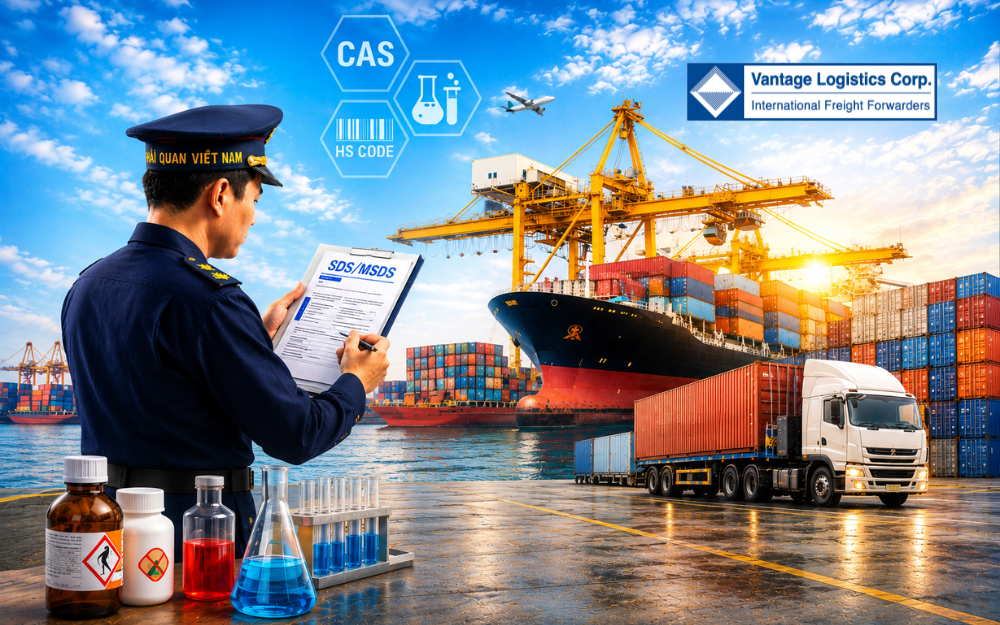
Chemical Composition Declarations in Import and Export: How Businesses Can Avoid Customs Delays

Recent market feedback has drawn attention to chemical composition declaration procedures in import and export activities. In response, Customs authorities have clarified that no new regulations have been introduced. What has changed, however, is the level of scrutiny applied to technical data and supporting documents during customs clearance. For businesses involved in cross-border trade, this means documentation standards matter more than ever. Where technical information is incomplete, inconsistent, or unclear, shipments may face longer processing times, additional checks, and unnecessary cost exposure. Chemical composition declarations are not simply an administrative step. They also provide the basis for product classification, regulatory assessment, transport review, and, in some cases, tax treatment. As a result, even small discrepancies in technical documentation can create wider operational issues across the supply chain. Why chemical composition declarations are receiving closer attention Under the current legal framework, chemical composition declarations continue to follow existing customs and chemical management regulations. There has been no formal introduction of new procedures. However, authorities are taking a more detailed approach to verifying the accuracy, completeness, and consistency of the information submitted. This is particularly relevant for products such as industrial chemicals, paints, inks, battery materials, cosmetics, food additives, and manufacturing inputs. For these categories, technical data plays an important role in determining the nature of the goods and the regulatory requirements that may apply. When the declared information does not align across documents, customs clearance may be delayed while further verification is carried out. Technical data that directly affects customs clearance For products containing chemical substances or chemical-related components, several types of technical information can significantly influence the clearance process. 1/ CAS numbers, concentration, and purity These details help identify the exact substance or chemical mixture contained in the goods. If CAS references, concentration levels, or purity data are missing or inconsistent, authorities may need to conduct additional checks before confirming product classification. 2/ Safety Data Sheets (SDS/MSDS) A Safety Data Sheet is often one of the most important supporting documents for shipments involving chemical content. It helps both regulators and transport providers assess product safety, especially where the cargo may be hazardous, restricted, or sensitive in international transport. 3/ Product technical data sheets Technical data sheets provide further information on product composition, physical characteristics, purity, and intended use. These documents are commonly reviewed when customs authorities need a clearer understanding of the declared product profile. Business risks linked to inaccurate declarations Inaccurate or inconsistent technical documentation does more than slow down a customs procedure. It can also create cost, timing, and service issues across the broader logistics chain. Longer clearance times and stricter inspections: Where product data is unclear, shipments may be subject to deeper inspection or reassigned to a stricter review channel. This can affect transit planning and delivery commitments. Additional port and storage-related charges: If cargo is held at port due to documentation gaps, businesses may incur extra detention, demurrage, storage, and handling charges. These costs can escalate quickly, particularly on time-sensitive or high-volume shipments. Missed sailings and delivery disruption: A customs delay can cause a shipment to miss vessel cut-offs or transport schedules. In turn, this may disrupt customer orders, production timelines, and inventory planning. Higher exposure for dangerous goods: For dangerous goods, technical document checks are typically even more stringent. Carriers may require additional SDS documents, technical specifications, or confirmation of chemical composition before accepting the cargo for booking and transport. What businesses can do to reduce customs clearance risk To reduce delays and unexpected costs, businesses should address compliance early rather than waiting until the shipment reaches the final stage of processing. A more effective approach is to verify and standardize technical documentation before filing. Review technical data before customs submission: Before submitting a customs declaration, businesses should carefully review CAS numbers, concentration levels, purity, chemical names, trade names, and the consistency of all supporting documents. Early verification helps reduce the likelihood of later amendments or clarification requests. Improve coordination across internal and external stakeholders: Stronger coordination between the shipper, product or regulatory team, freight forwarder, and customs broker can help identify mismatches early in the process. This is especially important for products with mixed compositions, regulated ingredients, or transport-related sensitivities. Confirm carrier requirements in advance: For cargo involving chemical content, and especially for dangerous goods, businesses should confirm carrier requirements before booking. This includes document expectations related to safety, composition, packaging, and transport conditions. A more compliance-focused approach is now essential As customs authorities place greater emphasis on technical data verification, accurate chemical composition declarations are becoming a key factor in clearance efficiency. For importers and exporters, compliance is no longer just about filing the required paperwork. It increasingly depends on document quality, technical consistency, and proactive operational coordination. Businesses that invest in stronger data preparation and earlier compliance review will be better positioned to reduce delays, control logistics costs, and maintain supply chain reliability when trading products that contain chemical substances.   Contact Vantage Logistics for tailored transport solutions and competitive quotations. Please provide details on cargo type, market, origin, destination, and estimated timeline. Vantage Logistics Corp – South East Asia (S.E.A) Logistics Provider One-Stop Shop For Integrated Logistics Services Head Office Viet Nam – Suite 6.01, Floor 6th, Block A, RiverGate Residence, 151-155 Ben Van Don, Khanh Hoi Ward, HCMC, Viet Nam Branch Thailand, Laos, Cambodia, Malaysia, Indonesia, Singapore Contact Us Email in**@*****om.vn Phone +84-28 382 67312 Hotline +84-909-026-261 Website https://vantage-logistics.com Send your shipment enquiry today and receive a tailored transport plan from the Vantage Logistics team....

18/05/2026

View More
vlc-vn-sea-food-export-outlook-p2

Market updates

Part 2: Viet Nam’s Seafood Exports – China Becomes The Largest Import Market

Viet Nam’s seafood exports are rebounding in 2026, with markets shifting: U.S. sales remain constrained by tariffs, while China’s imports surge. This shift is reshaping trade flows, cold-chain logistics, cross-border transport, and exporters’ supply chains. China Becomes The Fastest-Growing Market For Vietnamese Seafood According to data from Viet Nam’s Ministry of Agriculture and Environment and the Viet Nam Association of Seafood Exporters and Producers (VASEP), Viet Nam’s seafood exports reached approximately USD 3.7–4 billion in the first four months of 2026, up around 14–15% year-on-year. The industry’s full-year export target is currently set at USD 11.5–12.3 billion. Most notably, China has become the fastest-growing market for Viet Nam’s seafood industry, recording growth of approximately 52.3%. In contrast, exports to the United States declined by around 7.4%, reflecting increasing pressure from trade remedies and stricter technical compliance requirements. China currently accounts for approximately 26.7% of Viet Nam’s total seafood export turnover, surpassing both Japan and the United States to become the industry’s largest market. While the seafood sector previously relied heavily on the U.S. and European markets, 2026 is seeing a strong shift toward Asian markets, where import demand is more stable and consumption cycles are shorter. Seafood Logistics Trends Are Shifting The rapid growth of the Chinese market is significantly changing how seafood products are transported and distributed. Unlike long-haul ocean freight routes to the United States or Europe, the Chinese market requires shorter delivery cycles, faster inventory replenishment, and more stable supply continuity during peak consumption periods. As a result, cross-border transportation, refrigerated containers, transit cold storage facilities, and cold-chain coordination capabilities are becoming increasingly important in seafood export operations. In many cases, exporters are no longer focused solely on minimising costs. Instead, they are prioritising delivery reliability and shorter transit times to maintain product quality. For frozen seafood products, even minor disruptions in vessel schedules or container dwell times can directly affect product quality, shelf life, and port-related costs. Cold-Chain Logistics Becomes A Direct Competitive Advantage According to businesses in the industry, demand for cold-chain logistics is rising rapidly alongside export recovery. In 2026, the market continues to face pressure related to refrigerated container availability, freight rates, vessel space allocation, and cold-storage capacity in key export regions. In particular, the characteristics of the Chinese market are driving stronger demand for flexible cold-chain transportation models, including: Cross-border trucking Multimodal transportation Short-term transshipment And seasonal container coordination This trend is transforming logistics from a supporting function into a core component of exporters’ competitive strategies. Companies capable of maintaining stable cold-chain operations, controlling transportation data, and responding quickly to market changes will hold a major advantage in retaining international customers. Seafood Supply Chains Are Becoming More Flexible Diverging conditions across export markets are forcing seafood exporters to adapt their operating models. Rather than focusing solely on production volume and pricing, competitiveness is now increasingly determined by: Delivery speed Cold-chain continuity And logistics flexibility Many exporters are actively diversifying transportation routes, optimising container planning, combining ocean freight with cross-border road transport, and strengthening coordination between factories, cold storage facilities, and logistics providers. In the Mekong Delta – Viet Nam’s largest seafood farming and processing hub – demand for integrated logistics solutions is also rising as businesses seek to reduce storage pressure and shorten delivery times to international markets. Logistics Capabilities Will Determine Competitive Advantage In The Next Growth Cycle Viet Nam’s seafood export outlook for 2026 is significantly more positive compared to the previous slowdown period. However, the market is no longer operating under the same model as before. China’s rapid import growth is creating new trade flows and placing greater emphasis on speed, flexibility, and stable cold-chain operations throughout the supply chain. In this environment, logistics capabilities will play a decisive role in helping exporters maintain stable orders, optimise costs, and reduce delivery risks. Businesses that adapt quickly and build resilient cold-chain logistics networks will be better positioned to capture growth opportunities in the next phase of Viet Nam’s seafood export expansion. > Read more: Part 1: U.S. Tariffs on Vietnamese Shrimp   Contact Vantage Logistics for tailored transport solutions and competitive quotations. Please provide details on cargo type, market, origin, destination, and estimated timeline. Vantage Logistics Corp – South East Asia (S.E.A) Logistics Provider One-Stop Shop For Integrated Logistics Services Head Office Viet Nam – Suite 6.01, Floor 6th, Block A, RiverGate Residence, 151-155 Ben Van Don, Khanh Hoi Ward, HCMC, Viet Nam Branch Thailand, Laos, Cambodia, Malaysia, Indonesia, Singapore Contact Us Email in**@*****om.vn Phone +84-28 382 67312 Hotline +84-909-026-261 Website https://vantage-logistics.com Send your shipment enquiry today and receive a tailored transport plan from the Vantage Logistics team....

16/05/2026

View More
1 … 14 15 16 17 18 … 43