 LOGIN
LOGIN 
 VN
VN
 Sea Freight
  Air Freight
  Intermodal
  Customs Brokerage
  Project Logistics
  Warehouse Services
  Trucking
  Insurance
  Logistics Infrastructures
  Consulting & Assistance
  NVOCC
NVOCC  Barge & Coastal Feeder
  GSA / PCSA Airlines
  Perishable / Refrigerated Logistics
  Dangerous Good Logistics
  Oil & Gas Logistics
  Offshore Services
  Rice Logistics
  Global Sales Logistics
  Parcel / Courier Logistics
  Cross-Docking & End-To-End Warehousing
  On Board Courier
  Buying Agent
Recent market feedback has drawn attention to chemical composition declaration procedures in import and export activities. In response, Customs authorities have clarified that no new regulations have been introduced. What has changed, however, is the level of scrutiny applied to technical data and supporting documents during customs clearance.
For businesses involved in cross-border trade, this means documentation standards matter more than ever. Where technical information is incomplete, inconsistent, or unclear, shipments may face longer processing times, additional checks, and unnecessary cost exposure.
Chemical composition declarations are not simply an administrative step. They also provide the basis for product classification, regulatory assessment, transport review, and, in some cases, tax treatment. As a result, even small discrepancies in technical documentation can create wider operational issues across the supply chain.
Why chemical composition declarations are receiving closer attention
Under the current legal framework, chemical composition declarations continue to follow existing customs and chemical management regulations. There has been no formal introduction of new procedures. However, authorities are taking a more detailed approach to verifying the accuracy, completeness, and consistency of the information submitted.
This is particularly relevant for products such as industrial chemicals, paints, inks, battery materials, cosmetics, food additives, and manufacturing inputs. For these categories, technical data plays an important role in determining the nature of the goods and the regulatory requirements that may apply. When the declared information does not align across documents, customs clearance may be delayed while further verification is carried out.
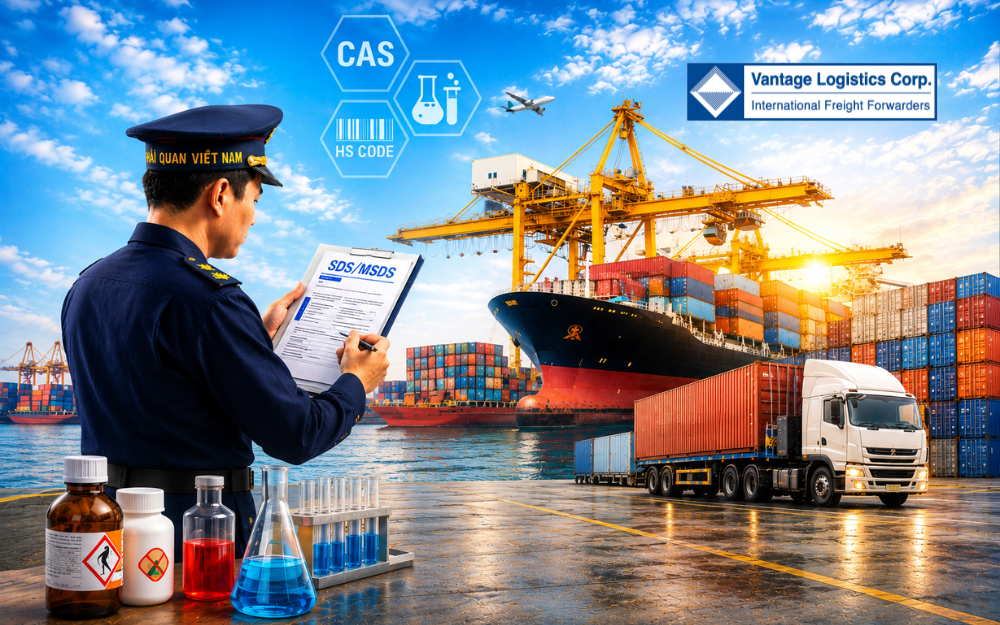
Technical data that directly affects customs clearance
For products containing chemical substances or chemical-related components, several types of technical information can significantly influence the clearance process.
1/ CAS numbers, concentration, and purity
These details help identify the exact substance or chemical mixture contained in the goods. If CAS references, concentration levels, or purity data are missing or inconsistent, authorities may need to conduct additional checks before confirming product classification.
2/ Safety Data Sheets (SDS/MSDS)
A Safety Data Sheet is often one of the most important supporting documents for shipments involving chemical content. It helps both regulators and transport providers assess product safety, especially where the cargo may be hazardous, restricted, or sensitive in international transport.
3/ Product technical data sheets
Technical data sheets provide further information on product composition, physical characteristics, purity, and intended use. These documents are commonly reviewed when customs authorities need a clearer understanding of the declared product profile.
Business risks linked to inaccurate declarations
Inaccurate or inconsistent technical documentation does more than slow down a customs procedure. It can also create cost, timing, and service issues across the broader logistics chain.
- Longer clearance times and stricter inspections: Where product data is unclear, shipments may be subject to deeper inspection or reassigned to a stricter review channel. This can affect transit planning and delivery commitments.
- Additional port and storage-related charges: If cargo is held at port due to documentation gaps, businesses may incur extra detention, demurrage, storage, and handling charges. These costs can escalate quickly, particularly on time-sensitive or high-volume shipments.
- Missed sailings and delivery disruption: A customs delay can cause a shipment to miss vessel cut-offs or transport schedules. In turn, this may disrupt customer orders, production timelines, and inventory planning.
- Higher exposure for dangerous goods: For dangerous goods, technical document checks are typically even more stringent. Carriers may require additional SDS documents, technical specifications, or confirmation of chemical composition before accepting the cargo for booking and transport.
What businesses can do to reduce customs clearance risk
To reduce delays and unexpected costs, businesses should address compliance early rather than waiting until the shipment reaches the final stage of processing. A more effective approach is to verify and standardize technical documentation before filing.
- Review technical data before customs submission: Before submitting a customs declaration, businesses should carefully review CAS numbers, concentration levels, purity, chemical names, trade names, and the consistency of all supporting documents. Early verification helps reduce the likelihood of later amendments or clarification requests.
- Improve coordination across internal and external stakeholders: Stronger coordination between the shipper, product or regulatory team, freight forwarder, and customs broker can help identify mismatches early in the process. This is especially important for products with mixed compositions, regulated ingredients, or transport-related sensitivities.
- Confirm carrier requirements in advance: For cargo involving chemical content, and especially for dangerous goods, businesses should confirm carrier requirements before booking. This includes document expectations related to safety, composition, packaging, and transport conditions.
A more compliance-focused approach is now essential
As customs authorities place greater emphasis on technical data verification, accurate chemical composition declarations are becoming a key factor in clearance efficiency. For importers and exporters, compliance is no longer just about filing the required paperwork. It increasingly depends on document quality, technical consistency, and proactive operational coordination.
Businesses that invest in stronger data preparation and earlier compliance review will be better positioned to reduce delays, control logistics costs, and maintain supply chain reliability when trading products that contain chemical substances.
Contact Vantage Logistics for tailored transport solutions and competitive quotations.
Please provide details on cargo type, market, origin, destination, and estimated timeline.
| Vantage Logistics Corp – South East Asia (S.E.A) Logistics Provider
One-Stop Shop For Integrated Logistics Services |
|
| Head Office | Viet Nam – Suite 6.01, Floor 6th, Block A, RiverGate Residence,
151-155 Ben Van Don, Khanh Hoi Ward, HCMC, Viet Nam |
| Branch | Thailand, Laos, Cambodia, Malaysia, Indonesia, Singapore |
| Contact Us | |
| in**@*****om.vn | |
| Phone | +84-28 382 67312 |
| Hotline | +84-909-026-261 |
| Website | https://vantage-logistics.com |
Send your shipment enquiry today and receive a tailored transport plan from the Vantage Logistics team.



 Vantage News

