

 ENG
ENG
 Sea Frieght
  Air Frieght
  Intermodal
  Customs Brokerage
  Project Logistics
  Warehouse Services
  Trucking
  Insurance
  Logistics Infrastructures
  Consulting & Assistance
  Nvocc
Nvocc  Truckers
  Barge & Coastal Feeder
  GSA / PCSA Airlines
  Perishable / Refrigerated Logistics
  Break Bulk / Bulk Logistics
  Dangerous Good Logistics
  Oil & Gas Logistics
  Offshore Services
  Rice Logistics
  Global Sales Logistics
  Cross-Docking & End-To-End Warehousing
  On Board Courier
  Buying Agent
Southeast Asia is strengthening its position in the restructuring of global supply chains as multinational corporations continue to reallocate production capacity. For Viet Nam, the shift in investment and manufacturing activity could expand cargo volumes for ports and maritime transport, but it does not automatically translate into higher port throughput. The extent of the benefit depends on three factors: cargo composition, connectivity to international shipping networks, and the logistics capacity connecting factories with ports.
Notably, Vietnam’s maritime connectivity has been showing clear progress. According to UNCTAD, Vietnam’s Liner Shipping Connectivity Index (LSCI) increased by 12% between June 2024 and June 2025, indicating that Vietnam’s position within the international container shipping network continues to strengthen.
I. Production Shifts Create More Cargo, but Not All Cargo Moves by Sea
1/ Cargo Composition Determines the Mode of Transport
The shift of manufacturing activity across ASEAN is creating clear two-way transportation demand: imports of machinery, components, and production inputs, alongside exports of finished goods to major consumer markets.
However, the actual volume of cargo moving through ports depends directly on cargo composition:
- High-tech shipments, compact components, high-value goods, and time-sensitive cargo tend to favor air freight.
- By contrast, industries with high volumes of production inputs and finished goods, such as textiles and apparel, footwear, machinery, furniture, and consumer electronics, are major sources of containerized cargo demand for maritime transport.
FDI and production shifts create potential cargo volumes; the actual amount moving through seaports still depends on cargo characteristics, import and export markets, and supply chain structures.
2/ Who Actually Benefits from the New Cargo Flows?
New cargo flows do not distribute benefits evenly across the supply chain.
For seaports, the direct impact is higher demand for container handling, particularly at gateways capable of receiving large vessels and integrated into international shipping networks.
For Vietnam’s maritime transport industry, the more immediate opportunities are concentrated in intra-Asia routes, feeder services, coastal shipping, and cargo connectivity between ports within the region.
Meanwhile, on direct deep-sea routes to North America and Europe, vessel capacity remains primarily controlled by international container shipping lines. As a result, Vietnamese logistics companies have clearer opportunities in connecting cargo sources to international shipping networks, through feeder services, barges, trucking, warehousing, and customs services.
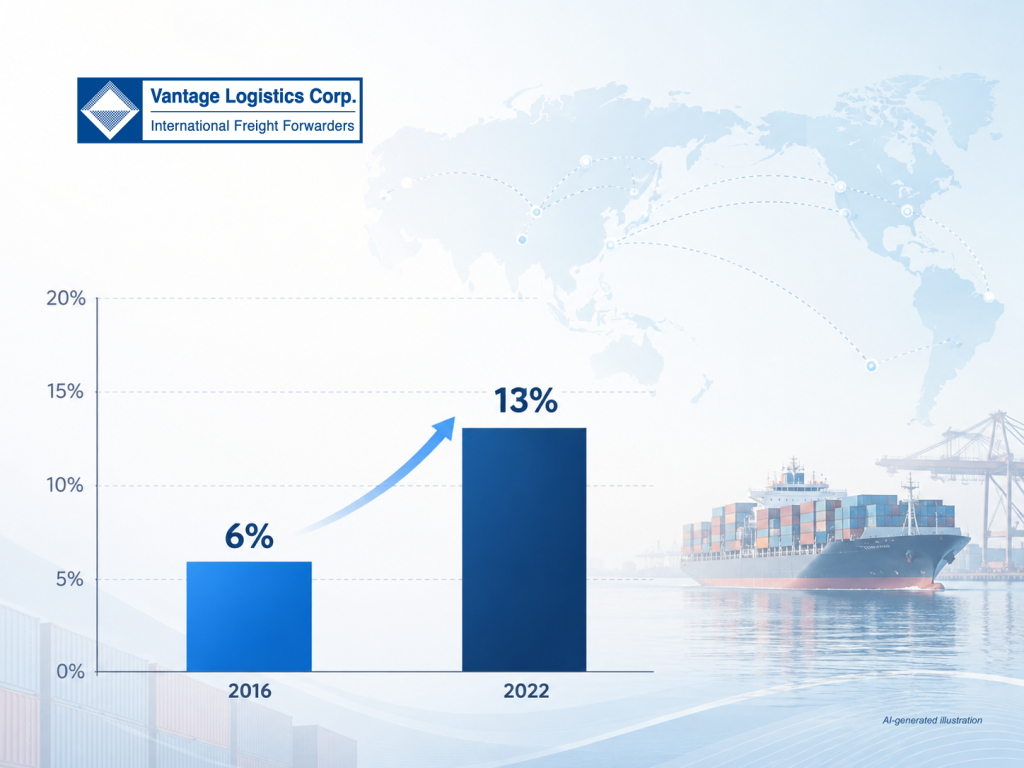
Vietnam’s share of cargo flows from Asia to North America & Europe
Source: Compiled from Kirin Capital & International Maritime Reports
II. Shipping Networks Determine Which Ports Actually Benefit
Channel depth and berth capacity are necessary conditions. However, to convert handling capacity into actual throughput, a port must be integrated into the service networks of international shipping lines.
The restructuring of service networks toward a Hub-and-Spoke model makes this factor even more important. A port may be selected as a mainline port of call, a regional connection point, or a feeder port; each position creates different cargo volumes and flow patterns.
In Viet Nam, Cai Mep–Thi Vai and Lach Huyen continue to serve as two key deep-water port clusters within the international maritime transport network.
Cai Mep’s performance shows how the ability to handle mainline vessels is being converted into actual throughput:
- In the first 10 months of 2025, the Cai Mep–Thi Vai port cluster handled nearly 6.3 million TEUs of mainline-vessel cargo, up more than 18% year over year
- At CMIT, during the first 11 months of 2025, the port handled more than 350 mainline vessel calls and over 8,000 barge and feeder vessel calls; mainline-vessel throughput exceeded 1.1 million TEUs, up 28%, while maintaining 8 direct international service routes to North America, Europe, and intra-Asia markets
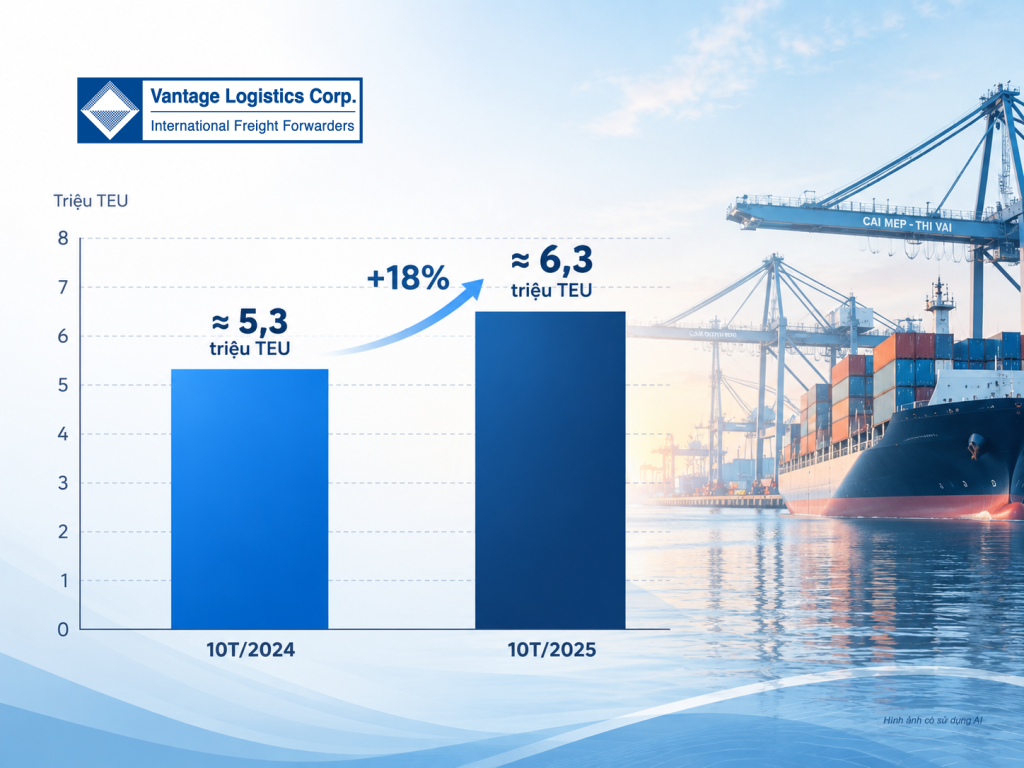
Cai Mep–Thi Vai port cluster: mainline-vessel cargo throughput surges
Source: Viet Nam Seaports Association – VPA
III. Logistics Connectivity Determines The Ability To Handle Cargo Flows
A deep-water port is only one node in the overall journey. For cargo from manufacturing centers to effectively enter the international maritime network, the port must be seamlessly connected to road transport, inland waterways, ICDs, warehousing, and customs clearance services.
When shipping lines operate on tight schedules and cut-off times, a delay in transporting cargo from the factory to the port can cause the shipment to miss its mainline vessel.
This is particularly important for major manufacturing centers. Barge and trucking capacity, as well as the ability to consolidate cargo from industrial parks and move it to deep-water ports, directly affect the time, cost, and reliability of the entire journey.
Beyond infrastructure expansion, port operating performance in Vietnam is also improving. According to the 2025 Container Port Performance Index (CPPI) published by the World Bank and S&P Global in 2026, Cai Mep ranked 11th and Hai Phong ranked 13th among more than 400 ports evaluated.
This shows that port competitiveness is not determined solely by capacity scale, but increasingly by the ability to operate reliably and connect efficiently with the broader network.
IV. Three Challenges To Watch
The benefits of supply chain shifts will not automatically translate into uniform growth across the market. Three challenges require close attention:
- Post-port infrastructure connectivity: The expansion of berths needs to be accompanied by sufficient inland waterway and barge capacity, road connections, satellite ICD networks, and customs clearance capacity to prevent localized bottlenecks.
- Capacity competition among terminals: New terminals coming into operation give shippers more options, but they also intensify competition for cargo among terminals within the same area if cargo growth does not keep pace with capacity expansion.
- Changes in shipping networks: Changes in route allocation and port-call frequency by international shipping alliances can cause cargo flows to shift between port clusters.
V. Conclusion: From Port Capacity To Supply Chain Synchronization
Production shifts create cargo; shipping networks determine which ports handle that cargo; and logistics capacity behind the port determines whether the entire supply chain can convert that opportunity into economic efficiency.
The advantage of Vietnam’s seaports today is measured not only by berth length, but by their ability to provide seamless connectivity from the factory gate to the mainline vessel. For shippers, port selection is increasingly shifting from the question “Which port has lower handling fees?” to “Which transportation option can keep the entire cargo journey reliable, on schedule, and as cost-efficient as possible?”
Vantage Logistics provides integrated transportation solutions, connecting ocean freight, inland waterway barges, trucking, warehousing, and end-to-end customs clearance. Contact us to develop a transportation and logistics plan aligned with your production schedule and vessel schedules.
Contact Vantage Logistics for tailored transport solutions and competitive quotations.
Please provide details on cargo type, market, origin, destination, and estimated timeline.
| Vantage Logistics Corp – South East Asia (S.E.A) Logistics Provider
One-Stop Shop For Integrated Logistics Services |
|
| Head Office | Viet Nam – Suite 6.01, Floor 6th, Block A, RiverGate Residence,
151-155 Ben Van Don, Khanh Hoi Ward, HCMC, Viet Nam |
| Branch | Thailand, Laos, Cambodia, Malaysia, Indonesia, Singapore |
| Contact Us | |
| in**@*****om.vn | |
| Hotline | +84-909-026-261 |
| Website | |
Send your shipment enquiry today and receive a tailored transport plan from the Vantage Logistics team.



 Vantage News

