RESOURCE

Market updates

SINGAPORE STRENGTHENS PRODUCT SAFETY CONTROLS: WHAT VIETNAMESE EXPORTERS NEED TO KNOW

Singapore is strengthening its product safety controls through two key regulations: the Consumer Protection (Safety Requirements) Regulations (CPSR) and the Consumer Goods (Safety Requirements) Regulations (CGSR). For exporters, these requirements go beyond product compliance. They can also affect delivery schedules, logistics costs, and supply chain reliability. 1. Singapore Strengthens Product Safety Requirements According to information published by Vietnam’s Ministry of Industry and Trade, Singapore applies two main regulatory frameworks for product safety. – CPSR: Covers 33 categories of controlled goods, including electrical and electronic products, household appliances, and gas appliances. Products within scope must meet applicable safety requirements, complete registration, and carry the SAFETY Mark before being supplied or sold in Singapore. – CGSR: Covers general consumer goods such as toys, clothing, furniture, and sports equipment, which must comply with the relevant safety standards. Non-compliant products may be subject to sales restrictions or recalls. Businesses that violate applicable requirements may also face penalties. For exporters, checking compliance requirements before shipment is essential. Addressing documentation or registration issues early can help avoid costly adjustments after cargo has already left the port of origin. 2. Potential Impact on Southeast Asia’s Trade and Logistics Singapore plays an important role in Southeast Asia’s trade and logistics network. Tighter product safety controls may require exporters, importers, and distributors to review their procedures for placing goods on the Singapore market. Several potential risks deserve attention: – Delivery delays: Incomplete documentation or missing certificates may affect cargo acceptance and delivery schedules. – Additional logistics costs: Delays in resolving compliance issues may lead to storage, port handling, or additional transportation costs. – Disrupted distribution plans: Late deliveries can affect inventory planning, distribution schedules, and commitments to business partners. These requirements do not automatically apply across all ASEAN markets. However, they highlight the importance of understanding the specific regulations of each destination country when planning regional trade and distribution. 3. What Should Vietnamese Exporters Prepare? For Vietnamese businesses exporting to Singapore, compliance checks should take place before shipment arrangements are finalized. Exporters should determine whether their products fall under CPSR or CGSR, verify the applicable safety standards and registration requirements, and clarify responsibilities with their Singaporean importers. Documentation preparation should also be factored into the shipping schedule. If an issue is discovered only after cargo arrives at the destination port, businesses may need to manage several challenges simultaneously, including delivery delays, additional costs, and changes to distribution plans. A reliable shipping plan therefore involves more than selecting the right route or sailing schedule. It also requires anticipating potential obstacles before the cargo reaches its destination. 4. Managing Risks Through Early Planning Not every risk in international shipping can be eliminated, but many disruptions can be reduced through early preparation. Reviewing cargo information, documentation, shipping schedules, and destination requirements helps all parties make better-informed decisions. For shipments to Singapore, close coordination among exporters, importers, agents, and logistics providers helps maintain visibility over shipment readiness, address changes, and adjust plans when necessary. At Vantage Logistics, international transportation planning takes into account the practical requirements of each shipment and the coordination needed among relevant parties. This approach helps businesses manage potential disruptions and maintain better control over delivery schedules. As market requirements evolve, careful preparation does more than protect an individual shipment. It also helps businesses maintain reliable supply chains and build lasting partnerships across international markets.

15/10/2026

View More
vlc-news-shipping-container-guide-13102026

Logistics

A GUIDE TO SHIPPING CONTAINER TYPES: DIMENSIONS, CAPACITY AND TECHNICAL SPECIFICATIONS

Choosing the right shipping container depends on the cargo’s dimensions, characteristics, weight and handling requirements. Understanding container specifications helps businesses determine the most suitable equipment and plan cargo loading more effectively. This guide provides a quick reference to 12 container types, covering their dimensions, internal volume and key weight specifications. Key Considerations When Selecting a Shipping Container Check the internal dimensions: Use the container’s internal dimensions to calculate the available loading space. Compare the cargo’s length, width and height against the usable internal dimensions, allowing for the clearance needed for loading and unloading Understand payload and gross weight limits: Payload refers to the maximum cargo weight a container is designed to carry, while maximum gross weight includes both the container’s tare weight and the cargo. For inland transportation, also check the applicable vehicle weight limits and road regulations along the planned route Inspect the container before loading: Check the container’s exterior, floor and doors for damage or signs of water ingress. For refrigerated containers, verify that the refrigeration unit is operating properly and that the required temperature can be maintained for the cargo Note: Specifications may vary by container model and manufacturer. Always check the equipment plate on the assigned container before loading.   Contact Vantage Logistics for tailored transport solutions and competitive quotations. Please provide details on cargo type, market, origin, destination, and estimated timeline. Vantage Logistics Corp – South East Asia (S.E.A) Logistics Provider One-Stop Shop For Integrated Logistics Services Head Office Viet Nam – Suite 6.01, Floor 6th, Block A, RiverGate Residence, 151-155 Ben Van Don, Khanh Hoi Ward, HCMC, Viet Nam Branch Thailand, Laos, Cambodia, Malaysia, Indonesia, Singapore Contact Us Email in**@*****om.vn Hotline +84-909-026-261 Website https://vantage-logistics.com Send your shipment enquiry today and receive a tailored transport plan from the Vantage Logistics team.

13/10/2026

View More
vlc-news-cross-border-logistics-10102026

Vantage News

VANTAGE LOGISTICS – INTEGRATED CROSS-BORDER TRANSPORT SOLUTIONS IN THE MEKONG REGION

Connecting supply chains across Viet Nam, Cambodia, Laos, and Thailand through synchronized maritime-road corridors and cross-border transit customs. In manufacturing and international trade, moving raw materials, components, and finished goods across Mekong countries requires a balance between delivery speed and logistics costs. Compared to sea freight, cross-border trucking reduces transit times significantly. However, the most critical operational challenges involve transit customs procedures and differing axle-load regulations across jurisdictions. A minor documentation discrepancy at the border or an axle-load calculation error can cause border congestion and incur substantial truck demurrage fees. Vantage Logistics delivers integrated Cross-Border Logistics solutions, combining multimodal connectivity, strict regulatory compliance, and localized operational management: 1. Flexible Transport Configurations Tailored to project budgets, delivery schedules, and vehicle circulation regulations across each market, Vantage Logistics deploys adaptable transport options: Border Transshipment (Back-to-Back Trucking): Coordinating cargo transfers or prime mover swaps at key border checkpoints (such as Moc Bai / Bavet and Lao Bao / Dansavanh) to optimize operating costs when vehicles are restricted from operating deep into the destination country Direct Cross-Border Trucking: Providing vehicles with valid international road transport permits and logbooks, ensuring seamless door-to-door delivery from dispatch facility to consignee warehouse Cross-Border Axle-Load Compliance: Calculating and distributing cargo weight in strict accordance with national regulations across Viet Nam, Cambodia, and Laos, preventing fines or forced offloading at border weigh stations Bonded Trucking: Managing cargo transit under customs supervision with intact customs seals from seaports to export border checkpoints or designated bonded facilities 24/7 GPS Tracking: Delivering real-time vehicle positioning to monitor route progress, milestone checkpoints, and actual on-site delivery 2. Transit Customs Clearance & GMS Framework Expertise Synchronizing documentation workflows to maintain uninterrupted cross-border cargo flow: Multilateral Transport Frameworks (GMS & Bilateral Agreements): Assisting clients in completing applications for cross-border transport permits and logbooks under the Greater Mekong Subregion (GMS) Cross-Border Transport Agreement and bilateral road transport pacts between Viet Nam, Cambodia, and Laos Pre-Arrival Document Synchronization: Closely coordinating between documentation teams in Viet Nam and our Phnom Penh branch office / localized partner networks to cross-check transit declarations and commercial invoices before vehicles arrive at the border, minimizing wait times at border checkpoints Transit Customs Clearance via Viet Nam: Managing customs transit declarations for international shipments moving through Viet Nam’s major seaports (Cat Lai, Cai Mep, Hai Phong, Da Nang) to Cambodia, Laos, and vice versa Quarantine & Tariff Consultation: Representing cargo owners in specialized inspections (phytosanitary and veterinary quarantine) at international border gates; advising on HS code classification and verifying the validity of Certificate of Origin (C/O Form D) under the ATIGA framework to ensure applicable tariff preferences Proof of Delivery (POD) Management: Collecting, reviewing, and delivering official POD documents endorsed by customs authorities at both borders for tax finalization, while providing advisory support on local road tolls and regional fiscal requirements 3. Multimodal Transport Connectivity Beyond road transport, Vantage Logistics bridges cross-border corridors with international ocean freight loops to expand regional reach: Regional Export Gateway Support: Facilitating overland cargo movement from Cambodia and Laos to Viet Nam’s major seaport hubs, connecting regional exports with mainline ocean carriers bound for global destinations Project Cargo & Heavy Machinery Coordination: Mobilizing specialized equipment in coordination with our in-house Project Logistics technical team for oversized/overweight machinery, industrial plant equipment, and temporary import/re-export shipments 4. Commercial Value for Businesses Transit Time Optimization: Reducing transit time on key corridors – such as Viet Nam to Cambodia within 1–2 days (compared to 5–8 days by sea) – securing continuous raw material flow for manufacturing lines Cost Efficiency: Delivering substantial cost savings compared to air freight while meeting rapid delivery requirements across diverse cargo categories Direct Localized Presence: Backed by 5 branch offices in Viet Nam (Ho Chi Minh City, Ha Noi, Hai Phong, Da Nang, Qui Nhon) and an established branch office in Phnom Penh, Cambodia, Vantage Logistics ensures rapid problem resolution and on-site support without reliance on third-party intermediaries Looking for an optimal transport solution between Viet Nam, Cambodia, Laos, and Thailand? Contact Vantage Logistics for routing advice and tailored quotations.   Contact Vantage Logistics for tailored transport solutions and competitive quotations. Please provide details on cargo type, market, origin, destination, and estimated timeline. Vantage Logistics Corp – South East Asia (S.E.A) Logistics Provider One-Stop Shop For Integrated Logistics Services Head Office Viet Nam – Suite 6.01, Floor 6th, Block A, RiverGate Residence, 151-155 Ben Van Don, Khanh Hoi Ward, HCMC, Viet Nam Branch Thailand, Laos, Cambodia, Malaysia, Indonesia, Singapore Contact Us Email in**@*****om.vn Hotline +84-909-026-261 Website https://vantage-logistics.com Send your shipment enquiry today and receive a tailored transport plan from the Vantage Logistics team.

10/10/2026

View More

Vantage News

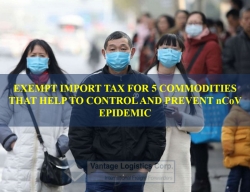
Vietnam Government Decided to Exempt Import Tax for 5 Commodities that Help to Control and Prevent nCoV Epidemic

For fast response action against the nCoV epidemic, Viet Nam Minister of Finance recently signed the Decision 15/QD-BTC on 7 February 2020 to exempt import tax for commodities that help to control and prevent the epidemic. The annex of said-above decision listed 5 groups of commodities that are tax exempted and the procedure and documents to be tax exempted will be in compliance with current law and regulations: – Medical masks, with circulation numbers issued by competent medical agencies, HS codes 6307.90.40 and 6307.90.90. – Disinfectant hand sanitizer (hand gel or liquid sanitizers) with the registration number issued by the Environment Management Department of the Ministry of Health, HS code is 3808.94.90. – Raw materials for manufacturing medical masks include: Non-woven fabrics for manufacturing medical masks and antibacterial filters for producing medical masks of heading 56.03; elastic bands for the manufacture of medical masks with HS codes 5604.10.00, 5606.00.00, 6002.40.00 and 6002.90.00; nasal splint for manufacturing medical masks (bars / rolls) with HS codes 3916.10.20, 3916.20.20, 3916.90.42, 3926.90.92, 3926.90.99, 7217.90.90, 7326.90.99, 7604.10.10 , 7604.29.10 and 7616.99.90. – Disinfectant water (liquid bactericidal preparations) with registration number issued by the Department of Health Environment Management, Ministry of Health has HS codes 3808.94.20 and 3808.94.90. – Other necessary supplies and equipment, including: Epidemic prevention suits (including pants, shirts, glasses, medical masks, helmets, gloves, shoes) with circulation numbers issued by authority Health agencies, HS code 6210.10.90. Coronavirus is not only impact to people’s health, but also the economy and politics Decision 155/QD-BTC takes effect from February 7, 2020 to the date of the competent authorities’ written announcement of the end of the epidemic. *** More information on acute respiratory infections caused by new Coronavirus strain: Originating from Wuhan City, China; the acute respiratory infection caused by the new Coronavirus strain (referred to as nCoV) has spread to 27 countries and territories (outside mainland China). As of February 10, 2020, the disease situation in the world is as follows: – Total number of positive cases: 40,553, of which in mainland China: 40,171 – Total deaths: 910, of which: 1. Mainland China: 908 2. Philippines: 01 3. Hong Kong (China): 01 – Total number of cases outside mainland China: 382, ​​including 27 countries and territories: 1. Japan: 96 cases 2. Singapore: 43 cases 3. Hong Kong (China): 36 cases 4. Thailand: 32 cases 5. South Korea: 27 cases 6. Taiwan (China): 18 cases 7. Malaysia: 17 cases 8. Australia: 15 cases 9. Germany: 14 cases 10. Vietnam: 14 cases 11. America: 12 cases 12. France: 11 cases 13. Macau (China): 10 cases 14. Canada: 7 cases 15. United Arab Emirates: 7 cases 16. England: 4 cases 17. India: 3 cases 18. Philippines: 3 cases 19. Italy: 3 cases 20. Russia: 2 cases 21. Spain: 2 cases 22. Cambodia: 1 case 23. Finland: 1 case 24. Nepal: 1 case 25. Sri Lanka: 1 case 26. Sweden: 1 case 27. Belgium: 1 case Source: Vietnam Public Health Emergency Operation Center – Ministry of Health...

11/02/2020

View More

Vantage News

Proudly Bring the Ever First Vietnamese Car Brand to The World

Paris Motor Show 2018 is being held from 2-14 October 2018 as a largest and prestigious automotive exhibition, where is gathering lot of big car brands in automotive industries around the world. This show is presenting to the world the most innovation design and advanced technology in car manufactoring.  First Vietnamese car brand at the Paris Motor Show 2018 VinFast is the most-mentioned name in serveral recent days. This name is considered as a miracle of the automotive industry in Vietnam when combining with Pininfarina (Italy) to debut 2 very first Vietnamese trademark car models at Paris Motor Show 2018 within only one year after starting this project. VinFast is honored as “New Star” of world automotive industry by Autobest – the Euro’s leading organization of automakers due to its unbelievable achievement. This award recognizes VinFast’s fervent and aspirational start. Video: https://www.cnet.com/roadshow/videos/vinfast-the-first-vietnamese-car-company-debuts-at-paris-motor-show/ Proudly bring the first Vietnamese car brand to the world With the hightened determination of the “New Star” VinFast, their debut at Paris Motor Show 2018 must be a flawless and “no-mistake-allowed” event. For an impressive presentation at one of the world’s largest exhibitions such as Paris Motor Show 2018, VinFast has  put  a lot of efforts in every step, so as all  VinFast’s  partners. Vantage received the request to handle Vinfast’s shipment for this Paris Motor Show Event just 2 weeks in advance. This is really a tough request, because a single small mistake may harm the whole preparation effort of Vinfast. We only have 1 choice: success with zero mistake. The most tough issue for Vantage is to define the right counter-part in France, among very limited authorized parties within a very short time and with very limited information, to handle France on-shore delivery. . Other tasks are also rushing:  pick up, documentation, HS assessment to match with regulations in France, customs clearance both Viet Nam and France ends …  Customer’s success is Vantage’s mission, we had overcome all obstacles and  achieved the tough job The shipment was safely handed-over at  the booth of VinFast before the show opened. On behalf of VinFast, Ms. Pham Quynh Anh (General Director Assistant) and Ms. Do Ngoc Chi (Product Branding and Activation Specialist) thanked Vantage for its good service, as well as expressed good will of  long-termed cooperation.  ...

16/10/2019

View More

Blog

A Case Study About Valued Policy Insurance Through a Dispute Case

Summary A vessel carried 5,500 tons of construction materials from Tuticorin (India) to Male and Foammulah (Maldives). The ship arrived Male on August 9, 2016 partially unloaded and left Male on August 12, 2016. On August 13, 2016, while the ship was looking for a safe anchorage at Foammulah, it ran aground on coral reefs and rocks near the coast. In the evening of September 5, 2016 the ship’s workers began to throw goods into the sea to lighten the ship; by the morning of September 9, 2016, the ship had disposed of nearly 3,000 tons of cargo and on September 14, 2016, the number of goods left on board was 1,882 tons. In the afternoon of September 15, 2016, the rescue tugboat, with the support of ship’s main engine, successfully free the ship, the ship tilted to the right of 8 degrees. After adjusting the tilt, the tugboat pulled the ship to a safe position 0.30S-073.40E but the ship was badly damaged. On September 23, 2016, the ship owner announced to abandon the ship. On October 1, 2016, the ship was towed out of Maldives waters to a position about 90 nautical miles from Foammulah Island, 4,000 meters deep and sank at this location on the same day. The ship-owner bought hull insurance with a sum insured of USD 2.8 million and a vessel value of USD 2.8 million. Therefore, for a total loss, the ship-owner claimed USD2.8 million from the insurance company, but the insurance company argued that this was not valued policy (from the ship owner’s point of view) but value insurance. Therefore, the compensation is only accepted according to the results of price determination at the time of loss (August 13, 2016) – much lower than USD2.8 million. Since it was impossible to negotiate, the ship owner sued the insurance company in court. Summary of the ship owner’s point of view The ship owner thinks that the insured is the ship including the hull, machinery and equipment on board, the insured value is USD 2.8 million, the insurance amount is also USD 2.8 million. The ship-owner and the insurance company agreed to define this case as an estimated total loss. The ship-owner disagrees with the amount of compensation offered by the insurance company under the appraisal deed on the grounds that this is “valued policy” as prescribed at point c, Clause 2, Article 228 of the Vietnam Maritime Code 2005: “A valued policy is an insurance policy in which the insurer agrees in advance the value of the insured subject stated in the policy, in accordance with the insured value, and is used in the settlement of a claim for total loss or partial loss compensation”. In addition, the ship owner also asked the insurance company to pay interest on the amount of USD 2.8 million from the date they should have been entitled to this amount until the date of the judgment. Summary of the insurance company’s point of view The insurance company invokes Article 46 of the Law on Insurance Business 2000: “1. The amount of compensation payable by the insurer to the insured is determined on the basis of the market price of the insured property at the time and place where the loss occurs and the actual extent of damage, unless otherwise agreed in the insurance contract. The cost of determining the market price and the extent of the damage shall be borne by the insurer. 2. The amount of compensation paid by the insurance company to the insured must not exceed the sum insured, unless otherwise agreed in the insurance contract” to refuse to indemnify the full sum insured (is also the value of ship insurance – USD 2.8 million) and considering that this is over-value insurance, it only accepts compensation according to the results of the ship’s appraisal. Summary of the Court and the Procuracy’s point of view Based on the results of studying the case file, through examination, questioning, answering and debate at the court hearing on October 19, 2018; The Court stated: “[… ] the insured value is the actual value of the insured subject. Therefore, the sum insured […] must be based on the actual value of the vessel at the time of the insured event” (page 12 of the Judgment). The Procuratorate held that “[…] the two parties signed an insurance contract that exceeded the value of the insured property […]” (page 10 of the Judgment) – often called over-value insurance – so it was necessary to determine price to obtain the amount of compensation according to the assessment certificate requested by the Court. Therefore, on October 23, 2018, the first-instance judgment was issued from the point of view of not recognizing this as valued policy as argued by the ship owner (plaintiff) and only accepting compensation as the opinion of the insurance company (defendant) according to the results of the valuation that the Court has solicited with the value of the ship at the time of the loss (August 13, 2016) is 41,541,429,000 VND (equivalent to USD 1,779,000 at the exchange rate of 1 USD = 23,351 VND) and the value of spare parts and supplies on board is 5,283,065,575 VND (equivalent to USD 226,246) and the amount of interest is 8,593,418,541 VND (equivalent to USD 368,010). Commentary Article 2.1 of the Insurance Contract states: “This insurance contract is governed by and regulated by the Vietnam Maritime Code. Where the Vietnam Maritime Code has not yet provided for, the International Maritime Insurance Laws and Practices shall apply”. Thus, the Vietnam Maritime Code 2005 (in force at the time of loss) is applied and if there is any shortage, international insurance laws and practices shall be applied. The hull insurance certificate clearly states: “Vessel Value: USD 2,800,000, Sum Insured: USD 2,800,000” and there is no agreement on re-valuation upon settlement indemnify. Therefore, based on Point c, Clause 2, Article 228 of the Vietnam Maritime Code 2005: “A valued policy is an insurance policy in which the insurer agrees in advance to the value of the subject-matter insured stated in the policy insurance, in accordance with the insured value and used in the settlement of a total loss or partial loss claim”, the insurance service in this case is valued policy and the insurance company must pay $2.8 million. The judgment is 15 pages long, the writer only commented briefly on the nature of the incident and hoped to have the opportunity to discuss and clarify more. It is known that on November 2, 2018, the ship-owner submitted an appeal against the judgment of the first-instance Court for appellate trial. Summarize and synthesize by Lawyer Ngo Khac Le (Vietnam Logistics Association — VLA) – Vietnamese-English translation by www.vantage-logistics.com.vn...

02/07/2019

View More

Blog

”Must Be More Than a Good Service” – Vantage’s Lodestar in Business

Good service is not enough; in order to succeed, businesses must be helpful to customers when they are in need. Business has never been easy, especially in today’s increasingly fierce competition. So what do businesses should do to survive and grow in the market? The answer is – Businesses must be helpful to customers when they are in need. The quality of products and services you provide to customers must always be guaranteed to the highest level – But this is just a necessary, but not a sufficient condition for a successful business. Ms.Truong Thi Uyen My, senior specialist of Vantage’s Customs Broker Department, stated: “Over 20 years of serving customers, I realized that the prerequisite for customers to think about us, to choose us among the multitude of competitors is: Are we helpful for customers when they need us?” To explain why, she shared a recent case, by which she and her colleagues have won the trust of customers as well as business opportunity with enthusiastic, timely and effective support when they need it. Solar Park 1 and 2 solar power projects are under same investor and EPC contractor, the logistics part was contracted to 2 service providers: Vantage and another logistics service provider (company “X”); both have to match the very harsh time frame for customs clearance and delivery. According to the original plan, company X was assigned to apply for tax exemption master list, full-set declaration list and customs inspection at site for the two projects Solar 1 and 2, as well as customs clearance and delivery to job site for Solar 1; while Vantage was only responsible for handling customs clearance and transporting to the job site for Solar 2. However, when we start the project, we realize that the way company X handling tax exemption master list, full-set list was not the best way and had potential risk for project owner could not enjoy tax exemption for many equipment that they should be able to enjoy legally, Vantage had proactively proposed our solution and got approval from the investor and EPC contractor to provide full logistics service for Solar 2 project (instead of responssible for customs clearance and delivery to jobsite as originally planned). Since the first shipments arrived, Vantage’s team always proved our expertise on customer service focusing, ensuring timeliness, safety and accuracy for all tasks that we handled. Thank to this, Vantage gained more and more trust from customer; we were regularly being asked to give advice or support to company X when they encountered difficulties in their scopes of work. Then there was an unexpected incident occurred. Company X had made a rather serious professional mistake in the process of customs declaration which leaded to the fact that they could not prove the integrity of the goods during transportation; resulting in the customs deciding to hold 13 containers of equipment at the port for further inspection, while the project was deadly in need of these containers. Company X was not capable to convince and prove the intergrity of goods with customs. Customer asked Vantage to help them solving this problem. This was meaning that we had to help our “competitor” doing their job. It also meant that we needed to help without knowing about our “reward”. But we don’t hesitate. When our customer needs help, just do it and give customer our highest effort, using our rich experience and knowledge accumulated through various types of projects to prove and convince customs officers about the integrity and correctness of goods. Late on same day, Vantage got customs’ release and let company X to pick up and deliver shipment to jobsite. After this incident, the customer recognized how benefitable Vantage’s service is, and eventually, had decided to shift all scope of both projects Solar 1 and 2 to Vantage....

27/06/2019

View More

Blog

The Key to Long-Term Success: Building and Maintaining Client Trust

Nothing is as important as the trust of clients. Vantage believes that nothing is as important as the trust of clients; and gaining someone’s trust has never been an easy job. Mr. Pham Minh Nhut – Branch Director of Vantage in Da Nang city – shared about how his team and himself have made outstanding efforts to have the trust and appreciation of our client. Gaining client’s trust has never been an easy job In October 2018, a client who is speciallized in exporting automotive components to South Korea, China and Myanmar started to use trucking and customs clearance services of Vantage for their export shipments. The job is pretty simple and many logistics providers definietely can handle. However, with our working spirit “Every customer is served as our unique customer”, we take care of each individual set of shipping document, each individual customs declaration, each truck, the serving attitude of all involved personals and teams, always deliver the work more than expected. Eventually, our Vantage Da Nang team gain the trust from customer, they assign us more and more jobs, and then, including the jobs that traditionally they fix with just several service providers (who are still delivering a fair service). Moreover, their appreciation to Vantage also leads to a lot of precious recommendation for Vantage to do business with many of their buyers and partners, helping Vantage to expand our business network. And up to now, whenever there is any demand, issues, questions about logistics, the first company this customer come to is Vantage. Mr. Nhut said: “Everything we do, we do it on customer’s benefit. When we really care about our customers, and treat their problems as our own problem, their success as our own success, we don’t feel our job is a burden anymore, it is really our happiness, our creation, our strong connection. We “nourish” our client’s trust by continuous excelling at everything we do, as if taking care of a seedling, and our harvest is their trust and appreciation for us.”...

12/06/2019

View More

Blog

Role of Business in Environmental Protection

Businesses hold a very important role in the economy and society. But there is a fact that, pollution is also mainly caused by businesses, so limiting and reducing pollution must also be from businesses. Taking responsibilities of businesses in environment protection is a key solution to solve current environmental issues. Besides businesses that directly impact environment such as exploitation of natural resources or waste discharge from plants and factories, office activities though seem to be “innocent” but do have significant impact, too, especially in industries with high printing demands such as law, health, accounting, finance, education… (Sources: Tonerbuzz – 2017) Therefore, along with investing in green technologies, seeking alternative sources of materials to reduce the impact of business activities on environment, businesses also need to impose appropriate solutions such as  using energy reasonably, reducing unnecessary usage of printing paper, which not only saving costs but also reducing the explotiation of natural resources, especially forest resource – the main raw material for paper production. At Vantage, below is what we are doing. We follow 3R method: Reduce – Reuse – Recycle when using paper at our office: – Reduce: + Only print when necessary. + Print two-sided documents. + Go digital. Use e-mail instead of paper memo. + Proofread! Thoroughly check the document for typos and other errors to avoid having to print again. + Fit into a single page. Reduce the font size, shrink the margins, reduce the space taken up by the footer and header. Check the print preview before printing to ensure the integrity of the content. – Reuse: + Reuse paper that is clean on one side for in-house drafts, notes and photocopies. + Reuse cardboard boxes of the right size to keep a stack of such reused paper, clean side up, near printers and copiers. + Conduct research online and at libraries rather than ordering lots of written materials. + Share periodicals with associates instead of receiving multiple copies. – Recycle and buy recycled: + Collect office paper, newspapers, cardboard, magazines, and colored paper scrap wood and send for recycle. + Buy copier paper, paper towels, tissues, and toilet paper with “post-consumer recycled” content. The higher the post-consumer content, the greater the amount of materials that have been through the entire recycling process – and the greater the savings of precious natural resources and energy. Besides, the development of information technology nowardays also helps employees at Vantage completing their tasks with less paper. Take advantage of email, public folders, open sources to store documents, vouchers, receipts…; only print when really needed; this help us minimize paper usage, while also saving time and costs on operation. Preliminary statistics at our company show that, by using cost-effective measures and using reasonably available technologies, we can reduce paper consumption by 10-20%. Each of us understands one thing, the responsibility of protecting the environment does not belong to any individual or organization, but all of us. Living and doing business environmentally responsible, is also responsible for ourselves, as well as the future generations. Environment’s Tomorrow Needs Our Participation Today....

11/06/2019

View More

Blog

Because every shipment, whether big or small, must be cared for

Each shipment is not only the goods, but also a client’s trust. When client hand over their shipment to a logistics service provider, they are also giving their trust. A shipment is transported promptly and safely will bring competitive advantages and reputation, otherwise, could be some negative effects. Therefore, clients would only choose reliable and reputable logistics service providers that can bring them the best quality services. Besides timely deliver, optimal transportation cost, the safety for goods is one of the vital factors that drive client’s determinants when they choose logistics partner.  At Vantage, each shipment must be cared for, no matter how big or small it is As an international logistics company, Vantage understands the roles and responsibilities of a logistics service provider to clients and their goods. Each of Vantage’s employees, regardless of their position, must not only be bring optimal services to meet client needs, but also do their work with outstanding efforts, take full responsibility in each of their task even the smallest one. To us, every shipment, whether it is several tens of tons or only few kilograms, worth several hundred thousand dollars or only worth a few dozen dollars, must to be carefully handled. When receiving any shipment from clients, the first thing that Vantage do is to check carefully the detailed information and specification as well as special instruction; in order to provide the most optimal plan on time, cost and safety for goods at the highest level. Below is a typical case of how mastering information of shipment helped us on proactively handling arisen problems. In the beginning of April, 2019, Vantage received information about the shipment of a set of integrated procedure trainer for airbus A321 which imported by Vietnam Airlines from France. This equipment shipment is packed in 6 wooden pallets with total volume of 1,784kgs. Vantage is required to receive the shipment at the warehouse in Tan Son Nhat International Airport and deliver to consignee’s nominated warehouse. Shipper’s logistics company provided information of the shipment; yet, there was no special note / instruction attached. Recognizing that the commodity is very special, Vantage’s import department has requested for more specific details and instruction. The packages were also attached with a shock watch (shock warning) as well as ‘Handle with care’ label. As soon as receiving cargo discharged from airplane, Vantage immediately checked the condition of cargo and found that 3 out of 6 shock watches had turned red. Vantage’s person in charge immediately contacted both origin and destination sides to report and request for instruction, as well as to prepare the solution basing on our technical team’s knowledge and experience. After our proposed method is approved, the shipment was transported at 200% of carefulness and finally safely delivered to consignee’s assigned warehouse. For specific cargo, we know that understanding the cargo nature and strictly follow transportation instruction is a must for a safe delivery....

20/05/2019

View More

Market updates

Vantage Is Proud to Accompany Investors to Bring Solar Power to Viet Nam.

In Viet Nam, the investment in renewable energy, particularly wind and solar power plants, is being encouraged by the Government with favorable policies and incentives. Of which, solar power is being high interested by investors when a lot of policies of investment incentives, especially FIT policies for projects which come into operation before June 2019 issued by the Government. As of the end of 2018, total capacity of newly registered solar power projects amounted to more than 11,000MV, focusing mainly in the central highlands and southeastern provinces, in which, solar power projects in Tay Ninh province such as Dau Tieng 1 & 2, or TTC 1 & 2 are considered as the first major projects to launch the explosion of solar power in Vietnam. However, besides advantage incentive policies by the Government, it is a real challenge to match the project time frame, and a reliable logistics partner is one of the key factors to overcome this challenge. Solar power projects are large in volume and high in time pressure, jobsites are far away and at some, the investors even don’t have enough time to do proper grounding for safe delivery, if the logistics company is not capable, it is easily incurred cost and delay. Vantage did well fore-casting and good preparation from human resources, finance, equipment to subcontracts to ensure the best quality of logistics services for solar power plant customers. Typically, Dau Tieng 2 project (240MW) starting construction in June 2018, Vantage is strategic logistics partner, covering international shipping, master list application, customs clearance, delivery from port of arrival to job site at Tay Ninh province, supervision and unloading goods. The total volume of whole project is up to 5,000teus, continuously imported to Vietnam during the period from September 2018 to May 2019. There were sometimes hundreds of containers arrive together. Vantage project delegation had to work over weekend and holidays to ensure fastest customs clearance and delivery to and minimize detention cost and optimize time frame. Besides, other solar power projects such as TTC 1 & 2 (Tay Ninh); Xuan Tho 1 & 2, Tay Hoa (Phu Yen); Ham Thuan (Binh Thuan); Cam An Nam, Cam An Lam (Khanh Hoa); AMI BMT (Dak Lak)… Vantage Logistics also optimized the time and cost. Peak season, holidays are the tough time when demand is much higher than supply, many projects are thirsty of labor and transportation equipment, yet thanks to well preparation, Vantage have our back-up plan, even transportation subsidies to ensure trucks availability to match time frame. Besides our business ethic and reputation, the strong believe that solar power plants will deliver green energy for sustainable development of our country also push us forward to great efforts to achieve the jobs professionally and timely....

13/05/2019

View More

Vantage News

Returning Goods: Concerned Factor in International Trade

Returning goods/ Re-exporting goods: Concerned Factor in International Trade In international trade, smooth process of import-exporting cargo is one of the key factors of success. To achieve that, traders need to work on a lot of things: capital, products, applicable regulations and policies of both origin and destination countries, choice of reliable logistics partners… Especially the product-related factors, if the required specifications or product quality are not matched, it is easily resulted to the situation that the buyer denies shipment; or the buyer has to return the goods after receiving; hence, causing negative effects to business activities of both seller and buyer, and costs incurrence. Sharing about this topic, Ms. Theresa – Vantage’s Customs Expert – talked about a case that she and her colleagues had processed for our customer before 2019 Tet holiday. Theresa – Customs Expert of Vantage’s Cusbrok Department One day at the end of August 2018, a shipment from Penang, Malaysia was discharged at Hai Phong port, Vietnam; however, since contracted-particulars were not matched, the buyer denied it. Seller and buyer had several negotiations but could not reach the agreement that buyer will accept cargo, eventually the shipment was forced to return. And due to some reasons, the shipment was not returned until end of December 2018, incurring a demurrage amount of more than USD7,200. On December 26, 2018, seller’s logistics company contacted Vantage, asking for assistance to re-export that shipment to Malaysia. Being assigned to assist them, Theresa immediately took action, contacted all related parties to obtain details and worked out a solution. Bearing in her mind that the faster the processing of return is, the more cost she could save for customer, Theresa had fully prepared all relevant information and documents, just waiting for official confirmation from the seller and their logistics company’s confirmation to proceed. On January 22, 2019, Theresa finally received confirmation from Malaysia to proceed the re-export tasks. Theresa and her team ran to fulfill the tasks in the rushing period, targeting themselves “no mistake – no delay” to load the shipment onboard before the long Lunar New Year holidays to cut down demurrage cost for customer. Thus, with professionalism and spirit of ‘supporting customer first’, on January 30, 2019, Theresa and her colleagues had completed all necessary procedures (obtaining signature and stamp from related parties is the most time-consuming in this task) and loaded the shipment onboard to return to seller. Theresa added that re-exporting procedure is never simple as many people may think. It involves a lot of complicated documents, relations, problems, costs. If seller and buyer are not co-operative, the shipment could easily be stuck for months, cost incurred easily reaches to thousands USD, and even much more if the cargo is in reefer container. To avoid this situation, the seller needs to check carefully the status and particulars of goods and other contracted conditions before shipping out; meantime, the buyer should check carefully the information before receiving the goods. In case the buyer denies cargo due to any reason, both seller and buyer should co-operate to return shipment as smoothly and quickly as possible, avoiding unnecessary cost incurrence, especially demurrage / storage cost which is considerably high (average 60-70USD/day). If you have any inquiry on returning goods / re-export procedures, our Customs Expert – Ms. Theresa/ Email: th********@***************cs.com is willing to assist....

02/05/2019

View More
1 … 36 37 38 39 40 … 43