RESOURCE

Market updates

SINGAPORE STRENGTHENS PRODUCT SAFETY CONTROLS: WHAT VIETNAMESE EXPORTERS NEED TO KNOW

Singapore is strengthening its product safety controls through two key regulations: the Consumer Protection (Safety Requirements) Regulations (CPSR) and the Consumer Goods (Safety Requirements) Regulations (CGSR). For exporters, these requirements go beyond product compliance. They can also affect delivery schedules, logistics costs, and supply chain reliability. 1. Singapore Strengthens Product Safety Requirements According to information published by Vietnam’s Ministry of Industry and Trade, Singapore applies two main regulatory frameworks for product safety. – CPSR: Covers 33 categories of controlled goods, including electrical and electronic products, household appliances, and gas appliances. Products within scope must meet applicable safety requirements, complete registration, and carry the SAFETY Mark before being supplied or sold in Singapore. – CGSR: Covers general consumer goods such as toys, clothing, furniture, and sports equipment, which must comply with the relevant safety standards. Non-compliant products may be subject to sales restrictions or recalls. Businesses that violate applicable requirements may also face penalties. For exporters, checking compliance requirements before shipment is essential. Addressing documentation or registration issues early can help avoid costly adjustments after cargo has already left the port of origin. 2. Potential Impact on Southeast Asia’s Trade and Logistics Singapore plays an important role in Southeast Asia’s trade and logistics network. Tighter product safety controls may require exporters, importers, and distributors to review their procedures for placing goods on the Singapore market. Several potential risks deserve attention: – Delivery delays: Incomplete documentation or missing certificates may affect cargo acceptance and delivery schedules. – Additional logistics costs: Delays in resolving compliance issues may lead to storage, port handling, or additional transportation costs. – Disrupted distribution plans: Late deliveries can affect inventory planning, distribution schedules, and commitments to business partners. These requirements do not automatically apply across all ASEAN markets. However, they highlight the importance of understanding the specific regulations of each destination country when planning regional trade and distribution. 3. What Should Vietnamese Exporters Prepare? For Vietnamese businesses exporting to Singapore, compliance checks should take place before shipment arrangements are finalized. Exporters should determine whether their products fall under CPSR or CGSR, verify the applicable safety standards and registration requirements, and clarify responsibilities with their Singaporean importers. Documentation preparation should also be factored into the shipping schedule. If an issue is discovered only after cargo arrives at the destination port, businesses may need to manage several challenges simultaneously, including delivery delays, additional costs, and changes to distribution plans. A reliable shipping plan therefore involves more than selecting the right route or sailing schedule. It also requires anticipating potential obstacles before the cargo reaches its destination. 4. Managing Risks Through Early Planning Not every risk in international shipping can be eliminated, but many disruptions can be reduced through early preparation. Reviewing cargo information, documentation, shipping schedules, and destination requirements helps all parties make better-informed decisions. For shipments to Singapore, close coordination among exporters, importers, agents, and logistics providers helps maintain visibility over shipment readiness, address changes, and adjust plans when necessary. At Vantage Logistics, international transportation planning takes into account the practical requirements of each shipment and the coordination needed among relevant parties. This approach helps businesses manage potential disruptions and maintain better control over delivery schedules. As market requirements evolve, careful preparation does more than protect an individual shipment. It also helps businesses maintain reliable supply chains and build lasting partnerships across international markets.

15/10/2026

View More
vlc-news-shipping-container-guide-13102026

Logistics

A GUIDE TO SHIPPING CONTAINER TYPES: DIMENSIONS, CAPACITY AND TECHNICAL SPECIFICATIONS

Choosing the right shipping container depends on the cargo’s dimensions, characteristics, weight and handling requirements. Understanding container specifications helps businesses determine the most suitable equipment and plan cargo loading more effectively. This guide provides a quick reference to 12 container types, covering their dimensions, internal volume and key weight specifications. Key Considerations When Selecting a Shipping Container Check the internal dimensions: Use the container’s internal dimensions to calculate the available loading space. Compare the cargo’s length, width and height against the usable internal dimensions, allowing for the clearance needed for loading and unloading Understand payload and gross weight limits: Payload refers to the maximum cargo weight a container is designed to carry, while maximum gross weight includes both the container’s tare weight and the cargo. For inland transportation, also check the applicable vehicle weight limits and road regulations along the planned route Inspect the container before loading: Check the container’s exterior, floor and doors for damage or signs of water ingress. For refrigerated containers, verify that the refrigeration unit is operating properly and that the required temperature can be maintained for the cargo Note: Specifications may vary by container model and manufacturer. Always check the equipment plate on the assigned container before loading.   Contact Vantage Logistics for tailored transport solutions and competitive quotations. Please provide details on cargo type, market, origin, destination, and estimated timeline. Vantage Logistics Corp – South East Asia (S.E.A) Logistics Provider One-Stop Shop For Integrated Logistics Services Head Office Viet Nam – Suite 6.01, Floor 6th, Block A, RiverGate Residence, 151-155 Ben Van Don, Khanh Hoi Ward, HCMC, Viet Nam Branch Thailand, Laos, Cambodia, Malaysia, Indonesia, Singapore Contact Us Email in**@*****om.vn Hotline +84-909-026-261 Website https://vantage-logistics.com Send your shipment enquiry today and receive a tailored transport plan from the Vantage Logistics team.

13/10/2026

View More
vlc-news-cross-border-logistics-10102026

Vantage News

VANTAGE LOGISTICS – INTEGRATED CROSS-BORDER TRANSPORT SOLUTIONS IN THE MEKONG REGION

Connecting supply chains across Viet Nam, Cambodia, Laos, and Thailand through synchronized maritime-road corridors and cross-border transit customs. In manufacturing and international trade, moving raw materials, components, and finished goods across Mekong countries requires a balance between delivery speed and logistics costs. Compared to sea freight, cross-border trucking reduces transit times significantly. However, the most critical operational challenges involve transit customs procedures and differing axle-load regulations across jurisdictions. A minor documentation discrepancy at the border or an axle-load calculation error can cause border congestion and incur substantial truck demurrage fees. Vantage Logistics delivers integrated Cross-Border Logistics solutions, combining multimodal connectivity, strict regulatory compliance, and localized operational management: 1. Flexible Transport Configurations Tailored to project budgets, delivery schedules, and vehicle circulation regulations across each market, Vantage Logistics deploys adaptable transport options: Border Transshipment (Back-to-Back Trucking): Coordinating cargo transfers or prime mover swaps at key border checkpoints (such as Moc Bai / Bavet and Lao Bao / Dansavanh) to optimize operating costs when vehicles are restricted from operating deep into the destination country Direct Cross-Border Trucking: Providing vehicles with valid international road transport permits and logbooks, ensuring seamless door-to-door delivery from dispatch facility to consignee warehouse Cross-Border Axle-Load Compliance: Calculating and distributing cargo weight in strict accordance with national regulations across Viet Nam, Cambodia, and Laos, preventing fines or forced offloading at border weigh stations Bonded Trucking: Managing cargo transit under customs supervision with intact customs seals from seaports to export border checkpoints or designated bonded facilities 24/7 GPS Tracking: Delivering real-time vehicle positioning to monitor route progress, milestone checkpoints, and actual on-site delivery 2. Transit Customs Clearance & GMS Framework Expertise Synchronizing documentation workflows to maintain uninterrupted cross-border cargo flow: Multilateral Transport Frameworks (GMS & Bilateral Agreements): Assisting clients in completing applications for cross-border transport permits and logbooks under the Greater Mekong Subregion (GMS) Cross-Border Transport Agreement and bilateral road transport pacts between Viet Nam, Cambodia, and Laos Pre-Arrival Document Synchronization: Closely coordinating between documentation teams in Viet Nam and our Phnom Penh branch office / localized partner networks to cross-check transit declarations and commercial invoices before vehicles arrive at the border, minimizing wait times at border checkpoints Transit Customs Clearance via Viet Nam: Managing customs transit declarations for international shipments moving through Viet Nam’s major seaports (Cat Lai, Cai Mep, Hai Phong, Da Nang) to Cambodia, Laos, and vice versa Quarantine & Tariff Consultation: Representing cargo owners in specialized inspections (phytosanitary and veterinary quarantine) at international border gates; advising on HS code classification and verifying the validity of Certificate of Origin (C/O Form D) under the ATIGA framework to ensure applicable tariff preferences Proof of Delivery (POD) Management: Collecting, reviewing, and delivering official POD documents endorsed by customs authorities at both borders for tax finalization, while providing advisory support on local road tolls and regional fiscal requirements 3. Multimodal Transport Connectivity Beyond road transport, Vantage Logistics bridges cross-border corridors with international ocean freight loops to expand regional reach: Regional Export Gateway Support: Facilitating overland cargo movement from Cambodia and Laos to Viet Nam’s major seaport hubs, connecting regional exports with mainline ocean carriers bound for global destinations Project Cargo & Heavy Machinery Coordination: Mobilizing specialized equipment in coordination with our in-house Project Logistics technical team for oversized/overweight machinery, industrial plant equipment, and temporary import/re-export shipments 4. Commercial Value for Businesses Transit Time Optimization: Reducing transit time on key corridors – such as Viet Nam to Cambodia within 1–2 days (compared to 5–8 days by sea) – securing continuous raw material flow for manufacturing lines Cost Efficiency: Delivering substantial cost savings compared to air freight while meeting rapid delivery requirements across diverse cargo categories Direct Localized Presence: Backed by 5 branch offices in Viet Nam (Ho Chi Minh City, Ha Noi, Hai Phong, Da Nang, Qui Nhon) and an established branch office in Phnom Penh, Cambodia, Vantage Logistics ensures rapid problem resolution and on-site support without reliance on third-party intermediaries Looking for an optimal transport solution between Viet Nam, Cambodia, Laos, and Thailand? Contact Vantage Logistics for routing advice and tailored quotations.   Contact Vantage Logistics for tailored transport solutions and competitive quotations. Please provide details on cargo type, market, origin, destination, and estimated timeline. Vantage Logistics Corp – South East Asia (S.E.A) Logistics Provider One-Stop Shop For Integrated Logistics Services Head Office Viet Nam – Suite 6.01, Floor 6th, Block A, RiverGate Residence, 151-155 Ben Van Don, Khanh Hoi Ward, HCMC, Viet Nam Branch Thailand, Laos, Cambodia, Malaysia, Indonesia, Singapore Contact Us Email in**@*****om.vn Hotline +84-909-026-261 Website https://vantage-logistics.com Send your shipment enquiry today and receive a tailored transport plan from the Vantage Logistics team.

10/10/2026

View More
vlc-news-customs-regulation-6102026

Market updates

ENTRUSTED IMPORT: KEY NOTES ON CUSTOMS DECLARATIONS, INVOICES, AND C/O FORM E

The General Department of Customs has recently issued guidelines clarifying issues in entrusted import dossiers concerning the declarant, commercial invoices, and C/O Form E. The core takeaway for enterprises: documents do not strictly have to share identical entity names, but the entire dossier must accurately reflect the true nature of the transaction and ensure consistency. On October 5, 2026, the General Department of Customs issued Official Letter No. 22560/CHQ-GSQL in response to enterprise inquiries regarding customs procedures, entrusted import dossiers, and Form E Certificates of Origin. This document clarifies the application of current regulations to specific cases, focusing on the relationship among the customs declarant, the commercial invoice, the entrustment relationship, and origin documents. Below are 3 key points that enterprises should note: 1/ The Entrusiary Acting as Declarant Must Meet Customs Declarant Requirements According to the guidelines in Official Letter No. 22560/CHQ-GSQL, if an enterprise signs an entrusted import contract in accordance with the law on commerce and foreign trade management and acts as the customs declarant on the customs declaration, that enterprise must fully satisfy the conditions applicable to a customs declarant. Recommendation for Enterprises: Clearly define the participating entities right from the preparation stage (entrustor, entrusted party, and the unit acting as the customs declarant) to ensure compatibility between legal status and declaration dossiers. 2/ Invoices Do Not Necessarily Have to Match the Declarant’s Name A notable point of the official letter is that current customs dossier regulations do not require the buyer on the commercial invoice to match the name of the customs declarant. However, not requiring matching names means enterprises must still ensure information alignment: Information on the commercial invoice must accurately reflect the actual purchase and sale transaction with the overseas partner. The transaction’s dossiers and documents must accurately demonstrate the true nature of the entrustment relationship between the entrustor and the entrusted party. 3/ C/O Form E and the Requirement for Cross-Checking Documentation Regarding preferential import tariff rates under ACFTA, the official letter reiterates the application conditions under Decree No. 118/2022/NĐ-CP (goods must belong to the preferential tariff schedule, be imported from an ACFTA member state, meet rules of origin including direct consignment, and possess a valid Form E Certificate of Origin). Additionally, pursuant to Circular No. 12/2019/TT-BCT, customs authorities note that the declared information on Form E (especially information in Box 2 regarding the consignee’s name, address, and importing member state) must align with the customs declaration and related documents within the dossier. Checklist for Dossier Review Prior to Declaration: Enterprises should cross-check the entire document chain rather than reviewing each document in isolation: Entrusted Import Contract (Defining entities and scope of entrustment) International Sales Contract (Information on the buyer and overseas seller) Commercial Invoice Customs Declaration C/O Form E and related transport documents For enterprises utilizing customs and logistics services, handling entrusted shipments involving C/O Form E requires early data synchronization rather than waiting until goods arrive at the border gate. Reviewing the consistency of the entire dossier in advance will help enterprises ensure smooth customs clearance and avoid risks related to the denial of tax preferences. For enterprises seeking detailed consultation on customs procedures, origin of goods, and tailored logistics solutions for each entrusted shipment, please contact Vantage Logistics.   Contact Vantage Logistics for tailored transport solutions and competitive quotations. Please provide details on cargo type, market, origin, destination, and estimated timeline. Vantage Logistics Corp – South East Asia (S.E.A) Logistics Provider One-Stop Shop For Integrated Logistics Services Head Office Viet Nam – Suite 6.01, Floor 6th, Block A, RiverGate Residence, 151-155 Ben Van Don, Khanh Hoi Ward, HCMC, Viet Nam Branch Thailand, Laos, Cambodia, Malaysia, Indonesia, Singapore Contact Us Email in**@*****om.vn Hotline +84-909-026-261 Website https://vantage-logistics.com Send your shipment enquiry today and receive a tailored transport plan from the Vantage Logistics team....

06/10/2026

View More
vlc-news-IATA-6102026

Market updates

IATA Calls for Enhanced Control of Dangerous Goods in the Air Supply Chain

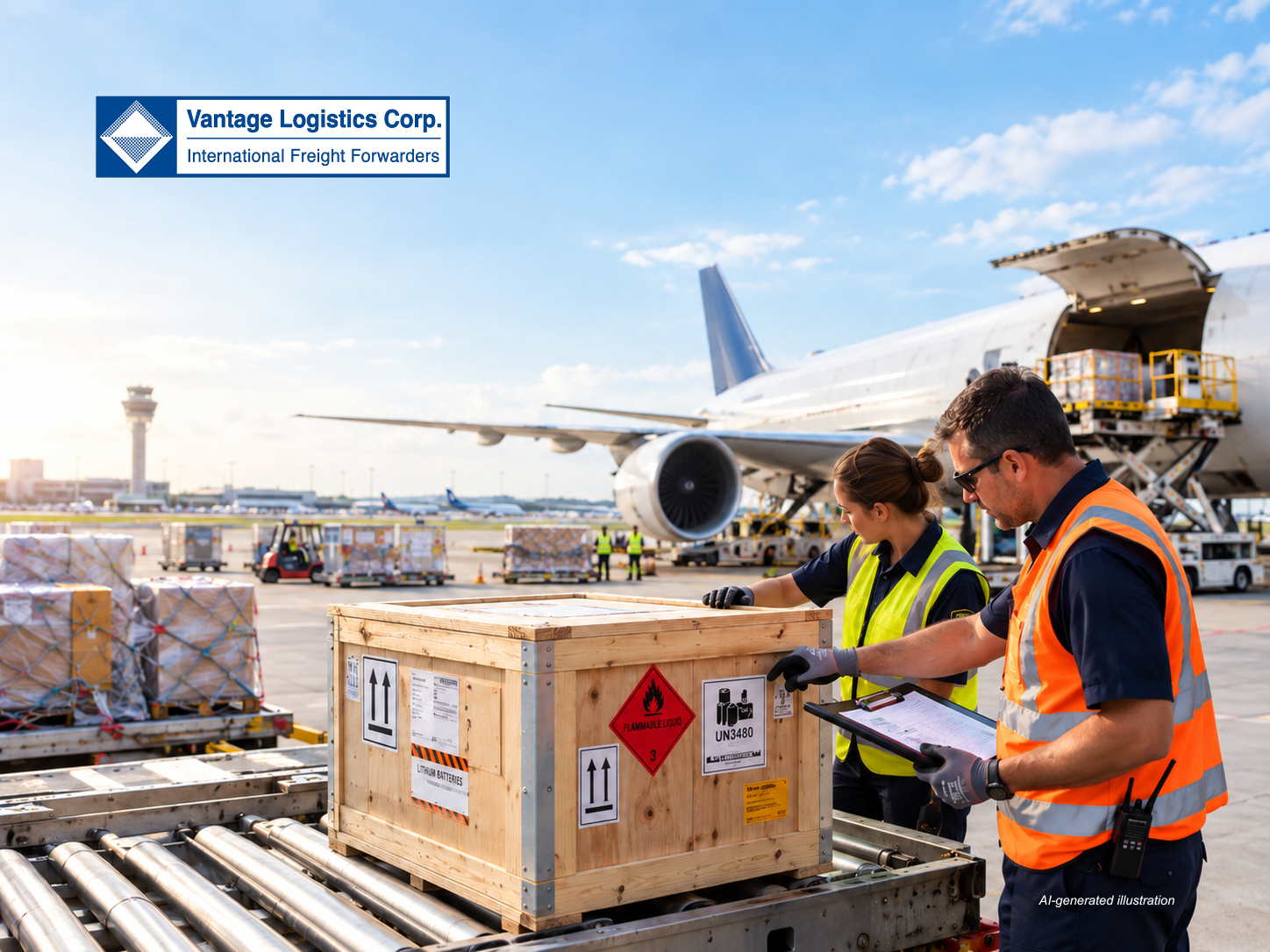
IATA is promoting a multi-layered control model for dangerous goods, emphasizing that risk identification, declaration, and control must be implemented early rather than relying solely on screening at the airport. According to IATA, airport security screening remains a vital layer of defense, but it cannot single-handedly address the risks posed by undeclared or hidden dangerous goods. Effective control requires seamless coordination among manufacturers, shippers, freight forwarders, airlines, ground handlers, and regulatory authorities across the entire supply chain. Risks Arising Before Cargo Reaches the Airport Dangerous goods transported by air must comply with stringent regulations concerning classification, packaging, marking, labeling, and documentation. However, risks typically arise when cargo is not properly identified, classified, or accurately declared during the initial stages of the supply chain. Key Notable Data Points: Approximately 80% of dangerous goods incidents reported to IATA in the first half of 2025 involved undeclared or hidden dangerous goods Lithium batteries, e-cigarettes, and aerosol cans are among the items most frequently detected in connection with declaration violations Early identification of risks provides stakeholders with additional opportunities to inspect, verify, and apply appropriate handling measures before cargo enters the air transportation system Multi-Layered Control Solutions Aligned with IATA’s Framework To minimize risks, IATA emphasizes shifting from a reactive inspection mechanism to proactive early management through the following measures: Enhanced Enforcement: Strengthening oversight by regulatory authorities and e-commerce platforms regarding product information Staff Training: Focusing on inspection and cargo identification competencies for intake teams at freight forwarding enterprises Data Sharing: Optimizing information flow among stakeholders to screen high-risk shipments before they are loaded onto aircraft Classification Challenges and the Role of Freight Forwarders The responsibility for accurately classifying dangerous goods rests with the shipper. Technical characteristics and compositions – particularly for products containing lithium batteries with varying configurations and quantities – must be determined at the planning stage. Nevertheless, freight forwarders remain a critical link in receiving information and conducting physical checks. Personnel trained in IATA DGR enable forwarders to recognize signs of undeclared or improperly declared dangerous goods while coordinating with shippers on packaging, labeling, and documentation requirements according to applicable regulations. Specialized Air Freight Solutions for Dangerous Goods at Vantage Logistics Amid rising compliance demands in international air transport, selecting a logistics partner with appropriate professional capabilities is essential for businesses to proactively manage risks and ensure supply chain continuity. Backed by our recognized credentials – IATA Code 3730023004 and IATA DGR Certificate #159783 – Vantage Logistics possesses the capability to support the transportation of high-scrutiny commodities via air freight. Beyond execution, we accompany customers from the initial stages of assessing cargo characteristics, consulting on compliance requirements, and preparing documentation, to coordinating with airlines and relevant parties to deploy suitable transport plans. This approach helps clients proactively meet international air transport standards while mitigating risks during transit. Contact Vantage Logistics to discuss your dangerous goods air freight requirements.   Contact Vantage Logistics for tailored transport solutions and competitive quotations. Please provide details on cargo type, market, origin, destination, and estimated timeline. Vantage Logistics Corp – South East Asia (S.E.A) Logistics Provider One-Stop Shop For Integrated Logistics Services Head Office Viet Nam – Suite 6.01, Floor 6th, Block A, RiverGate Residence, 151-155 Ben Van Don, Khanh Hoi Ward, HCMC, Viet Nam Branch Thailand, Laos, Cambodia, Malaysia, Indonesia, Singapore Contact Us Email in**@*****om.vn Hotline +84-909-026-261 Website https://vantage-logistics.com Send your shipment enquiry today and receive a tailored transport plan from the Vantage Logistics team....

06/10/2026

View More

Market updates

EU TIGHTENS RULES ON MEAT-RELATED PRODUCT NAMES FROM 2029: WHAT VIETNAMESE EXPORTERS NEED TO KNOW

The EU is tightening rules on meat-related product names from 2029. Vietnamese food exporters should review product names, labels, packaging, and marketing materials. EU Introduces New Rules on Meat-Related Product Names The European Union (EU) has adopted Regulation (EU) 2026/1739, introducing additional requirements concerning the use of meat and meat-related product names. The regulation entered into force on 18 August 2026, while the provisions concerning meat-related names will apply from 19 August 2029. A key change is the protection of 31 terms associated with meat, meat cuts, and meat products. The list includes beef, veal, pork, poultry, chicken, turkey, duck, goose, lamb, mutton, ovine, goat, drumstick, tenderloin, sirloin, flank, loin, ribs, shoulder, shank, chop, wing, breast, thigh, brisket, ribeye, T-bone, rump, bacon, steak, and liver. The use of these terms in product names will therefore require closer attention once the new provisions take effect. Implications for Plant-Based and Meat-Alternative Products The new rules are particularly relevant to businesses exporting vegan, vegetarian, plant-based, and meat-alternative products to the EU. Product names such as vegan chicken, plant-based beef, vegetarian pork, vegan bacon, or plant-based steak should be reviewed to ensure compliance with the new requirements. Simply adding descriptions such as “vegan,” “vegetarian,” or “plant-based” may not automatically exempt a product from rules governing protected meat-related terms. For Vietnamese exporters, compliance considerations extend beyond product labels to the broader commercial information used to market products in the EU. What Should Vietnamese Exporters Review? Businesses exporting food products to the EU should begin reviewing: Product names and food labels; Packaging and supplementary labels; Websites, catalogues, and sales materials; Product listings on e-commerce platforms; Advertising and promotional content; Product lines using any of the 31 protected meat-related terms. Particular attention should be given to terms such as beef, chicken, pork, steak, bacon, tenderloin, ribs, breast, and liver, especially where they are used in product names, descriptions, or to communicate flavor rather than actual ingredients. Preparation Ahead of the 2029 Deadline The new provisions on meat-related names will apply from 19 August 2029, giving Vietnamese exporters time to assess their product portfolios and make necessary adjustments to packaging, labels, and commercial materials. Under the transitional arrangements, certain non-compliant products manufactured or imported before the application date may remain on the EU market for a limited period, potentially until 19 August 2032 or until existing stocks are exhausted, whichever comes first. Early review of product names and labeling will help Vietnamese exporters reduce compliance risks, prepare for the new EU requirements, and maintain access to the European market as the rules come into effect.   Contact Vantage Logistics for tailored transport solutions and competitive quotations. Please provide details on cargo type, market, origin, destination, and estimated timeline.   Vantage Logistics Corp – South East Asia (S.E.A) Logistics Provider One-Stop Shop For Integrated Logistics Services Head Office Viet Nam – Suite 6.01, Floor 6th, Block A, RiverGate Residence, 151-155 Ben Van Don, Khanh Hoi Ward, HCMC, Viet Nam Branch Thailand, Laos, Cambodia, Malaysia, Indonesia, Singapore Contact Us Email in**@*****om.vn Hotline +84-909-026-261 Website https://vantage-logistics.com   Send your shipment enquiry today and receive a tailored transport plan from the Vantage Logistics team....

05/10/2026

View More

Market updates

U.S. COLD CHAIN MARKET: GROWTH TRENDS AND KEY DRIVERS

The U.S. cold chain market continues to expand as demand for temperature-controlled storage and transportation grows. Beyond fresh and frozen food, pharmaceuticals, vaccines, biological products, and emerging medical therapies are creating increasingly stringent requirements for cold storage, transportation, and temperature monitoring. Developments in the U.S. market also offer valuable insights for Southeast Asia and Vietnam. The Global Cold Chain Market Continues to Expand Globally, cold chain infrastructure is becoming increasingly important for the movement of temperature-sensitive goods. Growth in the food, pharmaceutical, and e-commerce sectors is driving investment in cold storage facilities, specialized transportation, and temperature-control systems. Against this backdrop, the United States has one of the most developed cold chain markets. The industry is gradually moving beyond a storage-focused model toward solutions capable of controlling cargo conditions throughout the entire storage and transportation process. U.S. Cold Chain Market Approaches USD 100 Billion According to data cited by the Vietnam Logistics Portal from Mordor Intelligence, the U.S. cold chain market is expected to reach USD 97.13 billion in 2026 and USD 133.87 billion by 2031, representing a compound annual growth rate (CAGR) of 6.63%. Cold storage remains a major component of the market, accounting for 57.53% of the market in 2025. Meanwhile, air cold chain logistics is projected to be the fastest-growing transportation segment, with a CAGR of 13.23% through 2031. By temperature range, frozen products accounted for 61.42% of the market in 2025, while the deep-frozen and ultra-cold segment is expected to grow at a CAGR of 11.87%. Healthcare is another important growth area. The vaccines and clinical trial materials segment is projected to grow at a CAGR of 14.11%, significantly outpacing several traditional cold chain segments. Key Growth Drivers Several factors are supporting the expansion of the U.S. cold chain market, particularly changes in consumer behavior and growing demand for products requiring specialized temperature control. Challenges Hindering Market Growth Despite its positive outlook, the U.S. cold chain market faces several significant barriers. Technology and Pharmaceuticals Are Reshaping the Market These growth drivers and challenges are accelerating the adoption of automation and technology across the U.S. cold chain industry. IoT, real-time temperature monitoring, data traceability, and automated management systems are becoming increasingly important for maintaining cargo conditions and improving operational control. This is particularly relevant to biopharmaceuticals and cell and gene therapies, where the high value of cargo makes accuracy and control critical. Even a relatively short temperature deviation can result in significant losses, making backup power, remote monitoring, and data traceability increasingly essential components of cold chain operations. Implications for Southeast Asia and Vietnam Several trends emerging in the U.S. are also becoming increasingly relevant to Southeast Asia as demand for frozen food, agricultural products, pharmaceuticals, and e-commerce continues to grow. However, cold chain infrastructure remains uneven across the region. In Vietnam, opportunities are particularly relevant to seafood, agricultural products, processed food, and pharmaceuticals. As export markets place greater emphasis on product quality and storage conditions, the ability to maintain stable temperatures, monitor shipments, and control risks throughout the supply chain will become increasingly important. The U.S. experience shows that cold chain development is not simply about adding warehouses or refrigerated vehicles. Backup power, monitoring technology, operating standards, traceability, and integrated services will increasingly determine service quality and competitiveness. From a system primarily associated with food preservation, cold chain logistics is evolving into a sector that combines infrastructure, technology, and operational control. Developments in the United States therefore offer more than a view of a major market; they also provide useful direction for the continued development of cold chain capabilities across Southeast Asia and Vietnam.   Contact Vantage Logistics for tailored transport solutions and competitive quotations. Please provide details on cargo type, market, origin, destination, and estimated timeline.   Vantage Logistics Corp – South East Asia (S.E.A) Logistics Provider One-Stop Shop For Integrated Logistics Services Head Office Viet Nam – Suite 6.01, Floor 6th, Block A, RiverGate Residence, 151-155 Ben Van Don, Khanh Hoi Ward, HCMC, Viet Nam Branch Thailand, Laos, Cambodia, Malaysia, Indonesia, Singapore Contact Us Email in**@*****om.vn Hotline +84-909-026-261 Website https://vantage-logistics.com   Send your shipment enquiry today and receive a tailored transport plan from the Vantage Logistics team....

05/10/2026

View More
vlc-news-cat-lai-long-hung-bridges-5102026

Market updates

Construction Begins on Cat Lai and Long Hung Bridges Linking Ho Chi Minh City and Dong Nai

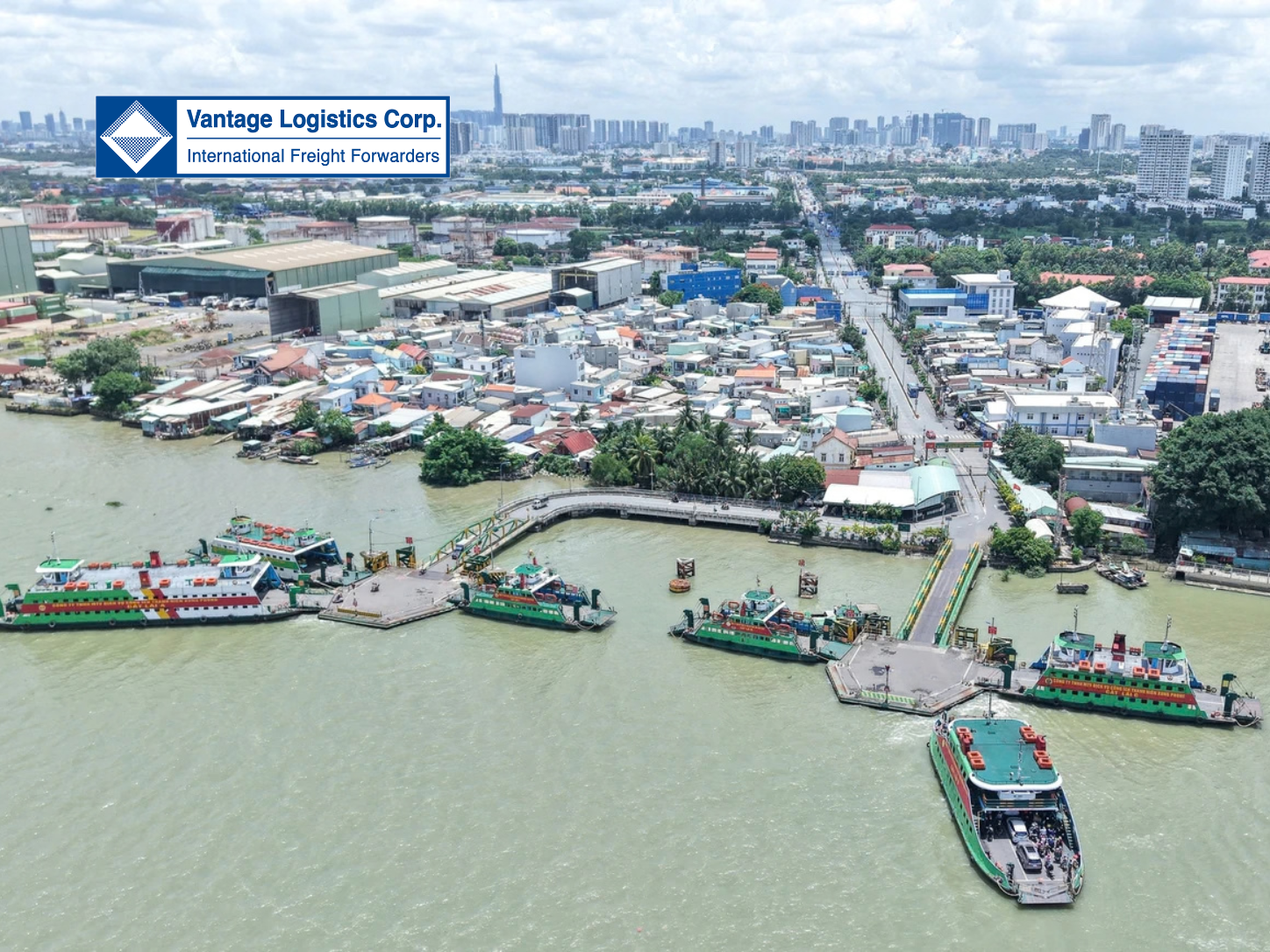
Construction has begun on the Cat Lai and Long Hung bridge projects linking Ho Chi Minh City with neighboring Dong Nai Province, marking the start of two major transport investments aimed at improving regional connectivity and easing pressure on existing road networks. The two projects, with a combined investment of more than VND36.7 trillion ($1.5 billion), are scheduled for completion in 2029. After years of planning, route adjustments and land clearance work, both bridges have entered the construction phase under public-private partnership (PPP) arrangements. Once completed, they are expected to provide new road links between Ho Chi Minh City, Nhon Trach and Long Thanh, while improving access to ports, industrial zones and Long Thanh International Airport. Cat Lai Bridge Designed to Maintain River Navigation The Cat Lai Bridge project has a total route length of more than 11.6 km, including 3.65 km of bridge and approach sections. The bridge will carry six vehicle lanes and two mixed-traffic lanes and is designed for speeds of up to 80 kph. On the Ho Chi Minh City side, the route will connect with My Thuy Interchange on Ring Road 2 before linking to the Ben Luc-Long Thanh Expressway in Dong Nai. A key feature of the project is its 450-meter cable-stayed main span and a 55-meter navigational clearance above the Dong Nai River. Planned location of the Cat Lai Bridge. Source: Internet According to project design specifications, the clearance is intended to ensure continued access for large vessels serving the Cat Lai port area and other facilities upstream. The bridge is designed to allow container ships of up to 60,000 deadweight tons (DWT), equivalent to about 4,000 to 5,000 twenty-foot equivalent units (TEU), to continue operating on the waterway. When completed, the bridge will replace the Cat Lai ferry service, creating a direct road connection between Thu Duc City and Nhon Trach District. Long Hung Bridge Adds Alternative Route to Long Thanh The Long Hung Bridge project will extend about 9.8 km, including roughly 3.5 km of bridge and approach sections. The structure will be 37 meters wide, carrying six vehicle lanes and two mixed-traffic lanes. The route will connect Long Phuoc Ward in Thu Duc City with An Phuoc in Dong Nai Province and link directly with the Bien Hoa-Vung Tau Expressway. Rendering of Long Hung Bridge. Source: Internet At present, traffic traveling between eastern Ho Chi Minh City and Dong Nai is concentrated mainly on National Highway 1 via Dong Nai Bridge and the Ho Chi Minh City-Long Thanh-Dau Giay Expressway. The new bridge is expected to provide an additional route for passenger and freight traffic, helping distribute vehicle flows more evenly across the transport network. It will also strengthen links between Ho Chi Minh City’s eastern districts, Long Thanh International Airport and nearby industrial areas. Implications for Logistics The two projects are expected to improve freight movement between Ho Chi Minh City and Dong Nai, one of Vietnam’s most important industrial and logistics corridors. Industry operators are expected to gain additional routing options, reducing reliance on a limited number of heavily used roads. Improved connections between Cat Lai Port, logistics facilities and industrial parks in Nhon Trach and Long Thanh could also support more efficient cargo transport and container movements. In addition, the Long Hung route is expected to improve access to Long Thanh International Airport, which is set to become a major air cargo gateway for southern Vietnam. Supporting Infrastructure Remains Key Transport planners say the effectiveness of the two bridge projects will depend on the completion of connecting roads and interchanges on both sides of the Dong Nai River. In Ho Chi Minh City, upgrades around My Thuy Interchange and Nguyen Thi Dinh Road are expected to play a key role in handling future traffic volumes. In Dong Nai, connections to the Ben Luc-Long Thanh Expressway, the Bien Hoa-Vung Tau Expressway and other regional roads will need to be completed in parallel with bridge construction. If delivered on schedule, the projects will add new transport links between Ho Chi Minh City and Dong Nai and support the movement of goods and people across Vietnam’s southeastern economic region.   Contact Vantage Logistics for tailored transport solutions and competitive quotations. Please provide details on cargo type, market, origin, destination, and estimated timeline. Vantage Logistics Corp – South East Asia (S.E.A) Logistics Provider One-Stop Shop For Integrated Logistics Services Head Office Viet Nam – Suite 6.01, Floor 6th, Block A, RiverGate Residence, 151-155 Ben Van Don, Khanh Hoi Ward, HCMC, Viet Nam Branch Thailand, Laos, Cambodia, Malaysia, Indonesia, Singapore Contact Us Email in**@*****om.vn Hotline +84-909-026-261 Website https://vantage-logistics.com Send your shipment enquiry today and receive a tailored transport plan from the Vantage Logistics team....

05/10/2026

View More
vlc-news-us-shipper-reshare-inland-distribution-5102026

Market updates

U.S. Shippers Reshape Inland Distribution: Strategic Takeaways for Global Supply Chains

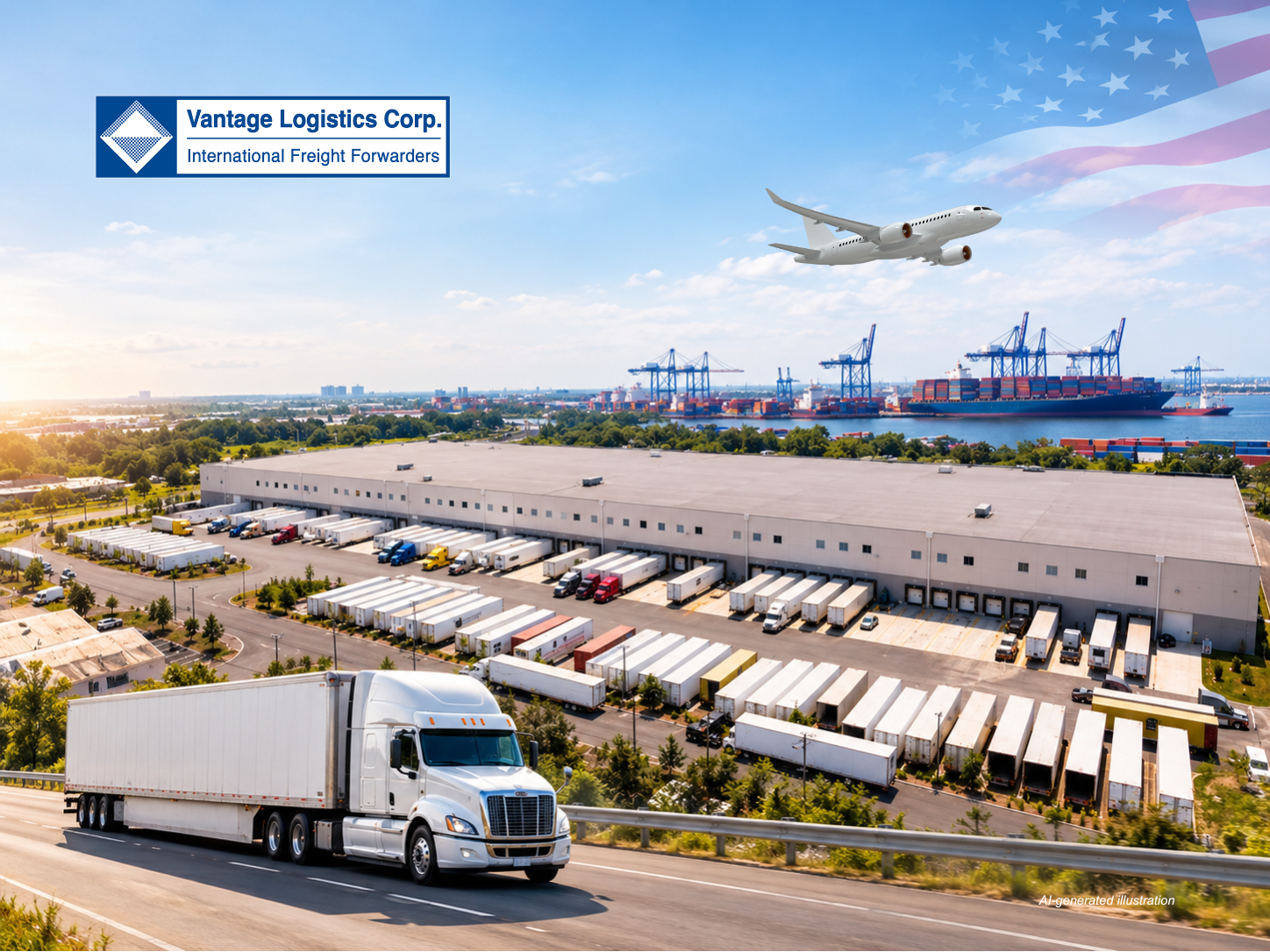
From gateway ports to regional warehouses, businesses are enhancing operational flexibility in inventory positioning and domestic distribution across the U.S. market. Shippers across the United States are increasingly diversifying their entry gateways and inland distribution networks instead of relying on a single seaport or centralized distribution hub. This growing push to connect seaports with inland logistics hubs is creating more viable options for multimodal transport and strategic inventory placement. Beyond the Port Call: The Challenge of U.S. Inland Distribution For importers and exporters – particularly those operating in fast-paced industries with stringent delivery schedules, such as automotive parts, electronics, and consumer goods – a container touching down at a U.S. port represents only half the journey. The remaining inland corridor introduces complex operational challenges that require meticulous planning: Long-Haul Road Freight Costs: Extended trucking routes often lead to inflated operational expenses and substantial deadhead mileage incurred from repositioning containers or chassis Domestic Regulatory Constraints: Strict Hours of Service (HOS) regulations for truck drivers, coupled with stringent state-level axle weight limits, impose rigid constraints on continuous long-haul transit Risk of Port-Related Surcharges: Tight container turnaround windows and the persistent risk of demurrage and detention (DEM/DET) charges escalate rapidly if inland pickup and transport are not synchronized flawlessly Strategic Solution: Transitioning to Distributed Inventory To overcome the bottlenecks of traditional single-node warehousing, modern supply chain strategies increasingly favor a multi-point distribution network: Gateway port > Inland multimodal transport > Regional warehouse > End customers/ Sales channels Positioning inventory in regional facilities closer to target consumption zones provides substantial competitive advantages: Accelerated Speed-to-Market: Empowers businesses to respond rapidly to local market demand without waiting for cross-country transshipments. Total Supply Chain Cost Control: Minimizes reliance on long-haul trucking, cushions against unexpected regional bottlenecks, and bolsters resilience against port-level disruptions. Global Sales Logistics: An End-to-End Distribution Solution by Vantage Logistics For exporters across Viet Nam and Southeast Asia expanding into North America, an effective logistics plan must be designed as an unbroken continuum – bridging international freight with local destination distribution. The integrated service ecosystem of Vantage Logistics serves as a specialized operational bridge through our dedicated Global Sales Logistics solution: Strategic Warehousing and Facility Network: Established presence across premier logistics hubs including California (Commerce, Chino, Fontana, Ontario), New Jersey (Pennsauken), and Texas (Houston), alongside operational hubs in Chicago, Seattle, and the Savannah/Atlanta corridor, offering businesses flexible options to position inventory near high-demand markets Standardized Warehousing & Order Fulfillment: Comprehensive cargo intake (inbound handling), precision counting, classification, storage, and pick-and-pack services tailored to the rigid specifications of wholesale partners and major e-commerce platforms (such as Amazon FBA and Walmart fulfillment standards) Unified Data Integration & Last-Mile Orchestration: Direct API connectivity linking client systems and major marketplaces (Amazon, Walmart, eBay) to Vantage’s OMS/WMS platforms enables real-time 24/7 inventory tracking; seamless TMS integration with leading domestic carriers (UPS, FedEx, DHL, USPS) coordinates last-mile delivery and manages delayed, lost, or return shipments efficiently Navigating supply chain risks in the U.S. requires proactive orchestration – from international maritime transit down to the final mile of domestic delivery. Are you planning your export and distribution strategy for the U.S. market? Contact Vantage Logistics today to consult on tailored solutions for international freight, customs clearance, order fulfilment, and Global Sales Logistics.   Contact Vantage Logistics for tailored transport solutions and competitive quotations. Please provide details on cargo type, market, origin, destination, and estimated timeline. Vantage Logistics Corp – South East Asia (S.E.A) Logistics Provider One-Stop Shop For Integrated Logistics Services Head Office Viet Nam – Suite 6.01, Floor 6th, Block A, RiverGate Residence, 151-155 Ben Van Don, Khanh Hoi Ward, HCMC, Viet Nam Branch Thailand, Laos, Cambodia, Malaysia, Indonesia, Singapore Contact Us Email in**@*****om.vn Hotline +84-909-026-261 Website https://vantage-logistics.com Send your shipment enquiry today and receive a tailored transport plan from the Vantage Logistics team....

05/10/2026

View More
vlc-news-integrated-cold-chain-solution-3102026 (1)

Vantage News

VANTAGE LOGISTICS – INTEGRATED COLD CHAIN SOLUTIONS FOR PERISHABLE & AGRICULTURAL EXPORTS

From reefer container preparation and transport coordination to in-transit temperature monitoring and incident management. For temperature-sensitive cargo, product quality depends not only on post-harvest storage but also on uninterrupted preservation throughout transit. Selecting suitable equipment, planning precise transit schedules, and continuously monitoring container integrity are critical to maintaining the specific shelf-life requirements of each shipment. Vantage Logistics delivers integrated cold chain solutions, combining technical equipment control, peak-season space allocation, and end-to-end operational monitoring from the packing facility to the destination port. Cold Chain Logistics Capabilities for Perishable & Agricultural Exports 1/ Cold Chain Engineering & Pre-Trip Preparation Transport plans are structured around the biological and technical characteristics of each cargo type: Technical Parameter Verification: Reviewing and cross-referencing set-point temperature, ventilation, and humidity levels against cargo handbooks for specific agricultural produce (dragon fruit, fresh coconut, banana, mango) and frozen seafood Pre-Cooling & Core Temperature Verification: Advising on warehouse pre-cooling protocols and measuring core product temperatures with specialized probes prior to stuffing Pre-Trip Inspection (PTI): Thoroughly checking refrigeration machinery, container structural integrity, and data logger functionality before releasing equipment for loading 2/ Space Allocation & Peak-Season Equipment Management Vantage Logistics proactively secures equipment and vessel allocation to mitigate peak-season rollover risks: Reefer Space & Plug-in Allocation: Securing firm space commitments and dedicated reefer plug-in capacity with international ocean carriers during peak harvest seasons Specialized Reefer Equipment: Supplying standard reefer containers as well as Controlled Atmosphere (CA) units for long-haul maritime routes to Europe and North America Demurrage & Detention (DEM/DET) Free-Time Negotiation: Assisting in securing tailored free-time at destination ports, providing a safe operational buffer for phytosanitary inspection and customs clearance 3/ Stuffing Supervision & Inland Transportation On-site procedures are strictly monitored to ensure cold chain continuity: Warehouse Stuffing Supervision: Ensuring cargo is stowed below the maximum load line and keeping floor air channels (T-floor) clear to optimize airflow, supported by detailed stuffing reports with photographic evidence GenSet-Equipped Reefer Trucking: Dispatching dedicated prime movers equipped with generator sets (GenSets) to maintain continuous power supply from the packhouse to the port terminal Phytosanitary & Customs Clearance: Expediting phytosanitary inspection, fumigation, and export customs clearance to minimize dwell time at terminal gates 4/ In-Transit Monitoring & Incident Management Proactively monitoring container status throughout the shipment lifecycle: Remote Container Monitoring (RCM): Continuously tracking reefer operating status, set-point consistency, and temperature fluctuations across the ocean transit Terminal Plug-in Oversight: Coordinating with terminal operators to verify continuous reefer plug-in at loading and transshipment ports, enabling early detection of power interruptions Rapid Incident Response: Initiating contingency protocols within 2–4 hours upon temperature deviation alerts, coordinating with carrier technical teams for on-site inspection Data Logger Retrieval & Reporting: Extracting and delivering complete temperature log charts upon vessel arrival to verify product quality or support insurance documentation 5/ Value for Importers and Exporters Preserved Shelf-Life: Selecting optimal service loops with the shortest transit times to preserve freshness upon arrival in international markets. Reduced Cargo Loss: Maintaining core temperature and unobstructed airflow to minimize cargo deterioration and commercial claims. Cost Predictability: Clear cost breakdowns covering ocean freight, PTI charges, electricity plug-in fees, and quarantine inspection, helping eliminate unexpected demurrage/detention costs. Single Point of Contact: Streamlining communication through one centralized team managing everything from empty container release and reefer trucking to customs clearance and ocean delivery. Connecting Vietnamese Agriculture to Global Markets – Vantage Logistics delivers cold chain solutions engineered to the biological characteristics and technical requirements of each shipment, partnering with exporters to bring fresh agricultural and seafood products to international tables. Planning your upcoming agricultural or seafood export season? Contact Vantage Logistics today to discuss optimal shipping schedules and secure dedicated reefer space.   Contact Vantage Logistics for tailored transport solutions and competitive quotations. Please provide details on cargo type, market, origin, destination, and estimated timeline. Vantage Logistics Corp – South East Asia (S.E.A) Logistics Provider One-Stop Shop For Integrated Logistics Services Head Office Viet Nam – Suite 6.01, Floor 6th, Block A, RiverGate Residence, 151-155 Ben Van Don, Khanh Hoi Ward, HCMC, Viet Nam Branch Thailand, Laos, Cambodia, Malaysia, Indonesia, Singapore Contact Us Email in**@*****om.vn Hotline +84-909-026-261 Website Send your shipment enquiry today and receive a tailored transport plan from the Vantage Logistics team....

03/10/2026

View More
vlc-news-biendong-transpacific-Q4-30062026

Market updates

TRANSPACIFIC FREIGHT RATE VOLATILITY IN Q4: BUFFER STOCK STRATEGIES FOR VIETNAMESE & SOUTHEAST ASIA MANUFACTURERS

Heading into Q4, the Transpacific trade lane is experiencing severe volatility in both ocean spot rates and vessel space allocation. For OEM, ODM, and OBM manufacturers across Viet Nam and Southeast Asia, calibrating safety stock levels is critical to navigating holiday retail surges in the US market. 1/ Transpacific Q4 Market Overview Rate Benchmarks (SCFI & FBX Upward Pressure): Freight indices continue an upward trajectory as ocean carriers implement Peak Season Surcharges (PSS) alongside General Rate Increases (GRI) SCFI: Reached approximately 3,686 points by late September 2026, sustaining steady momentum from mid-year FBX: Hovering around $3,407/FEU, reflecting elevated 40-foot container shipping costs driven by localized port congestion and adverse weather conditions along major East-West corridors Tightened Space Allocation: Ocean carrier alliances are prioritizing allocations for tier-1 named accounts (long-term MQC contracts). Spot bookings and LCL shipments face heightened exposure to booking cancellations and rolled cargo US West Coast (USWC) Congestion: The San Pedro Bay port complex (Los Angeles/Long Beach) continues to grapple with chassis shortages (chassis splits). Vessel dwell times at anchorage range from 3 to 7 days, compounding demurrage and detention risks 2/ Three Pillars of Resilient Safety Stock Management Rather than relying on theoretical transit times, manufacturers must adjust inventory modeling to reflect actual supply chain lead times: Incorporate a 7-12 Day Buffer: Lead time forecasting must account for container release delays at origin in Viet Nam, anchorage dwell times at destination, and US Customs exams Implement Rolling Shipments: Transition from batch-heavy shipments (1-2 mega-lots) to weekly staggered dispatches. This diversifies risk and prevents severe stockouts if a single vessel faces blank sailings or terminal delays Diversify Distribution Footprints: Avoid pushing 100% of inventory directly into Amazon FBA or marketplace fulfillment centers, which triggers steep aged inventory surcharges. Maintain strategic reserves at port-adjacent transload and bonded facilities to replenish downstream fulfillment centers on demand 3/ Vantage Logistics Value-Added Solutions Contracted Space Guarantees: Backed by direct service contracts with major ocean alliances, Vantage Logistics secures dedicated capacity allocations and mitigates spot rate exposure during peak season Dynamic Port Routing: Proactive cargo diversion between US West Coast (USWC) and US East/Gulf Coast (USEC/USGC) gateways to bypass port bottlenecks Integrated US Warehousing & Fulfillment: Comprehensive near-dock warehousing, transloading, and cross-docking services integrated with drayage and domestic linehaul networks to ensure on-time delivery across North America   Contact Vantage Logistics for tailored transport solutions and competitive quotations. Please provide details on cargo type, market, origin, destination, and estimated timeline. Vantage Logistics Corp – South East Asia (S.E.A) Logistics Provider One-Stop Shop For Integrated Logistics Services Head Office Viet Nam – Suite 6.01, Floor 6th, Block A, RiverGate Residence, 151-155 Ben Van Don, Khanh Hoi Ward, HCMC, Viet Nam Branch Thailand, Laos, Cambodia, Malaysia, Indonesia, Singapore Contact Us Email in**@*****om.vn Hotline +84-909-026-261 Website https://vantage-logistics.com Send your shipment enquiry today and receive a tailored transport plan from the Vantage Logistics team....

03/10/2026

View More
vlc-news-updated-customs-procedure-2102026

Market updates

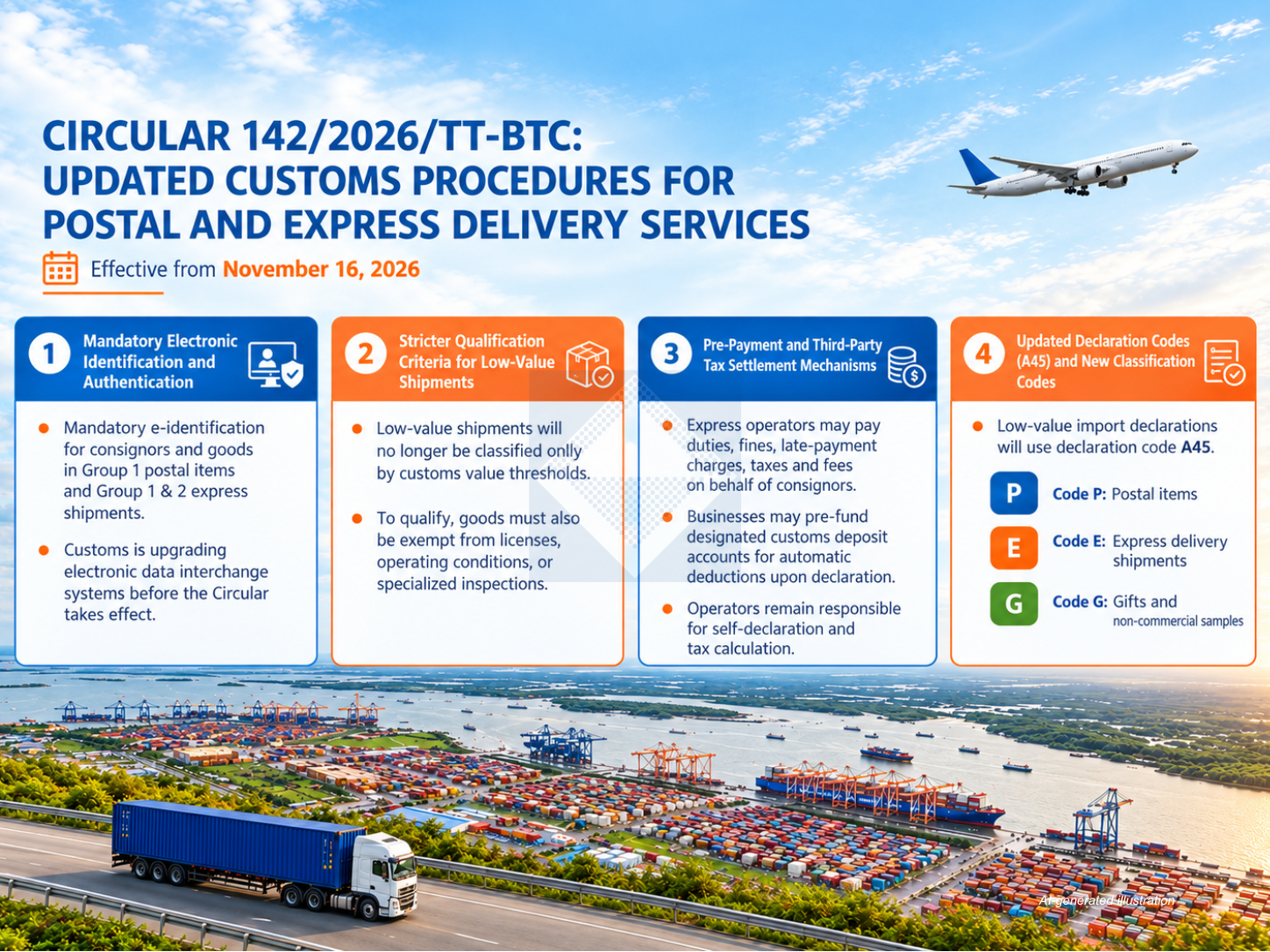
CIRCULAR 142/2026/TT-BTC: UPDATED CUSTOMS PROCEDURES FOR POSTAL AND EXPRESS DELIVERY SERVICES

Effective November 16, 2026, Circular 142/2026/TT-BTC officially enters into force, amending regulatory frameworks for customs procedures governing import and export goods handled via international postal and express delivery services. Key regulatory updates center on electronic identification, qualification criteria for low-value shipments, tax payment mechanisms, and customs declaration codes. The following 4 core changes are essential for importers, exporters, and logistics service providers to master: 1/ Mandatory Electronic Identification and Authentication New Requirements: Introduces mandatory electronic identification and authentication for consignors and goods during customs clearance (applicable to Group 1 postal items as well as Group 1 and Group 2 express shipments). Technical Infrastructure: Customs authorities are upgrading electronic data interchange systems ahead of the Circular’s effective date. 2/ Stricter Qualification Criteria for Low-Value Shipments Dual-Condition Framework: Classification of low-value shipments will no longer rely solely on customs value thresholds for import duty exemptions. Commodity Policies: Goods must strictly be exempt from licenses, operational conditions, or specialized inspections (or fall outside the scope of mandatory specialized inspection/licensing requirements) to qualify for this streamlined category. 3/ Pre-Payment and Third-Party Tax Settlement Mechanisms Proxy Payment: Express delivery companies are authorized to settle customs duties, fines, late payment penalties, assessed taxes, fees, and charges on behalf of consignors. Advance Deposit Accounts: Businesses can pre-fund a designated deposit account held by Customs at the State Treasury. Upon declaration filing, the system automatically deducts amounts due to expedite immediate clearance or release. Accountability: Express delivery operators assume full legal responsibility for self-declaration and tax calculation. 4/ Updated Declaration Codes (A45) and New Classification Codes Declaration Code: Low-value import declarations will officially adopt declaration type code A45. Additional Classification Codes: Code P: Postal items. Code E: Express delivery shipments. Code G: Gifts and non-commercial samples. Recommendations for Businesses The transformations introduced by Circular 142/2026/TT-BTC require postal operators, express couriers, and cross-border e-commerce players to proactively adjust their operating models: System & Data Audit: Upgrade technological infrastructure to seamlessly integrate identification data and optimize liquidity through Treasury advance accounts. Rigorous Commodity Compliance: Thoroughly review imported product categories to mitigate regulatory bottlenecks regarding licensing and specialized inspections, ensuring frictionless supply chain continuity. Vantage Logistics continuously monitors evolving trade policies and logistics regulations to help businesses navigate international compliance and optimize cross-border supply chains.   Contact Vantage Logistics for tailored transport solutions and competitive quotations. Please provide details on cargo type, market, origin, destination, and estimated timeline. Vantage Logistics Corp – South East Asia (S.E.A) Logistics Provider One-Stop Shop For Integrated Logistics Services Head Office Viet Nam – Suite 6.01, Floor 6th, Block A, RiverGate Residence, 151-155 Ben Van Don, Khanh Hoi Ward, HCMC, Viet Nam Branch Thailand, Laos, Cambodia, Malaysia, Indonesia, Singapore Contact Us Email in**@*****om.vn Hotline +84-909-026-261 Website https://vantage-logistics.com Send your shipment enquiry today and receive a tailored transport plan from the Vantage Logistics team....

02/10/2026

View More
1 2 3 4 … 43