MARKET UPDATES

vlc-news-philippines-cancels-rice-import-permit-15102026

Market updates

Philippines Cancels Permit for Controversial 12,480-Metric-Ton Rice Shipment from Viet Nam

The Philippine Department of Agriculture (DA) said it had ordered the cancellation of the Sanitary and Phytosanitary Import Clearance (SPSIC) for a 12,480-metric-ton rice shipment from Viet Nam before the vessel arrived. The case involves reported discrepancies in rice specifications and an expired import contract, highlighting the risks that can arise when shipping schedules do not align with import requirements in the destination market. 1. Developments at the Port of Arrival According to the Philippine Department of Agriculture (DA) and the Philippine News Agency (PNA), the vessel MV Tay Son 2, carrying 12,480 metric tons of rice from Viet Nam, arrived at the Port of Davao on September 14, 2026. According to these sources, the vessel’s captain refused to submit the shipment for inspection by the Philippine Bureau of Plant Industry (BPI). On September 17, 2026, the vessel departed Davao before the matter had been resolved. Philippine authorities subsequently prevented the cargo from being unloaded at another location and brought the vessel to the Port of General Santos before ordering it to return to Davao for further handling. 2. Rice Specifications and Import Requirements The case involves two issues: reported discrepancies in rice specifications and the status of the import contract and permit. 2.1. Reported Discrepancy in Rice Specifications The importer, Planters Product, Inc. (PPI), reported a discrepancy between the purchase order and the specifications communicated for the shipment: Specifications under the purchase order: 25% broken rice Reported specifications for the shipment: 5% broken rice In agricultural trade, the percentage of broken grains is an important commercial specification. However, the discrepancy remains based on information reported by the importer and has not been confirmed by an official inspection, as the physical inspection process was not completed. 2.2. Expired Contract and Canceled Import Permit In addition to the rice specifications, the delivery timeline and the status of the import documentation were also highlighted by the DA: Estimated time of arrival (ETA): July 2026 Actual arrival: Mid-September 2026 According to the DA, the import contract had expired and the SPSIC had been canceled before the vessel arrived. The vessel’s arrival also coincided with the period when the Philippines was preparing for the wet-season rice harvest. According to published information, import policy during this period was also linked to efforts to limit downward pressure on domestic palay prices. Operational Note: Even when goods meet quality requirements, a shipment may still face customs clearance difficulties if it fails to meet import requirements or if the relevant permit is no longer valid. 3. Proposed Measures for Handling the Shipment According to published information, the Bureau of Customs of the Philippines (BOC) was still considering the final course of action for the shipment. The proposed measures included: Proposed Measure Proposing Authority / Status Return to the Country of Origin The BPI was reported to have recommended returning the shipment to Viet Nam. Seizure and Penalties The DA proposed considering seizure of the shipment and the application of penalties under relevant regulations, subject to the competent authority’s findings and decision. Final Decision The BOC was reviewing the official course of action for the shipment. 4. Conclusion The controversial rice shipment in the Philippines highlights how international trade depends not only on product quality and contractual terms but also on shipping schedules, the validity of import documentation, and regulatory requirements in the destination market. When these elements are no longer aligned, shipments already in transit may face unexpected complications during arrival and customs clearance. Vantage Logistics will continue to provide updates on notable developments in logistics, import-export activities, and international supply chains, offering businesses additional insight into factors that may affect global trade. Contact Vantage Logistics for tailored transport solutions and competitive quotations. Please provide details on cargo type, market, origin, destination, and estimated timeline.   Vantage Logistics Corp – South East Asia (S.E.A) Logistics Provider One-Stop Shop For Integrated Logistics Services Head Office Viet Nam – Suite 6.01, Floor 6th, Block A, RiverGate Residence, 151-155 Ben Van Don, Khanh Hoi Ward, HCMC, Viet Nam Branch Thailand, Laos, Cambodia, Malaysia, Indonesia, Singapore Contact Us Email in**@*****om.vn Hotline +84-909-026-261 Website https://vantage-logistics.com Send your shipment enquiry today and receive a tailored transport plan from the Vantage Logistics team.

15/10/2026

View More
vlc-news-asean-east-asia-trade-15102026

Market updates

ASEAN–East Asia Trade Reaches USD 1.4 Trillion, Up 13.7% in 2025

According to preliminary data from the ASEAN Secretariat, two-way trade between ASEAN and its three East Asian partners (China, Japan, and South Korea) reached USD 1.4 trillion in 2025, representing a 13.7% year-on-year increase. Notably, China–ASEAN trade continued its upward trajectory in the first seven months of 2026, underscoring a sustained expansion in cross-regional trade volumes worth monitoring. 1. Regional Trade Volume and Foreign Direct Investment (ASEAN+3) Trade and investment flows between ASEAN and its three East Asian partners maintain a substantial footprint. In 2025, Foreign Direct Investment (FDI) inflows from China, Japan, and South Korea into ASEAN totaled USD 44.8 billion. Key ASEAN–East Asia Trade & Investment Indicators Indicator Value Growth / Share ASEAN – (China, Japan, South Korea) Trade in 2025 USD 1.4 Trillion Up 13.7% vs 2024 FDI from 3 East Asian Partners into ASEAN in 2025 USD 44.8 Billion Accounted for 18.2% of total ASEAN FDI China – ASEAN Trade (First 7 Months of 2026) USD 744.41 Billion Up 24.7% year-on-year The scale of merchandise trade and investment capital highlights the vital economic linkage between East Asia and Southeast Asia. However, assessing actual freight demand requires a granular evaluation of specific commodity structures, export-import markets, and active transport corridors. 2. Direct Impacts on Transport Networks and Logistics Infrastructure Expanding trade volumes underscore the critical role of regional transport connections. Depending on industry-specific cargo characteristics and delivery requirements, flexible logistics solutions are being actively deployed: Intra-Asia Ocean Freight Connections: For multi-leg shipments, vessel schedule reliability, transit times, and feeder network connectivity are pivotal factors for supply chain managers. Major gateway hubs such as Shanghai, Ningbo, Busan, and Yokohama maintain dense feeder linkages with Southeast Asian ports within ocean carrier networks Integrated Logistics and Multimodal Transport: Depending on lead-time sensitivity, combining ocean freight, Cross-Border Trucking, and inland warehousing offers expanded routing options. Real-world operational efficiency hinges heavily on border crossing clearance times, transit schedules, and the coordination capability of the logistics operator Rules of Origin (C/O) and Customs Compliance: When leveraging Free Trade Agreements such as RCEP, AKFTA, or AJCEP, enterprises must accurately determine rules of origin and prepare compliant documentation to qualify for preferential tariffs. Duty exemption eligibility depends on the specific conditions of each product line and destination market 3. Monitoring Southeast Asian Trade Dynamics and Logistics Connectivity Expanding trade and investment flows reflect an increasingly integrated economic relationship between East Asia and Southeast Asia. This growth in cross-border trade creates momentum for expanding logistics connectivity, helping strengthen supply chain coverage across the region.   Contact Vantage Logistics for tailored transport solutions and competitive quotations. Please provide details on cargo type, market, origin, destination, and estimated timeline. Vantage Logistics Corp – South East Asia (S.E.A) Logistics Provider One-Stop Shop For Integrated Logistics Services Head Office Viet Nam – Suite 6.01, Floor 6th, Block A, RiverGate Residence, 151-155 Ben Van Don, Khanh Hoi Ward, HCMC, Viet Nam Branch Thailand, Laos, Cambodia, Malaysia, Indonesia, Singapore Contact Us Email in**@*****om.vn Hotline +84-909-026-261 Website https://vantage-logistics.com Send your shipment enquiry today and receive a tailored transport plan from the Vantage Logistics team.

15/10/2026

View More

Market updates

SINGAPORE STRENGTHENS PRODUCT SAFETY CONTROLS: WHAT VIETNAMESE EXPORTERS NEED TO KNOW

Singapore is strengthening its product safety controls through two key regulations: the Consumer Protection (Safety Requirements) Regulations (CPSR) and the Consumer Goods (Safety Requirements) Regulations (CGSR). For exporters, these requirements go beyond product compliance. They can also affect delivery schedules, logistics costs, and supply chain reliability. 1. Singapore Strengthens Product Safety Requirements According to information published by Vietnam’s Ministry of Industry and Trade, Singapore applies two main regulatory frameworks for product safety. – CPSR: Covers 33 categories of controlled goods, including electrical and electronic products, household appliances, and gas appliances. Products within scope must meet applicable safety requirements, complete registration, and carry the SAFETY Mark before being supplied or sold in Singapore. – CGSR: Covers general consumer goods such as toys, clothing, furniture, and sports equipment, which must comply with the relevant safety standards. Non-compliant products may be subject to sales restrictions or recalls. Businesses that violate applicable requirements may also face penalties. For exporters, checking compliance requirements before shipment is essential. Addressing documentation or registration issues early can help avoid costly adjustments after cargo has already left the port of origin. 2. Potential Impact on Southeast Asia’s Trade and Logistics Singapore plays an important role in Southeast Asia’s trade and logistics network. Tighter product safety controls may require exporters, importers, and distributors to review their procedures for placing goods on the Singapore market. Several potential risks deserve attention: – Delivery delays: Incomplete documentation or missing certificates may affect cargo acceptance and delivery schedules. – Additional logistics costs: Delays in resolving compliance issues may lead to storage, port handling, or additional transportation costs. – Disrupted distribution plans: Late deliveries can affect inventory planning, distribution schedules, and commitments to business partners. These requirements do not automatically apply across all ASEAN markets. However, they highlight the importance of understanding the specific regulations of each destination country when planning regional trade and distribution. 3. What Should Vietnamese Exporters Prepare? For Vietnamese businesses exporting to Singapore, compliance checks should take place before shipment arrangements are finalized. Exporters should determine whether their products fall under CPSR or CGSR, verify the applicable safety standards and registration requirements, and clarify responsibilities with their Singaporean importers. Documentation preparation should also be factored into the shipping schedule. If an issue is discovered only after cargo arrives at the destination port, businesses may need to manage several challenges simultaneously, including delivery delays, additional costs, and changes to distribution plans. A reliable shipping plan therefore involves more than selecting the right route or sailing schedule. It also requires anticipating potential obstacles before the cargo reaches its destination. 4. Managing Risks Through Early Planning Not every risk in international shipping can be eliminated, but many disruptions can be reduced through early preparation. Reviewing cargo information, documentation, shipping schedules, and destination requirements helps all parties make better-informed decisions. For shipments to Singapore, close coordination among exporters, importers, agents, and logistics providers helps maintain visibility over shipment readiness, address changes, and adjust plans when necessary. At Vantage Logistics, international transportation planning takes into account the practical requirements of each shipment and the coordination needed among relevant parties. This approach helps businesses manage potential disruptions and maintain better control over delivery schedules. As market requirements evolve, careful preparation does more than protect an individual shipment. It also helps businesses maintain reliable supply chains and build lasting partnerships across international markets.

15/10/2026

View More

Market updates

Vietnam’s Import Landscape: Production Materials & Supply Chain Outlook 2026

Vietnam’s merchandise imports reached $455.01 billion in 2025, up 19.4% year-on-year. Production materials –encompassing machinery, equipment, components, and industrial raw materials – accounted for 93.6% of total inbound turnover. This dynamic accelerated through the first eight months of 2026, with total imports climbing 35.3% and the share of production inputs widening to 94.1%. As import flows remain overwhelmingly concentrated in manufacturing inputs, lead-time precision, regulatory compliance, and domestic freight execution have become decisive operational priorities across the supply chain. 1/ 2025 Import Turnover Surpasses $455 Billion Vietnam’s total merchandise trade reached $930.05 billion in 2025. Exports totaled $475.04 billion (+17.0% YoY), while imports reached $455.01 billion (+19.4% YoY), maintaining a merchandise trade surplus of $20.03 billion. Import growth outpaced export growth by 2.4 percentage points. However, this acceleration must be interpreted alongside cargo composition: the vast majority of import expenditure was allocated not to finished consumer goods, but to critical industrial inputs required to sustain factory output, capital expansion, and downstream export commitments. 2/ Production Materials Account for 93.6% of Total Imports According to data from the General Statistics Office (GSO), imports of production materials reached $426.11 billion, representing 93.6% of total import turnover in 2025. The structural breakdown reveals two dominant pillars: Machinery, equipment, tools, and spare parts: Accounted for 52.7% of total imports Raw materials, fuels, and intermediate inputs: Accounted for 40.9% of total imports Consumer goods: Accounted for the remaining 6.4% High-tech inputs served as the primary growth engine. The computers, electrical products, and components category led all imports at $150.7 billion, surging 40.7% YoY and contributing 33.1% to total national imports. This product mix reflects Vietnam’s position within global processing, assembly, and high-tech manufacturing networks: inbound supply flows directly drive outbound finished goods. Heavy reliance on foreign-sourced capital equipment and components makes procurement schedules and inbound freight predictability critical to plant continuity. 3/ FDI Expansion Drives Inbound Demand & 8M 2026 Performance FDI Sector Commands Nearly 70% of Import Value A distinct operational divergence characterized the market in 2025: Foreign-Invested Enterprise (FDI) sector: Imports totaled $317.63 billion, up 31.9% YoY, accounting for 69.8% of the national total Domestic economic sector: Imports reached $137.38 billion, a slight contraction of 2.0% YoY Inbound freight mirrored capital deployment trends. Realized FDI in Vietnam reached a record $27.62 billion in 2025, with processing and manufacturing securing $22.88 billion (82.8%). Sustained capital expenditure by multinational manufacturers generated immediate demand for initial capital machinery installations and recurring intermediate assembly components. 4/ 8M 2026: Production Input Share Widens to 94.1% Through the first eight months of 2026, demand for industrial inputs intensified: Total merchandise imports: Reached $395.3 billion, up 35.3% compared to the same period in 2025. FDI imports: Reached $290.23 billion, increasing 40.1% YoY. Production materials: Reached $372.04 billion, expanding their share to 94.1% of total imports. Key sourcing origin: China remained the largest supplier of raw materials and machinery, totaling $161.9 billion. Sustained import volume growth has placed elevated operational pressure on national deep-water ports, air cargo terminals, and intermodal transport corridors. 5/ Supply Chain Outlook: Transitioning from Cargo Availability to Precision Timing Expanding import volumes inherently increase complexity for inbound supply chains. An incoming consignment of raw materials or industrial machinery requires seamless handoffs across international transit, customs clearance, terminal handling, drayage, and warehousing. For manufacturers, the critical operational risk is rarely absolute cargo availability; it is lead-time volatility. Late arrivals, customs inspection bottlenecks, or misaligned transport schedules trigger plant downtime, demurrage and detention (Dem/Det) charges, and buffer inventory costs. With imports expanding faster than exports and over 94% dedicated to factory inputs, supply chain managers must actively mitigate exposure across key operational nodes: International ocean and air freight transit reliability Carrier space allocations and feeder connectivity Regulatory compliance and tariff classification accuracy Customs clearance turnaround times at ports and airports Port-to-factory linehaul trucking capacity Inventory buffers calibrated to just-in-time production schedules 6/ Inbound Supply Chain Solutions by Vantage Logistics Vantage Logistics provides integrated inbound logistics solutions designed to stabilize supply lines from overseas origin points directly to manufacturing floors across Vietnam: Multimodal International Freight (Air & Ocean): Global partner networks coordinate cargo collection across major industrial centers in Asia, Europe, and North America, securing dedicated allocations on key trade lanes with predictable transit schedules. Licensed Customs Brokerage: Operating under official Customs Brokerage License No. 2314/QD-TCHQ issued by the General Department of Vietnam Customs, in-house customs specialists manage declarations, tariff consulting, HS code determinations, and specialized technical inspections to accelerate border clearance for machinery and high-tech components. Contract Logistics & Domestic Transport (Trucking & Warehousing): Standard, bonded, and cross-dock facilities, paired with dedicated linehaul fleets, link primary port clusters (Cat Lai, Cai Mep, Hai Phong) directly to industrial parks nationwide, supporting strict Just-In-Time (JIT) production requirements. Consolidating cross-border freight, customs brokerage, and inland drayage under a single logistics partner reduces administrative overhead, minimizes communication handoffs, and delivers end-to-end milestone visibility. The trade data of 2025 and performance indicators throughout 2026 reaffirm that production materials are the structural core of Vietnam’s import economy. As production input volumes scale, disciplined lead-time management and resilient logistics partnerships remain essential to maintaining operational continuity. Planning inbound shipments of industrial materials, electronic components, or machinery into Viet Nam? Contact Vantage Logistics to consult with our specialists on optimal routings, trade compliance, and end-to-end logistics solutions tailored to your operational schedule.   Contact Vantage Logistics for tailored transport solutions and competitive quotations. Please provide details on cargo type, market, origin, destination, and estimated timeline. Vantage Logistics Corp – South East Asia (S.E.A) Logistics Provider One-Stop Shop For Integrated Logistics Services Head Office Viet Nam – Suite 6.01, Floor 6th, Block A, RiverGate Residence, 151-155 Ben Van Don, Khanh Hoi Ward, HCMC, Viet Nam Branch Thailand, Laos, Cambodia, Malaysia, Indonesia, Singapore Contact Us Email in**@*****om.vn Hotline +84-909-026-261 Website https://vantage-logistics.com Send your shipment enquiry today and receive a tailored transport plan from the Vantage Logistics team....

14/09/2026

View More
vlc-news-vn-food-safety-compliance-14092026

Market updates

Viet Nam Food Safety Compliance: Stricter Import Inspections from September 2026

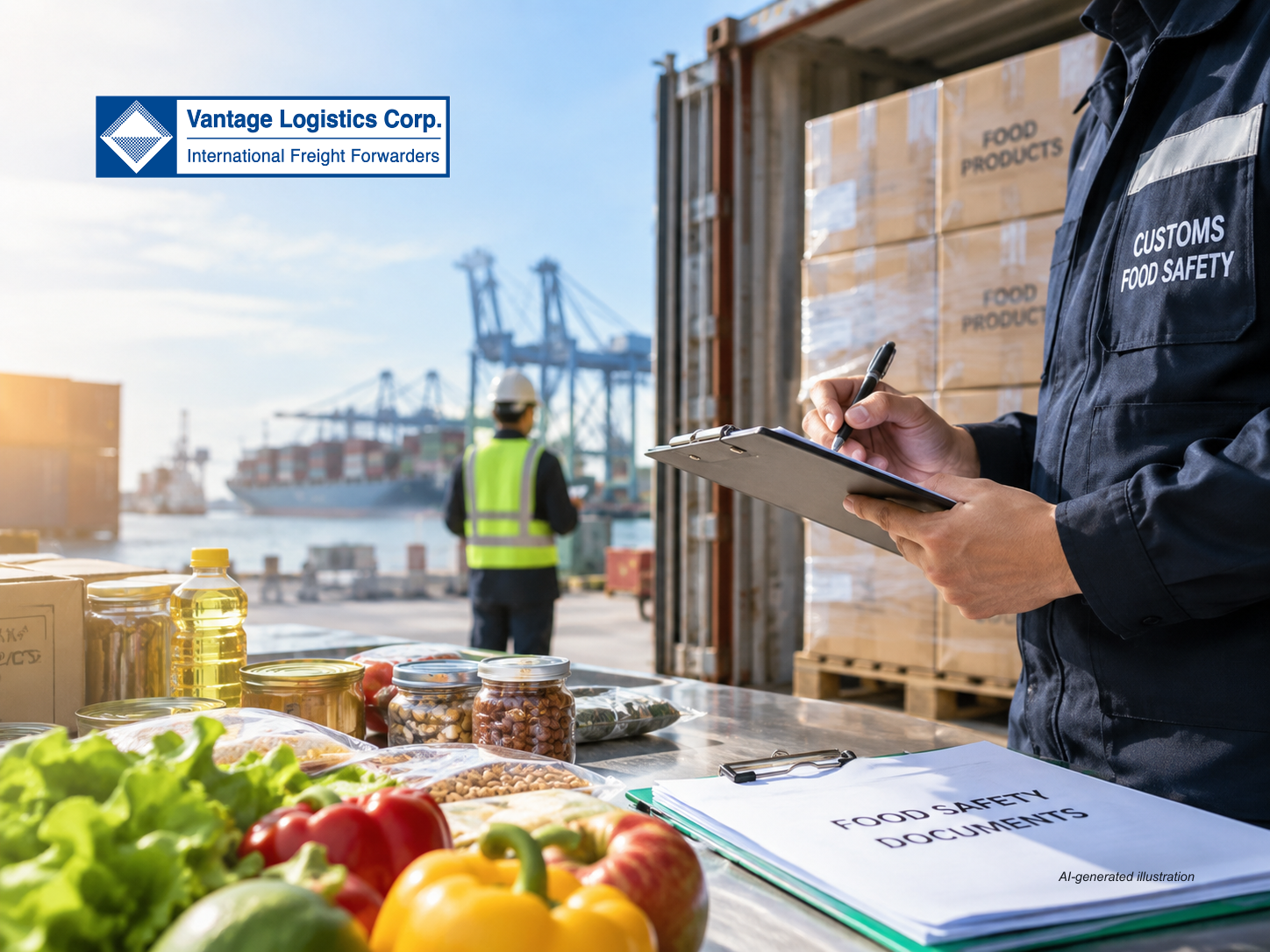
Effective September 2026, Vietnamese authorities are tightening food safety compliance checks for imported food and food-related products. Importers and overseas suppliers should take note of key regulatory shifts, associated operational risks, and essential pre-shipment checks. 1/ Key Regulatory Updates Automated and Rigorous Document Audits: Regulatory bodies are implementing more automated, in-depth checks on Self-Declaration files. All data across the Self-Declaration, Certificate of Analysis (COA/CA), product labels, and traceability records must match perfectly. Any discrepancy or missing data will lead to immediate rejection Tougher Lab Testing Criteria: Testing reports (COA/CA) must be issued by a designated or accredited laboratory compliant with ISO/IEC 17025 standards. The analysis must cover every mandatory safety parameter specified under the corresponding National Technical Regulation (QCVN) Accurate Product Classification: Certain commodities – such as dietary supplements, health foods, and new or mixed food additives – require Product Declaration Registration rather than the standard Self-Declaration. Filing under the incorrect category will result in application failure 2/ Operational & Financial Risks If food safety documentation is non-compliant or rejected after shipments arrive in Vietnam, importers face severe disruptions, including: Substantial demurrage, detention, and warehouse storage costs caused by clearance delays Cargo holds at terminal yards or bonded warehouses pending inspections or document amendments Administrative penalties, with extreme cases resulting in mandatory re-export or destruction of goods Missed delivery timelines and potential downstream contractual liabilities 3/ Recommended Actions: Pre-Shipment Document Audit To prevent border delays and unexpected overhead, importers and suppliers should review and verify the following documents prior to cargo departure: A valid Self-Declaration or Product Declaration Registration, as applicable A compliant COA/CA from a qualified laboratory meeting all required QCVN testing parameters Fully compliant product labels Consistent shipping documents, ensuring seamless alignment between the Commercial Invoice and Packing List Advisory: We strongly encourage partners to share documentation with our team for a preliminary audit well before cargo dispatch to ensure swift, trouble-free customs clearance upon arrival.   Contact Vantage Logistics for tailored transport solutions and competitive quotations. Please provide details on cargo type, market, origin, destination, and estimated timeline. Vantage Logistics Corp – South East Asia (S.E.A) Logistics Provider One-Stop Shop For Integrated Logistics Services Head Office Viet Nam – Suite 6.01, Floor 6th, Block A, RiverGate Residence, 151-155 Ben Van Don, Khanh Hoi Ward, HCMC, Viet Nam Branch Thailand, Laos, Cambodia, Malaysia, Indonesia, Singapore Contact Us Email in**@*****om.vn Hotline +84-909-026-261 Website https://vantage-logistics.com Send your shipment enquiry today and receive a tailored transport plan from the Vantage Logistics team....

14/09/2026

View More
vlc-news-nationwide-automated-customs-11092026

Market updates

Effective September 9, 2026: Nationwide Automated Customs Supervision Confirmation for EPE Declarations

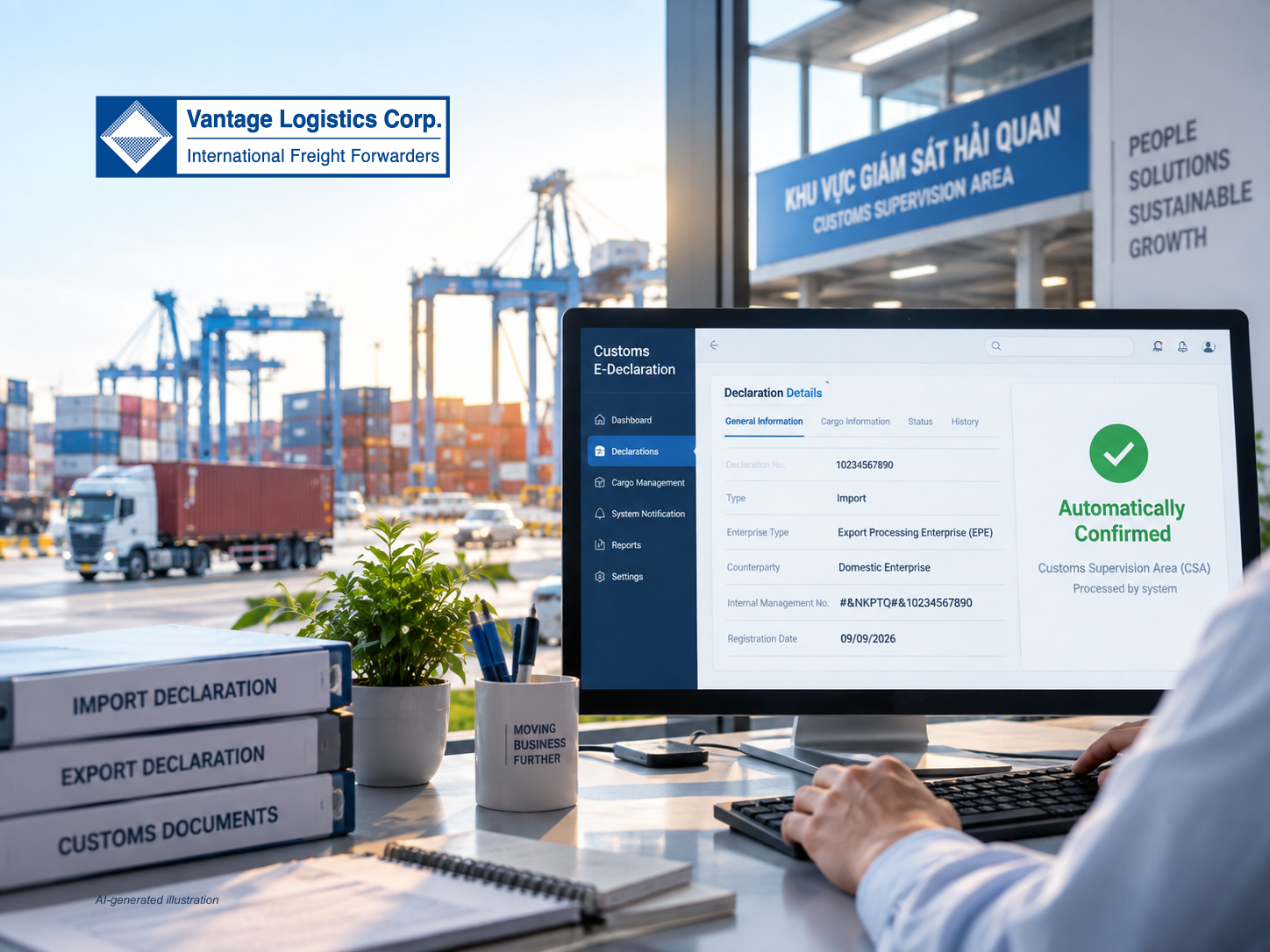
As of September 9, 2026, the Customs Authority officially activated the automated customs supervision confirmation function nationwide under Official Letter No. 20991/CHQ-GSQL. This update eliminates the need for manual cross-checking for declarations between Export Processing Enterprises (EPEs) and domestic companies, other EPEs, or their branches. To ensure successful automated matching, enterprises must accurately declare the “Enterprise Internal Management Number” field following the Customs Authority’s guidelines: Standard EPE transactions: Export declaration: #&XKPTQ Corresponding import declaration: #&NKPTQ#& + first 11 characters of the export declaration number Designated delivery transactions: Export declaration: #&XKTC Corresponding import declaration: #&NKTC#& + first 11 characters of the export declaration number Important: Missing the #& separator or entering an incorrect declaration number will prevent automatic approval, resulting in manual processing. Enterprises should promptly align documentation workflows and review customs procedures to ensure seamless clearance. Businesses are advised to review their customs declaration procedures and update internal instructions to ensure smooth processing under the new system.   Contact Vantage Logistics for tailored transport solutions and competitive quotations. Please provide details on cargo type, market, origin, destination, and estimated timeline. Vantage Logistics Corp – South East Asia (S.E.A) Logistics Provider One-Stop Shop For Integrated Logistics Services Head Office Viet Nam – Suite 6.01, Floor 6th, Block A, RiverGate Residence, 151-155 Ben Van Don, Khanh Hoi Ward, HCMC, Viet Nam Branch Thailand, Laos, Cambodia, Malaysia, Indonesia, Singapore Contact Us Email in**@*****om.vn Hotline +84-909-026-261 Website https://vantage-logistics.com Send your shipment enquiry today and receive a tailored transport plan from the Vantage Logistics team....

11/09/2026

View More
vlc-news-vietnam-port-vargo-throughput-1H2026-10092026

Market updates

VIETNAM’S PORT CARGO THROUGHPUT SURGES 18.3% TO 687.4 MILLION TONS IN 1H 2026

Vietnam’s maritime and inland waterway port system handled a total of 687.4 million tons of cargo in the first half of 2026, marking an 18.3% year-on-year increase compared to the same period in 2025. Dry bulk cargo remained the primary volume contributor, while container throughput reached a notable milestone of over 18 million TEUs. 1/ Total Cargo Throughput and Full-Year Target Progress According to data released by the Viet Nam Maritime Administration and Inland Waterways Authority, cumulative cargo throughput across the country’s port system reached 687.4 million tons in the first six months of 2026, up 18.3% YoY from 581.3 million tons recorded in 1H 2025. With this performance, the port sector has achieved approximately 52.9% of its full-year 2026 target by the end of June. 2/ Throughput Breakdown by Cargo Flow Domestic cargo emerged as the fastest-growing segment and continued to dominate total throughput: Domestic cargo: Reached 405.4 million tons, surging 25.2% YoY Import cargo: Reached 162.9 million tons, up 9.6% YoY Export cargo: Reached 115.8 million tons, up 8.6% YoY 3/ Throughput Breakdown by Commodity Type Dry bulk cargo accounted for the largest share of total traffic, while specialized cargo categories sustained steady growth: Dry bulk cargo: Reached 460.2 million tons, up 22.7% YoY, representing approximately 66.9% of total port volume Liquid bulk cargo: Reached 47.4 million tons, up 5.1% YoY Transit cargo (aggregate): Reached 56.8 million tons, reflecting a 15.6% YoY increase 4/ Container Throughput Tops 18 Million TEUs Containerized cargo reached 176.5 million tons in tonnage terms, rising 11.0% YoY. Measured in Twenty-foot Equivalent Units (TEUs), container volume climbed to 18.03 million TEUs, reflecting a 12.2% YoY increase compared to 16.07 million TEUs in 1H 2025. Broad-based growth was recorded across all three segments: Domestic containers: Stood at 6.75 million TEUs (holding the largest share at 37.4%) Import containers: Totaled 5.71 million TEUs (31.7%) Export containers: Handled 5.57 million TEUs (30.9%) The strong performance in the first half of 2026 highlights sustained double-digit growth across Vietnam’s port network, largely anchored by robust domestic transport demand and heavy dry bulk shipments.   Contact Vantage Logistics today for tailored freight forwarding and multimodal logistics solutions suited to your cargo needs. Source: Viet Nam Maritime Administration and Inland Waterways Authority – Data through June 2026.   Contact Vantage Logistics for tailored transport solutions and competitive quotations. Please provide details on cargo type, market, origin, destination, and estimated timeline. Vantage Logistics Corp – South East Asia (S.E.A) Logistics Provider One-Stop Shop For Integrated Logistics Services Head Office Viet Nam – Suite 6.01, Floor 6th, Block A, RiverGate Residence, 151-155 Ben Van Don, Khanh Hoi Ward, HCMC, Viet Nam Branch Thailand, Laos, Cambodia, Malaysia, Indonesia, Singapore Contact Us Email in**@*****om.vn Hotline +84-909-026-261 Website https://vantage-logistics.com Send your shipment enquiry today and receive a tailored transport plan from the Vantage Logistics team....

11/09/2026

View More
vlc-news-vietnam-port-cargo-throughput-10092026

Market updates

VIETNAM’S PORT CARGO THROUGHPUT TOPS 1.18 BILLION TONS IN 2025

Vietnam’s maritime and inland waterway port system handled a record 1,182.45 million tons of cargo in 2025, marking an 11.67% increase year-on-year and outperforming its annual target by 11.04%. Container volumes reached 34.46 million TEUs (+12.73%), driven by sustained double-digit growth at key deep-water gateway hubs, including Cai Mep – Thi Vai and Hai Phong. 1/ Total Cargo Throughput Up 11,67% Cumulative cargo throughput across the country’s maritime and inland waterway network reached 1,182.45 million tons in 2025 – an increase of 123.60 million tons over the 1,058.85 million tons recorded in 2024. Against the annual projection of 1,064.88 million tons, full-year throughput reached 111.04% of the target, delivering an excess of approximately 117.57 million tons. Performance by cargo stream: Domestic cargo: Handled 659.75 million tons, accounting for 55.80% of total system volume and climbing 15.17% YoY Import cargo: Reached 299.87 million tons, representing a 25.36% share and advancing 9.68% YoY Export cargo: Stood at 217.70 million tons (18.41% of total volume), up 4.78% YoY Transit cargo handled at berths: Reached 5.14 million tons (0.43% share), up 5.94% YoY 2/ Breakdown by Commodity Classification Under standard maritime classification guidelines, port volumes are categorized into four major segments: dry bulk, containerized cargo, liquid bulk, and transit cargo. Dry bulk cargo: Totaled 749.15 million tons, up 11.78% YoY and completing 114.91% of its annual target. Dry bulk remains the single largest volume driver across the nationwide system Containerized cargo: Handled 333.88 million tons (equivalent to 34.46 million TEUs), advancing 12.19% in tonnage and 12.73% in TEU terms Liquid bulk cargo: Reached 94.30 million tons, rising 9.37% YoY and achieving 104.21% of the full-year plan Transit cargo (aggregate): Reached 101.63 million tons, a 21.15% YoY increase, delivering 113.14% of the annual projection 3/ Container Traffic Surpasses 34 Million TEUs Total container throughput stood at 34.46 million TEUs in 2025, up 3.89 million TEUs (+12.73% YoY) from 30.57 million TEUs in 2024. Growth measured in TEUs outpaced tonnage growth (+12.19%), reflecting broader containerization and rising volumes across all trade lines: Domestic containers: Represented the largest share at 12.51 million TEUs (accounting for 36.30% of total box traffic), up 11.55% YoY Import containers: Led all sectors in growth rate, expanding 14.89% YoY to 11.20 million TEUs Export containers: Handled 10.75 million TEUs, reflecting an 11.93% YoY increase 4/ Overview of Dry Bulk and Liquid Bulk Shipments Dry Bulk (749.15 Million Tons) Dry bulk represented 63.36% of gross port throughput, catering to industrial manufacturing, energy generation, and construction supply chains: Domestic dry bulk: Stood at 489.22 million tons, making up 65.30% of the sector’s total volume Import dry bulk: Reached 152.64 million tons (20.38%) Export dry bulk: Accounted for 107.28 million tons (14.32%) Liquid Bulk (94.30 Million Tons) Liquid bulk traffic served key refineries, petrochemical facilities, and national energy reserves: Domestic liquid bulk: Handled 54.15 million tons (57.43% of total liquid cargo) Import liquid bulk: Reached 35.70 million tons (37.86%) Export liquid bulk: Logged 4.44 million tons (4.71%) 5/ Gateway Port Operations and Deep-Water Capacity International container volume growth remained heavily concentrated in the two strategic deep-water maritime gateways: Cai Mep – Thi Vai Gateway Mother vessel container throughput: Exceeded 6.30 million TEUs over the first 10 months of 2025, an 18% increase over the same period in 2024 Cai Mep International Terminal (CMIT): Handled more than 1.10 million TEUs on mother vessels in the first 11 months (+28%), accommodating over 350 direct mother vessel calls and 8,000 feeder/barge connections while operating 8 weekly direct services to the US and Europe Berth and channel capability: The Cai Mep terminal cluster maintained safe handling capabilities for ultra-large container vessels (ULCVs) of up to 24,000 TEUs (~232,000 DWT) Hai Phong Gateway Regional container volume: Throughput across Hai Phong port terminals surpassed 8.20 million TEUs in 2025, rising roughly 16% YoY Hai Phong Port: Single-handedly topped the 2 million TEU mark for the year Deep-water expansion: Dedicated container berths 3 and 4 at the Lach Huyen deep-water terminal are engineered to accommodate container ships up to 165,000 DWT fully laden, and up to 200,000 DWT under draft-reduced conditions Vietnam’s waterway and port transportation system closed 2025 with total throughput comfortably crossing the 1.18-billion-ton mark. Strong, balanced gains across both international and domestic flows – reinforced by rising deep-water handling capacity – continue to anchor the country’s direct access to global ocean trade lanes. Source: Viet Nam Maritime Administration and Inland Waterways Authority (2025 Data).   Contact Vantage Logistics for tailored transport solutions and competitive quotations. Please provide details on cargo type, market, origin, destination, and estimated timeline.   Vantage Logistics Corp – South East Asia (S.E.A) Logistics Provider One-Stop Shop For Integrated Logistics Services Head Office Viet Nam – Suite 6.01, Floor 6th, Block A, RiverGate Residence, 151-155 Ben Van Don, Khanh Hoi Ward, HCMC, Viet Nam Branch Thailand, Laos, Cambodia, Malaysia, Indonesia, Singapore Contact Us Email in**@*****om.vn Hotline +84-909-026-261 Website https://vantage-logistics.com   Send your shipment enquiry today and receive a tailored transport plan from the Vantage Logistics team....

11/09/2026

View More
vlc-news-custom-law-amended-mar1-04092026-vi (2)

Market updates

Vietnam’s Amended Customs Law Effective March 1, 2027: New Mandates on Data Governance

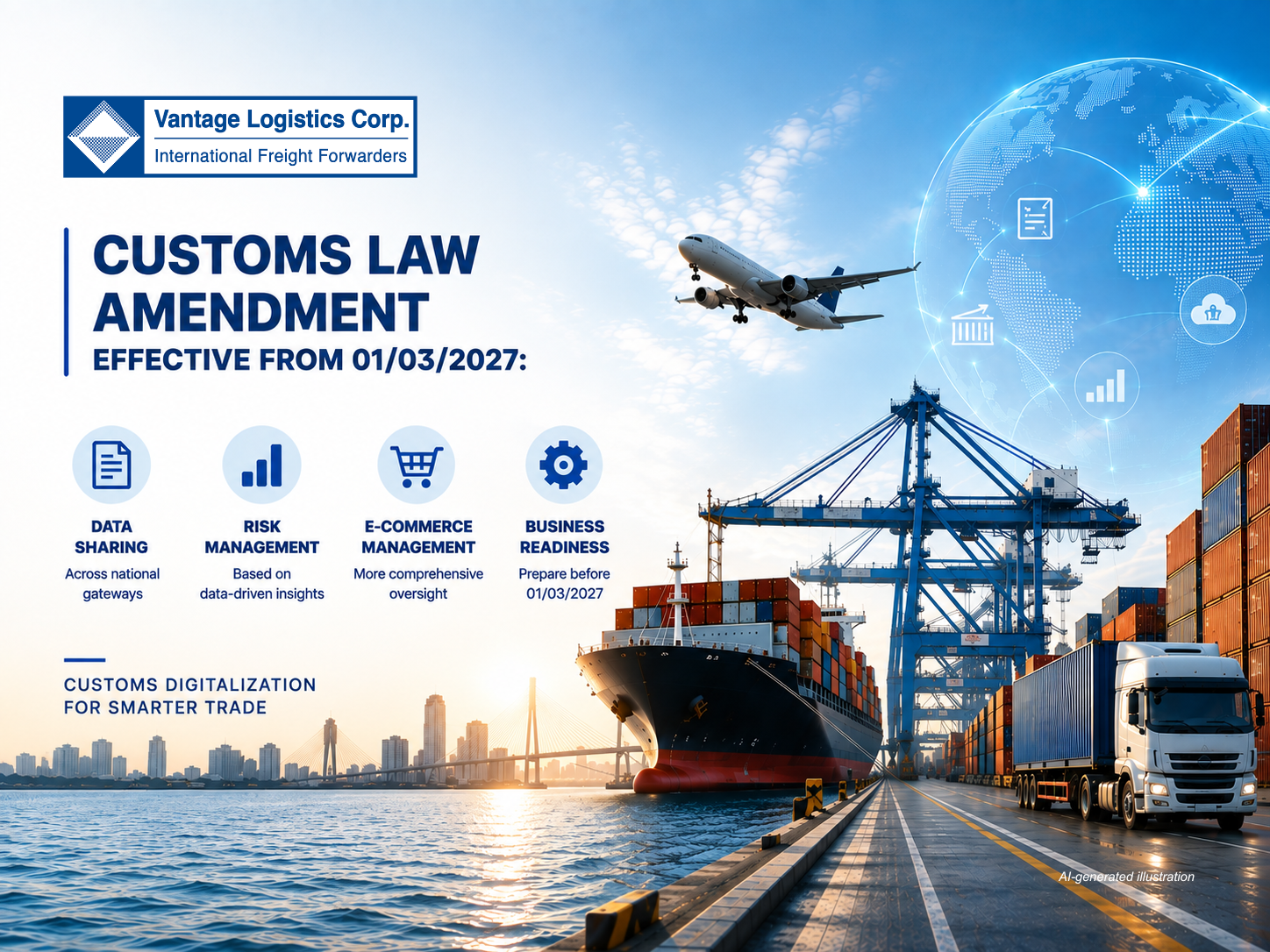
Passed by the National Assembly on August 23, 2026, and officially taking effect on March 1, 2027, Law No. 11/2026/QH16 (amending and supplementing certain articles of the Customs Law) represents a strategic shift in import-export governance. Regulatory oversight is pivoting decisively from “paper-based document sufficiency” to “end-to-end data integrity, consistency, and automated cross-system reconciliation.” Here are the key regulatory updates and a practical roadmap that trading enterprises must navigate ahead of the 2027 enforcement deadline. I. Inter-Agency Data Sharing via National Single Window (NSW): Eliminating Redundant Filings Under amended Article 24, customs declarations and supporting documents submitted as electronic data messages carry full legal validity, provided they satisfy integrity standards and established e-transaction data schemas. The “Once-Only” Submission Principle: Permits and specialized inspection results issued by line ministries via the National Single Window (NSW) are channeled straight into the customs automated system. Declarants are no longer required to re-submit or present physical or separate electronic copies The Consistency Imperative: As inter-agency system integration becomes fully automated, any discrepancy in commodity descriptions, HS codes, quantities, customs valuation, or origin across the declaration, Commercial Invoice, Packing List, and Certificate of Origin (C/O) will be flagged automatically by the system II. Risk Management and Customs Compliance: Powered by AI and Big Data Amended Articles 17 and 17a establish a clear legal basis for customs authorities to deploy Big Data analytics and Artificial Intelligence (AI) to collect, process, and cross-reference data for risk profiling and compliance tiering. Audit Trails and Historical Data Profiling: Customs evaluations will no longer focus solely on isolated shipments. The system tracks continuous data lineage: Internal ERP à Commercial Invoices/Docs à Historical Declarations à Post-Clearance Records Tangible Benefits for High-Compliance Traders: Businesses with clean transaction histories, consistent HS code classifications, and proactive self-amendment mechanisms will qualify for trade facilitation privileges: lower Yellow/Red channel physical inspection rates, streamlined specialized inspections, and reduced post-clearance audit frequency III. Dedicated Oversight for Cross-Border E-Commerce Article 16a introduces a focused regulatory framework for import and export operations transacted via e-commerce marketplaces: Entities and individuals conducting cross-border transactions through e-commerce platforms must undergo electronic identification and authentication Platform operators, international express couriers, 3PL providers, and bonded warehouse operators are mandated to interface directly with the customs data infrastructure, transmitting order details, logistics tracking milestones, and transaction values in real time IV. Shared Data Accountability Across the Supply Chain The amended law broadens the scope of reporting entities to include cargo owners, logistics service providers, carriers, licensed customs brokers, and digital platforms. A compliant customs declaration now relies on data integrity across multiple hands. Importers and exporters must clearly delineate responsibilities within Service Level Agreements (SLAs): Which data attributes must be validated and certified directly by the supplier/shipper? Which specific data fields are keyed and cross-checked by the customs broker? What are the clear liability and indemnification terms when data errors result in customs penalties, shipment holds, or supply chain disruptions? V. Strategic Roadmap: 5 Actionable Steps Before March 1, 2027 While the Government and the Ministry of Finance draft detailed implementing Decrees and Circulars, enterprises should establish internal data controls through the following operational flow: ERP/Accounting Source Data à Master Data Standardization à Document Pre-Audit à Sign-off à Filing & Digital Archiving Cleanse Product Master Data: Consolidate and lock standard product catalogs, including validated 8-digit HS codes, explicit commercial descriptions, standard Units of Measure (UOM), and country of origin rules for all regular product lines Eliminate Software Integration Gaps: Audit data interfaces between ERP systems, Warehouse Management Systems (WMS), accounting databases, and customs declaration software (e.g., VNACCS/ECUS). Remove manual copy-paste interventions that introduce human error Institute a 5-Point Pre-Filing Validation Checklist: Does line-item data on the declaration match the Commercial Invoice and Packing List exactly? Are cargo descriptions precise and technical, completely avoiding ambiguous or generic trade names? Are the assigned HS codes backed by verifiable technical documentation or formal Advance Rulings? Have specialized inspection certificates or licenses populated correctly on the National Single Window portal? Can all supporting technical literature and cost accounting records be retrieved and presented within 24 hours in the event of an audit inquiry? Institutionalize Electronic Archiving Protocols: Store comprehensive digital dossiers by shipment and declaration number. Ensure digital signatures remain cryptographically verifiable and metadata stays intact for post-clearance audits (PCA) Monitor Sub-Law Guidance: Track forthcoming ministerial Circulars through 2026–2027 detailing technical data schemas, API integration protocols, and voluntary compliance frameworks Digital customs compliance from 2027 onward requires a shift toward rigorous data governance rather than surface-level document assembly. Proactive businesses that clean their data today will turn regulatory compliance into an operational edge – securing faster green-channel clearance and lowering total landed costs. Looking to audit your customs data workflows, evaluate your compliance posture, or structure integrated logistics solutions ahead of the 2027 regulatory shift? Contact Vantage Logistics to consult with our trade compliance and freight advisory specialists.   Contact Vantage Logistics for tailored transport solutions and competitive quotations. Please provide details on cargo type, market, origin, destination, and estimated timeline. Vantage Logistics Corp – South East Asia (S.E.A) Logistics Provider One-Stop Shop For Integrated Logistics Services Head Office Viet Nam – Suite 6.01, Floor 6th, Block A, RiverGate Residence, 151-155 Ben Van Don, Khanh Hoi Ward, HCMC, Viet Nam Branch Thailand, Laos, Cambodia, Malaysia, Indonesia, Singapore Contact Us Email in**@*****om.vn Hotline +84-909-026-261 Website https://vantage-logistics.com Send your shipment enquiry today and receive a tailored transport plan from the Vantage Logistics team....

10/09/2026

View More

Market updates

PRODUCTION SHIFTING TO SOUTHEAST ASIA: WHAT DOES THIS MEAN FOR VIETNAM’S PORT AND MARITIME TRANSPORT INDUSTRY?

Southeast Asia is strengthening its position in the restructuring of global supply chains as multinational corporations continue to reallocate production capacity. For Viet Nam, the shift in investment and manufacturing activity could expand cargo volumes for ports and maritime transport, but it does not automatically translate into higher port throughput. The extent of the benefit depends on three factors: cargo composition, connectivity to international shipping networks, and the logistics capacity connecting factories with ports. Notably, Vietnam’s maritime connectivity has been showing clear progress. According to UNCTAD, Vietnam’s Liner Shipping Connectivity Index (LSCI) increased by 12% between June 2024 and June 2025, indicating that Vietnam’s position within the international container shipping network continues to strengthen. I. Production Shifts Create More Cargo, but Not All Cargo Moves by Sea 1/ Cargo Composition Determines the Mode of Transport The shift of manufacturing activity across ASEAN is creating clear two-way transportation demand: imports of machinery, components, and production inputs, alongside exports of finished goods to major consumer markets. However, the actual volume of cargo moving through ports depends directly on cargo composition: High-tech shipments, compact components, high-value goods, and time-sensitive cargo tend to favor air freight. By contrast, industries with high volumes of production inputs and finished goods, such as textiles and apparel, footwear, machinery, furniture, and consumer electronics, are major sources of containerized cargo demand for maritime transport. FDI and production shifts create potential cargo volumes; the actual amount moving through seaports still depends on cargo characteristics, import and export markets, and supply chain structures. 2/ Who Actually Benefits from the New Cargo Flows? New cargo flows do not distribute benefits evenly across the supply chain. For seaports, the direct impact is higher demand for container handling, particularly at gateways capable of receiving large vessels and integrated into international shipping networks. For Vietnam’s maritime transport industry, the more immediate opportunities are concentrated in intra-Asia routes, feeder services, coastal shipping, and cargo connectivity between ports within the region. Meanwhile, on direct deep-sea routes to North America and Europe, vessel capacity remains primarily controlled by international container shipping lines. As a result, Vietnamese logistics companies have clearer opportunities in connecting cargo sources to international shipping networks, through feeder services, barges, trucking, warehousing, and customs services. Vietnam’s share of cargo flows from Asia to North America & Europe Source: Compiled from Kirin Capital & International Maritime Reports II. Shipping Networks Determine Which Ports Actually Benefit Channel depth and berth capacity are necessary conditions. However, to convert handling capacity into actual throughput, a port must be integrated into the service networks of international shipping lines. The restructuring of service networks toward a Hub-and-Spoke model makes this factor even more important. A port may be selected as a mainline port of call, a regional connection point, or a feeder port; each position creates different cargo volumes and flow patterns. In Viet Nam, Cai Mep–Thi Vai and Lach Huyen continue to serve as two key deep-water port clusters within the international maritime transport network. Cai Mep’s performance shows how the ability to handle mainline vessels is being converted into actual throughput: In the first 10 months of 2025, the Cai Mep–Thi Vai port cluster handled nearly 6.3 million TEUs of mainline-vessel cargo, up more than 18% year over year At CMIT, during the first 11 months of 2025, the port handled more than 350 mainline vessel calls and over 8,000 barge and feeder vessel calls; mainline-vessel throughput exceeded 1.1 million TEUs, up 28%, while maintaining 8 direct international service routes to North America, Europe, and intra-Asia markets Cai Mep–Thi Vai port cluster: mainline-vessel cargo throughput surges Source: Viet Nam Seaports Association – VPA III. Logistics Connectivity Determines The Ability To Handle Cargo Flows A deep-water port is only one node in the overall journey. For cargo from manufacturing centers to effectively enter the international maritime network, the port must be seamlessly connected to road transport, inland waterways, ICDs, warehousing, and customs clearance services. When shipping lines operate on tight schedules and cut-off times, a delay in transporting cargo from the factory to the port can cause the shipment to miss its mainline vessel. This is particularly important for major manufacturing centers. Barge and trucking capacity, as well as the ability to consolidate cargo from industrial parks and move it to deep-water ports, directly affect the time, cost, and reliability of the entire journey. Beyond infrastructure expansion, port operating performance in Vietnam is also improving. According to the 2025 Container Port Performance Index (CPPI) published by the World Bank and S&P Global in 2026, Cai Mep ranked 11th and Hai Phong ranked 13th among more than 400 ports evaluated. This shows that port competitiveness is not determined solely by capacity scale, but increasingly by the ability to operate reliably and connect efficiently with the broader network. IV. Three Challenges To Watch The benefits of supply chain shifts will not automatically translate into uniform growth across the market. Three challenges require close attention: Post-port infrastructure connectivity: The expansion of berths needs to be accompanied by sufficient inland waterway and barge capacity, road connections, satellite ICD networks, and customs clearance capacity to prevent localized bottlenecks. Capacity competition among terminals: New terminals coming into operation give shippers more options, but they also intensify competition for cargo among terminals within the same area if cargo growth does not keep pace with capacity expansion. Changes in shipping networks: Changes in route allocation and port-call frequency by international shipping alliances can cause cargo flows to shift between port clusters. V. Conclusion: From Port Capacity To Supply Chain Synchronization Production shifts create cargo; shipping networks determine which ports handle that cargo; and logistics capacity behind the port determines whether the entire supply chain can convert that opportunity into economic efficiency. The advantage of Vietnam’s seaports today is measured not only by berth length, but by their ability to provide seamless connectivity from the factory gate to the mainline vessel. For shippers, port selection is increasingly shifting from the question “Which port has lower handling fees?” to “Which transportation option can keep the entire cargo journey reliable, on schedule, and as cost-efficient as possible?” Vantage Logistics provides integrated transportation solutions, connecting ocean freight, inland waterway barges, trucking, warehousing, and end-to-end customs clearance. Contact us to develop a transportation and logistics plan aligned with your production schedule and vessel schedules.   Contact Vantage Logistics for tailored transport solutions and competitive quotations. Please provide details on cargo type, market, origin, destination, and estimated timeline. Vantage Logistics Corp – South East Asia (S.E.A) Logistics Provider One-Stop Shop For Integrated Logistics Services Head Office Viet Nam – Suite 6.01, Floor 6th, Block A, RiverGate Residence, 151-155 Ben Van Don, Khanh Hoi Ward, HCMC, Viet Nam Branch Thailand, Laos, Cambodia, Malaysia, Indonesia, Singapore Contact Us Email in**@*****om.vn Hotline +84-909-026-261 Website Send your shipment enquiry today and receive a tailored transport plan from the Vantage Logistics team....

10/09/2026

View More
vlc-news-uae-vn-import-tariff-09092026

Market updates

VIET NAM IMPORT TARIFFS ON GOODS FROM THE UAE: KEY CEPA COMPLIANCE CONSIDERATIONS FOR IMPORTERS

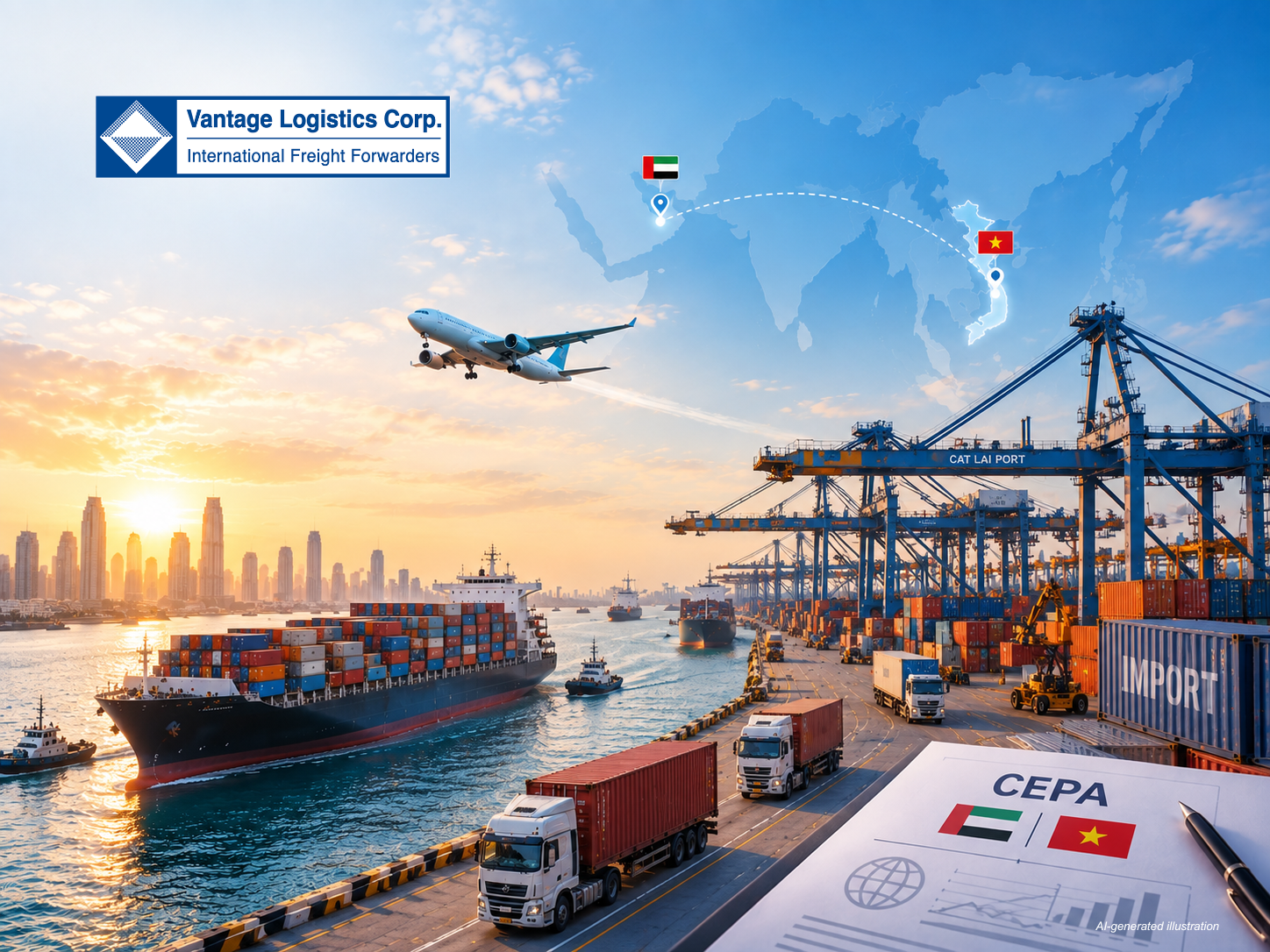
The Comprehensive Economic Partnership Agreement (CEPA) between Viet Nam and the UAE officially took effect on February 3, 2026. In conjunction with the agreement, the Government of Viet Nam enacted a Decree establishing the Special Preferential Import Tariff Schedule under CEPA for the 2026–2027 period. Qualifying imports from the UAE are eligible for preferential customs duty rates (CEPA tariff rates). To determine the applicable duty rate for each shipment, importers must cross-check three key elements: tariff classification (HS code), origin criteria, and declaration dates. 1/ Key Highlights of the CEPA Tariff Framework Product-Specific Duty Rates: The CEPA tariff schedule details preferential rates at the 8-digit HS code level for 2026 and 2027. It covers major import categories from the UAE, including raw plastics, chemicals, and base metals. Tariff lines marked with an asterisk (*) are excluded from preferential treatment under this agreement. Effective Date: While the governing decree was promulgated later, preferential CEPA tariff treatment applies retrospectively to customs declarations registered on or after February 3, 2026. 2/ Three Eligibility Requirements for Preferential Treatment  To qualify for CEPA tariff rates, an import shipment must meet all three requirements: HS Code Eligibility: The merchandise must fall under an eligible HS code in the CEPA Special Preferential Import Tariff schedule. Direct Consignment from the UAE: Goods must be imported directly from the UAE into Vietnam in compliance with the agreement’s transport and transshipment regulations. Origin and Valid Proof of Origin: The goods must satisfy CEPA rules of origin and be accompanied by a valid Certificate of Origin (C/O) or compliant origin declaration issued in accordance with regulations from the Ministry of Industry and Trade. Note on Origin: Purchasing or shipping goods from the UAE does not automatically confer UAE origin. Importers must confirm the originating status and valid origin documentation with suppliers prior to customs filing. 3/ Tariff Application & Duty Adjustment Provisions Current and Upcoming Entries: Importers should ensure that valid proof of origin (C/O or prescribed origin declarations) is ready at the time of customs clearance to secure CEPA duty rates immediately, avoiding provisional declarations under higher Most-Favored-Nation (MFN) rates. Prior Shipments (Registered from February 3, 2026): Regulatory provisions allow for the adjustment and refund of overpaid import duties if the goods met all CEPA qualification criteria but were cleared at higher tariff rates. Importers with unadjusted entries from this period should review their shipment files to initiate duty adjustment procedures with customs authorities.  4/ Pre-Import Checklist for Importers Confirm correct 8-digit HS classification Check applicable CEPA preferential duty rates Verify origin criteria compliance with the foreign supplier Secure compliant proof of origin (C/O or declaration) Cross-check all shipping and customs documentation prior to filing  5/ How Vantage Logistics Can Support  Pre-verifying HS codes, rules of origin, and applicable duty rates before shipment arrival mitigates compliance risks and prevents clearance delays. Vantage Logistics assists importers with: Pre-clearance document verification and tariff schedule reviews Customs clearance handling and duty treatment reconciliation End-to-end international freight and inland transportation from the UAE to Viet Nam   Regulatory References: Government Decree on the Special Preferential Import Tariff Schedule for the Implementation of CEPA (2026–2027); Ministry of Industry and Trade Regulations on Rules of Origin under CEPA.   Contact Vantage Logistics for tailored transport solutions and competitive quotations. Please provide details on cargo type, market, origin, destination, and estimated timeline.   Vantage Logistics Corp – South East Asia (S.E.A) Logistics Provider One-Stop Shop For Integrated Logistics Services Head Office Viet Nam – Suite 6.01, Floor 6th, Block A, RiverGate Residence, 151-155 Ben Van Don, Khanh Hoi Ward, HCMC, Viet Nam Branch Thailand, Laos, Cambodia, Malaysia, Indonesia, Singapore Contact Us Email in**@*****om.vn Hotline +84-909-026-261 Website https://vantage-logistics.com...

09/09/2026

View More
vlc-news-vn-imports-2025-08092026-cover (1)

Market updates

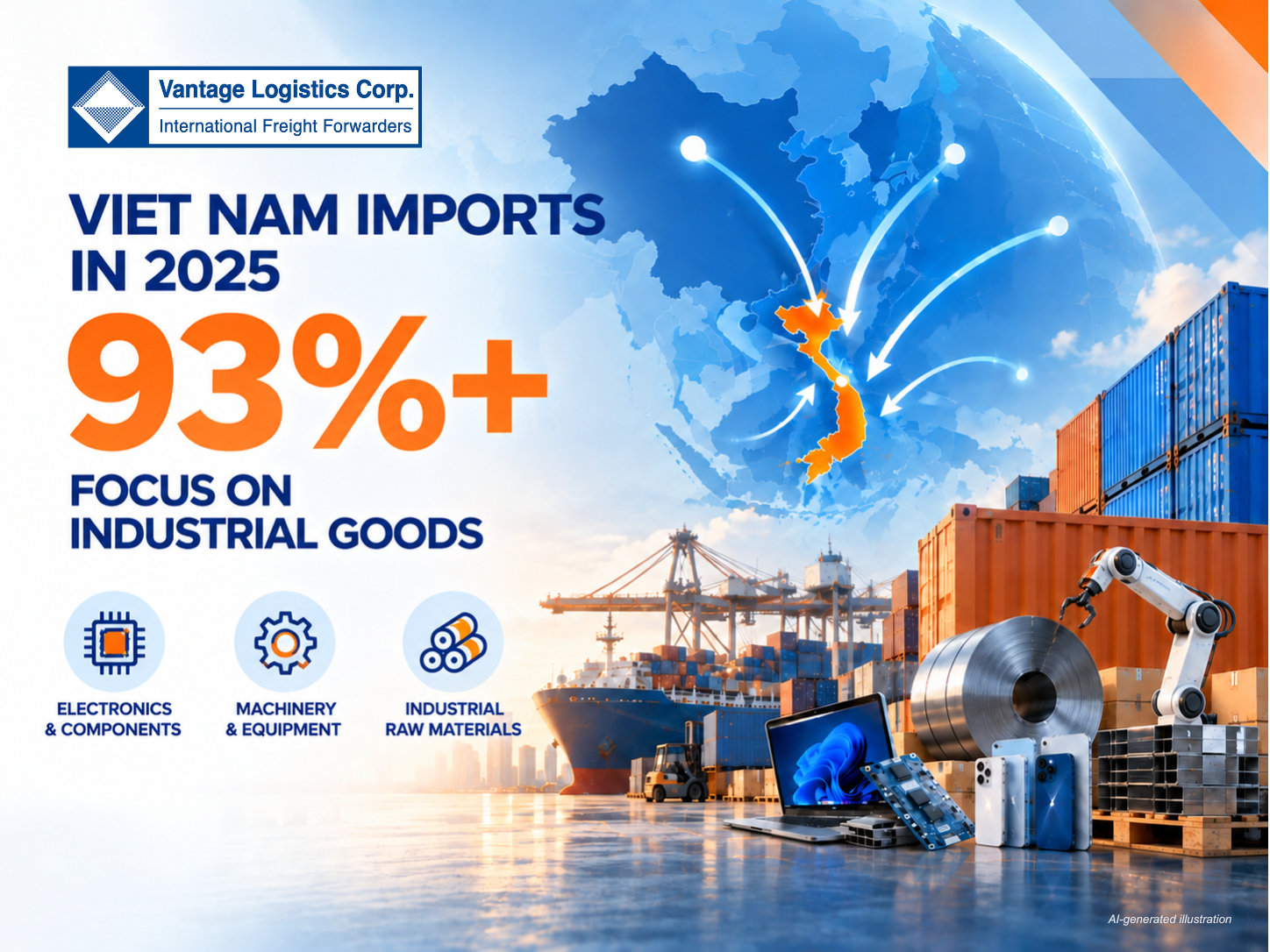
VIET NAM IMPORTS 2025: OVER 93% CONCENTRATED IN INDUSTRIAL GOODS, SUPPLY CHAIN OUTLOOK FOR 2026

In 2025, Vietnam’s total merchandise imports reached approximately USD 455.03 billion, up about 19.5% from 2024. The import mix remained heavily concentrated in goods used for manufacturing, processing, and exports. Industrial goods accounted for more than USD 426 billion, or around 93.6% of total import value, with machinery, equipment, and production materials making up the bulk of imports. I. IMPORT COMPOSITION: INDUSTRIAL GOODS ACCOUNT FOR MORE THAN 93% OF TOTAL IMPORT VALUEP Vietnam’s industrial imports in 2025 were concentrated in machinery, technology equipment, and materials used in production: 1/ Three technology, electronics, and machinery groups reach nearly USD 223 billion Combined imports of three groups – (1) Computers, electronic products and components; (2) Machinery, equipment, tools and spare parts; and (3) Telephones and components – reached approximately USD 223 billion, equivalent to nearly 49% of total importsc. Computers, electronic products and components: Imports reached USD 150.70 billion, up 40.7% from 2024, making this the country’s largest import category. According to the Ministry of Industry and Trade, the group includes key technology components such as chips, displays, semiconductor components, and specialized parts used in electronics manufacturing and assembly for export Machinery, equipment, tools and spare parts: Imports totaled USD 61.03 billion, up 24.8%. FDI companies accounted for 66.7% of the group’s import value, at USD 40.7 billion, up 37.1%. The increase came as demand for production equipment, automation, and capacity expansion grew. Electrical and electronic equipment was the largest segment, at USD 23.7 billion Telephones and components: Imports reached USD 11.26 billion, up 8.2%. FDI companies accounted for 92.5% of total imports in this category 2/ Raw materials for processing and manufacturing Textile, garment, and footwear materials: Imports exceeded USD 28.30 billion, up 2.4% from 2024. Fabrics accounted for the largest share at USD 15.20 billion (+1.9%), representing 53.7% of the group. Textile, garment, and leather materials totaled USD 7.4 billion; cotton USD 2.9 billion; and textile fibers and yarn USD 2.8 billion Plastics and plastic products: Imports reached USD 23.40 billion, up 13.4%. FDI companies accounted for USD 15.3 billion, or 65.2% of the group Iron and steel: Import volume reached 16.13 million metric tons, valued at USD 11.20 billion, down 10.9% in value as the average import price fell to USD 697 per ton. The import mix shifted, with steel sheet imports rising to USD 1.98 billion (+21.8%), while steel coil imports declined II. KEY IMPORTS OF AGRICULTURAL, SEAFOOD, AND ENERGY INPUTS Alongside industrial goods, imports of agricultural and seafood products for processing, as well as fuels and minerals, remained significant: Agricultural and seafood products for processing: Imports reached USD 25.55 billion, up 13.8% (5.6% of total imports). Cashew nuts reached USD 4.49 billion (+39.3%), mainly for processing; seafood imports hit a record USD 3.38 billion (+28.2%); rubber reached USD 3.08 billion; and corn for animal feed totaled USD 2.95 billion Fuels and minerals: Coal imports reached 65.4 million metric tons (USD 6.60 billion); petroleum products 9.96 million metric tons (USD 6.82 billion); crude oil approximately USD 6.2 billion (including USD 6.1 billion supplied by Kuwait to domestic refineries); and ores and other minerals USD 3.2 billion (+10.6%) III. SOURCING MARKETS: ASIA REMAINS THE MAIN SOURCE OF IMPORTS By source, Asia accounted for 82.6% of Vietnam’s total import value, reaching USD 375.90 billion, up 20.5% from 2024. This highlights Vietnam’s continued reliance on regional supply networks for production inputs. Within the region, China remained Vietnam’s largest source of imports, with import value reaching USD 186.0 billion (up 29.0%), equivalent to 40.8% of total national imports. China remained a major source of machinery and equipment, electronic components, and industrial materials. IV. FDI CAPACITY EXPANSION AND SUPPLY CHAIN OUTLOOK FOR 2026 Machinery imports as a signal of FDI production growth In 2025, FDI enterprises imported USD 40.7 billion worth of machinery, equipment, and spare parts, up 37.1%, significantly outpacing the national average. FDI firms accounted for 66.7% of total machinery imports and 92.5% of telephone and component imports. This surge highlights stronger investment in production lines, automation, and capacity expansion. It will be a key driver of demand for imported raw materials, components, and logistics services in 2026 Two supply chain and logistics issues to watch in 2026 Environmental and traceability requirements: Export markets are tightening standards. The EU’s CBAM (covering steel and aluminum) and the EU Deforestation Regulation (EUDR, covering wood, rubber, coffee, and soy) require detailed emissions data and supply-chain traceability. Companies must prepare documentation and data from the raw-material sourcing stage to remain compliant. Managing Asia-centric supply concentration: With 82.6% of imports sourced from Asia, firms face heightened exposure to regional suppliers, ports, and transport routes. Building contingency inventories and adopting flexible transport solutions will help mitigate risks from freight-rate volatility, container shortages, and customs delays   Contact Vantage Logistics for tailored transport solutions and competitive quotations. Please provide details on cargo type, market, origin, destination, and estimated timeline. Vantage Logistics Corp – South East Asia (S.E.A) Logistics Provider One-Stop Shop For Integrated Logistics Services Head Office Viet Nam – Suite 6.01, Floor 6th, Block A, RiverGate Residence, 151-155 Ben Van Don, Khanh Hoi Ward, HCMC, Viet Nam Branch Thailand, Laos, Cambodia, Malaysia, Indonesia, Singapore Contact Us Email in**@*****om.vn Hotline +84-909-026-261 Website https://vantage-logistics.com Send your shipment enquiry today and receive a tailored transport plan from the Vantage Logistics team....

08/09/2026

View More
1 … 5 6 7 8 9 … 23