MARKET UPDATES

vlc-news-philippines-cancels-rice-import-permit-15102026

Market updates

Philippines Cancels Permit for Controversial 12,480-Metric-Ton Rice Shipment from Viet Nam

The Philippine Department of Agriculture (DA) said it had ordered the cancellation of the Sanitary and Phytosanitary Import Clearance (SPSIC) for a 12,480-metric-ton rice shipment from Viet Nam before the vessel arrived. The case involves reported discrepancies in rice specifications and an expired import contract, highlighting the risks that can arise when shipping schedules do not align with import requirements in the destination market. 1. Developments at the Port of Arrival According to the Philippine Department of Agriculture (DA) and the Philippine News Agency (PNA), the vessel MV Tay Son 2, carrying 12,480 metric tons of rice from Viet Nam, arrived at the Port of Davao on September 14, 2026. According to these sources, the vessel’s captain refused to submit the shipment for inspection by the Philippine Bureau of Plant Industry (BPI). On September 17, 2026, the vessel departed Davao before the matter had been resolved. Philippine authorities subsequently prevented the cargo from being unloaded at another location and brought the vessel to the Port of General Santos before ordering it to return to Davao for further handling. 2. Rice Specifications and Import Requirements The case involves two issues: reported discrepancies in rice specifications and the status of the import contract and permit. 2.1. Reported Discrepancy in Rice Specifications The importer, Planters Product, Inc. (PPI), reported a discrepancy between the purchase order and the specifications communicated for the shipment: Specifications under the purchase order: 25% broken rice Reported specifications for the shipment: 5% broken rice In agricultural trade, the percentage of broken grains is an important commercial specification. However, the discrepancy remains based on information reported by the importer and has not been confirmed by an official inspection, as the physical inspection process was not completed. 2.2. Expired Contract and Canceled Import Permit In addition to the rice specifications, the delivery timeline and the status of the import documentation were also highlighted by the DA: Estimated time of arrival (ETA): July 2026 Actual arrival: Mid-September 2026 According to the DA, the import contract had expired and the SPSIC had been canceled before the vessel arrived. The vessel’s arrival also coincided with the period when the Philippines was preparing for the wet-season rice harvest. According to published information, import policy during this period was also linked to efforts to limit downward pressure on domestic palay prices. Operational Note: Even when goods meet quality requirements, a shipment may still face customs clearance difficulties if it fails to meet import requirements or if the relevant permit is no longer valid. 3. Proposed Measures for Handling the Shipment According to published information, the Bureau of Customs of the Philippines (BOC) was still considering the final course of action for the shipment. The proposed measures included: Proposed Measure Proposing Authority / Status Return to the Country of Origin The BPI was reported to have recommended returning the shipment to Viet Nam. Seizure and Penalties The DA proposed considering seizure of the shipment and the application of penalties under relevant regulations, subject to the competent authority’s findings and decision. Final Decision The BOC was reviewing the official course of action for the shipment. 4. Conclusion The controversial rice shipment in the Philippines highlights how international trade depends not only on product quality and contractual terms but also on shipping schedules, the validity of import documentation, and regulatory requirements in the destination market. When these elements are no longer aligned, shipments already in transit may face unexpected complications during arrival and customs clearance. Vantage Logistics will continue to provide updates on notable developments in logistics, import-export activities, and international supply chains, offering businesses additional insight into factors that may affect global trade. Contact Vantage Logistics for tailored transport solutions and competitive quotations. Please provide details on cargo type, market, origin, destination, and estimated timeline.   Vantage Logistics Corp – South East Asia (S.E.A) Logistics Provider One-Stop Shop For Integrated Logistics Services Head Office Viet Nam – Suite 6.01, Floor 6th, Block A, RiverGate Residence, 151-155 Ben Van Don, Khanh Hoi Ward, HCMC, Viet Nam Branch Thailand, Laos, Cambodia, Malaysia, Indonesia, Singapore Contact Us Email in**@*****om.vn Hotline +84-909-026-261 Website https://vantage-logistics.com Send your shipment enquiry today and receive a tailored transport plan from the Vantage Logistics team.

15/10/2026

View More
vlc-news-asean-east-asia-trade-15102026

Market updates

ASEAN–East Asia Trade Reaches USD 1.4 Trillion, Up 13.7% in 2025

According to preliminary data from the ASEAN Secretariat, two-way trade between ASEAN and its three East Asian partners (China, Japan, and South Korea) reached USD 1.4 trillion in 2025, representing a 13.7% year-on-year increase. Notably, China–ASEAN trade continued its upward trajectory in the first seven months of 2026, underscoring a sustained expansion in cross-regional trade volumes worth monitoring. 1. Regional Trade Volume and Foreign Direct Investment (ASEAN+3) Trade and investment flows between ASEAN and its three East Asian partners maintain a substantial footprint. In 2025, Foreign Direct Investment (FDI) inflows from China, Japan, and South Korea into ASEAN totaled USD 44.8 billion. Key ASEAN–East Asia Trade & Investment Indicators Indicator Value Growth / Share ASEAN – (China, Japan, South Korea) Trade in 2025 USD 1.4 Trillion Up 13.7% vs 2024 FDI from 3 East Asian Partners into ASEAN in 2025 USD 44.8 Billion Accounted for 18.2% of total ASEAN FDI China – ASEAN Trade (First 7 Months of 2026) USD 744.41 Billion Up 24.7% year-on-year The scale of merchandise trade and investment capital highlights the vital economic linkage between East Asia and Southeast Asia. However, assessing actual freight demand requires a granular evaluation of specific commodity structures, export-import markets, and active transport corridors. 2. Direct Impacts on Transport Networks and Logistics Infrastructure Expanding trade volumes underscore the critical role of regional transport connections. Depending on industry-specific cargo characteristics and delivery requirements, flexible logistics solutions are being actively deployed: Intra-Asia Ocean Freight Connections: For multi-leg shipments, vessel schedule reliability, transit times, and feeder network connectivity are pivotal factors for supply chain managers. Major gateway hubs such as Shanghai, Ningbo, Busan, and Yokohama maintain dense feeder linkages with Southeast Asian ports within ocean carrier networks Integrated Logistics and Multimodal Transport: Depending on lead-time sensitivity, combining ocean freight, Cross-Border Trucking, and inland warehousing offers expanded routing options. Real-world operational efficiency hinges heavily on border crossing clearance times, transit schedules, and the coordination capability of the logistics operator Rules of Origin (C/O) and Customs Compliance: When leveraging Free Trade Agreements such as RCEP, AKFTA, or AJCEP, enterprises must accurately determine rules of origin and prepare compliant documentation to qualify for preferential tariffs. Duty exemption eligibility depends on the specific conditions of each product line and destination market 3. Monitoring Southeast Asian Trade Dynamics and Logistics Connectivity Expanding trade and investment flows reflect an increasingly integrated economic relationship between East Asia and Southeast Asia. This growth in cross-border trade creates momentum for expanding logistics connectivity, helping strengthen supply chain coverage across the region.   Contact Vantage Logistics for tailored transport solutions and competitive quotations. Please provide details on cargo type, market, origin, destination, and estimated timeline. Vantage Logistics Corp – South East Asia (S.E.A) Logistics Provider One-Stop Shop For Integrated Logistics Services Head Office Viet Nam – Suite 6.01, Floor 6th, Block A, RiverGate Residence, 151-155 Ben Van Don, Khanh Hoi Ward, HCMC, Viet Nam Branch Thailand, Laos, Cambodia, Malaysia, Indonesia, Singapore Contact Us Email in**@*****om.vn Hotline +84-909-026-261 Website https://vantage-logistics.com Send your shipment enquiry today and receive a tailored transport plan from the Vantage Logistics team.

15/10/2026

View More

Market updates

SINGAPORE STRENGTHENS PRODUCT SAFETY CONTROLS: WHAT VIETNAMESE EXPORTERS NEED TO KNOW

Singapore is strengthening its product safety controls through two key regulations: the Consumer Protection (Safety Requirements) Regulations (CPSR) and the Consumer Goods (Safety Requirements) Regulations (CGSR). For exporters, these requirements go beyond product compliance. They can also affect delivery schedules, logistics costs, and supply chain reliability. 1. Singapore Strengthens Product Safety Requirements According to information published by Vietnam’s Ministry of Industry and Trade, Singapore applies two main regulatory frameworks for product safety. – CPSR: Covers 33 categories of controlled goods, including electrical and electronic products, household appliances, and gas appliances. Products within scope must meet applicable safety requirements, complete registration, and carry the SAFETY Mark before being supplied or sold in Singapore. – CGSR: Covers general consumer goods such as toys, clothing, furniture, and sports equipment, which must comply with the relevant safety standards. Non-compliant products may be subject to sales restrictions or recalls. Businesses that violate applicable requirements may also face penalties. For exporters, checking compliance requirements before shipment is essential. Addressing documentation or registration issues early can help avoid costly adjustments after cargo has already left the port of origin. 2. Potential Impact on Southeast Asia’s Trade and Logistics Singapore plays an important role in Southeast Asia’s trade and logistics network. Tighter product safety controls may require exporters, importers, and distributors to review their procedures for placing goods on the Singapore market. Several potential risks deserve attention: – Delivery delays: Incomplete documentation or missing certificates may affect cargo acceptance and delivery schedules. – Additional logistics costs: Delays in resolving compliance issues may lead to storage, port handling, or additional transportation costs. – Disrupted distribution plans: Late deliveries can affect inventory planning, distribution schedules, and commitments to business partners. These requirements do not automatically apply across all ASEAN markets. However, they highlight the importance of understanding the specific regulations of each destination country when planning regional trade and distribution. 3. What Should Vietnamese Exporters Prepare? For Vietnamese businesses exporting to Singapore, compliance checks should take place before shipment arrangements are finalized. Exporters should determine whether their products fall under CPSR or CGSR, verify the applicable safety standards and registration requirements, and clarify responsibilities with their Singaporean importers. Documentation preparation should also be factored into the shipping schedule. If an issue is discovered only after cargo arrives at the destination port, businesses may need to manage several challenges simultaneously, including delivery delays, additional costs, and changes to distribution plans. A reliable shipping plan therefore involves more than selecting the right route or sailing schedule. It also requires anticipating potential obstacles before the cargo reaches its destination. 4. Managing Risks Through Early Planning Not every risk in international shipping can be eliminated, but many disruptions can be reduced through early preparation. Reviewing cargo information, documentation, shipping schedules, and destination requirements helps all parties make better-informed decisions. For shipments to Singapore, close coordination among exporters, importers, agents, and logistics providers helps maintain visibility over shipment readiness, address changes, and adjust plans when necessary. At Vantage Logistics, international transportation planning takes into account the practical requirements of each shipment and the coordination needed among relevant parties. This approach helps businesses manage potential disruptions and maintain better control over delivery schedules. As market requirements evolve, careful preparation does more than protect an individual shipment. It also helps businesses maintain reliable supply chains and build lasting partnerships across international markets.

15/10/2026

View More

Market updates

Indonesia’s Exports and Imports in the First 8 Months of 2026: Strong Import Growth, Trade Surplus Maintained

Indonesia’s exports and imports recorded positive growth in the first eight months of 2026. Exports reached US$193.64 billion, while imports increased by 19.84%, resulting in a trade surplus of US$7.25 billion. Southeast Asia Maintains Growth Momentum Amid Multiple Challenges In 2026, Southeast Asia’s economy continued to demonstrate resilience amid changes in global trade, energy markets, and supply chains. According to the Asian Development Bank (ADB)’s September 2026 update, growth in developing economies in Southeast Asia is forecast to reach 4.7% in 2026, slightly higher than the previous forecast. Manufacturing, services, and domestic demand continued to support growth, although energy costs and trade uncertainties remain factors to monitor. Against this backdrop, Indonesia remains one of the region’s largest economies, with international trade playing an important role in manufacturing activities and regional supply chains. Indonesia’s Exports and Imports in the First 8 Months of 2026 According to BPS – Statistics Indonesia, during the first eight months of 2026, Indonesia’s total exports reached US$193.64 billion, an increase of 4.74% compared with the same period in 2025. Non-oil and gas exports reached US$185.63 billion, up 5.48%. In August 2026 alone, exports reached US$26.61 billion, increasing 6.72% year-on-year. On the import side, imports reached US$186.39 billion, rising by 19.84%. Non-oil and gas imports reached US$157.09 billion, up 16.83%. In August, imports amounted to US$23.06 billion, an increase of 19.09% year-on-year. Indonesia’s exports and imports in the first eight months of 2026 A notable point is that imports grew significantly faster than exports, indicating stronger demand for goods supporting production and investment activities in Indonesia. Nickel and Manufacturing Continue to Support Exports Within Indonesia’s non-oil and gas export structure, nickel and nickel products recorded notable growth of 50.12%, equivalent to an increase of approximately US$2.87 billion. Several other commodity groups also recorded growth, including mineral fuels, animal and vegetable fats and oils, chemical products, iron and steel, electrical machinery and equipment, vehicles, and mechanical machinery. Meanwhile, precious metals, jewellery, and precious stones declined by 42.82%. By industry, manufactured products accounted for 82.40% of Indonesia’s total exports, reaching US$159.55 billion and increasing by 7.87%. In contrast, exports from agriculture, forestry, and fisheries declined by 18.45%, while mining and other products decreased by 4.94%. China Remains a Major Export Market and Import Source During the first eight months of the year, China was Indonesia’s largest non-oil and gas export market, with exports reaching US$47.44 billion, accounting for 25.55%. The United States followed with US$22.41 billion, while India reached US$12.77 billion. Exports to ASEAN totaled US$36.44 billion, representing 19.63%. On the import side, China’s role was even more significant. Indonesia imported US$66.64 billion worth of goods from China, accounting for 42.42% of total non-oil and gas imports. ASEAN ranked second, with US$22.91 billion, equivalent to 14.58%. Intermediate Goods and Machinery Account for a Large Share of Imports Indonesia’s import structure shows strong demand for goods supporting production activities. Intermediate goods reached US$133.38 billion, accounting for 71.56% of total imports, up 20.67% compared with the same period last year. Capital goods reached US$36.75 billion, representing 19.71%, while consumer goods accounted for 8.73%. Imports of machinery, mechanical appliances, and electrical machinery and equipment also increased significantly. In particular, imports of electrical machinery and equipment rose by 22.94%, equivalent to an increase of approximately US$4.58 billion. Indonesia Maintains a Trade Surplus Despite imports growing faster than exports, Indonesia recorded a US$7.25 billion trade surplus in the first eight months of 2026. The non-oil and gas trade balance recorded a surplus of US$28.54 billion, offsetting the US$21.29 billion deficit in the oil and gas sector. Overall, the first eight months of 2026 show clear growth in both directions of Indonesia’s trade, with exports supported by manufacturing and nickel, while imports increased strongly in machinery, equipment, and intermediate goods. These developments provide further insight into production activity and market demand in Indonesia’s role within regional supply chains.   Infographic of Indonesia’s exports and imports in August 2026   Contact Vantage Logistics for tailored transport solutions and competitive quotations. Please provide details on cargo type, market, origin, destination, and estimated timeline.   Vantage Logistics Corp – South East Asia (S.E.A) Logistics Provider One-Stop Shop For Integrated Logistics Services Head Office Viet Nam – Suite 6.01, Floor 6th, Block A, RiverGate Residence, 151-155 Ben Van Don, Khanh Hoi Ward, HCMC, Viet Nam Branch Thailand, Laos, Cambodia, Malaysia, Indonesia, Singapore Contact Us Email in**@*****om.vn Hotline +84-909-026-261 Website https://vantage-logistics.com   Send your shipment enquiry today and receive a tailored transport plan from the Vantage Logistics team....

02/10/2026

View More
vlc-news-thailand-market-1102026 (1)

Market updates

Thailand Market 2026: Trade, Infrastructure, and Logistics Opportunities

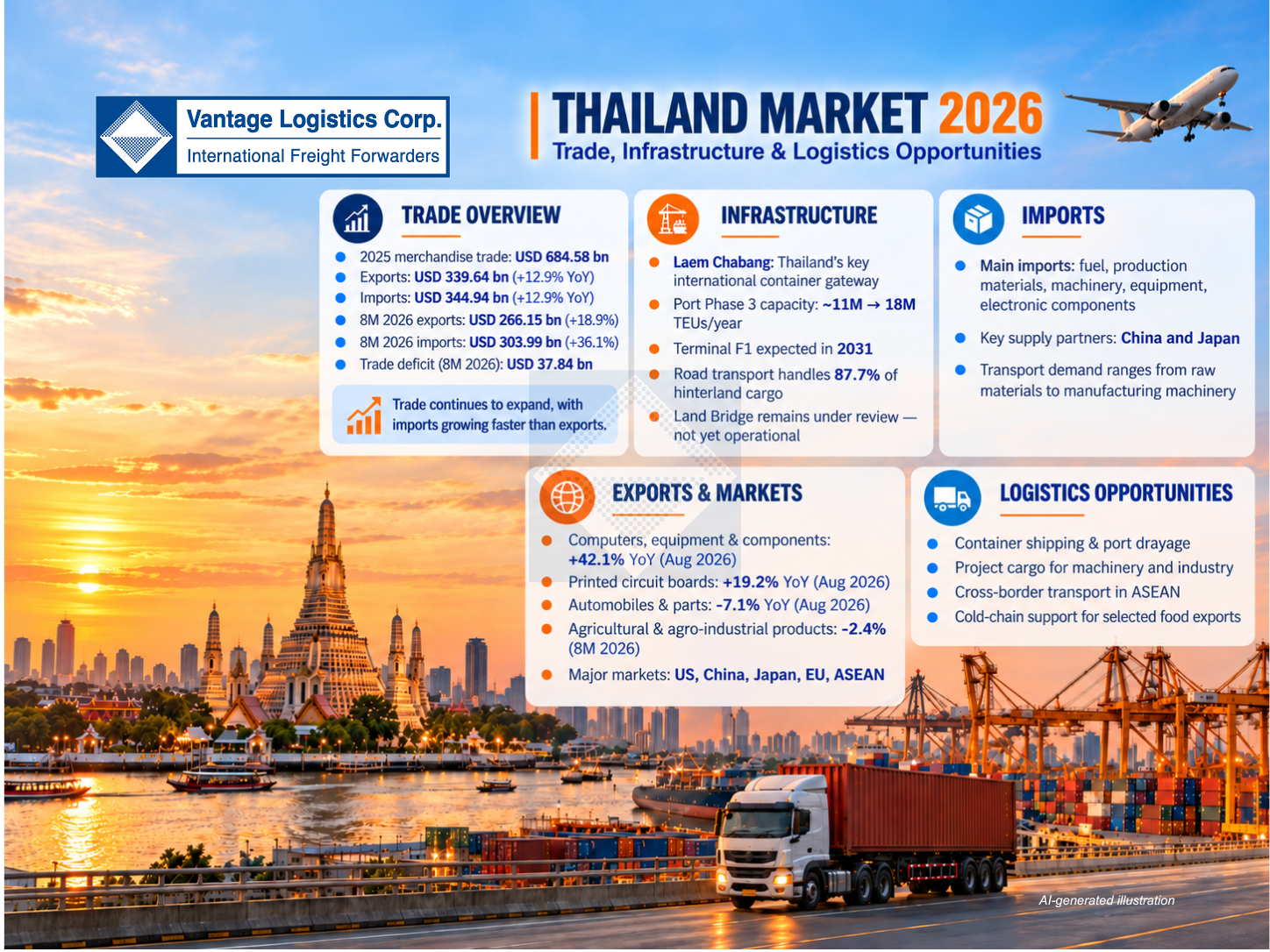
Thailand is an important manufacturing and trading hub in Southeast Asia. Its trade volume, industry composition, and infrastructure development are shaping diverse transportation and logistics needs across the market. 1/ Economic and Trade Overview In 2025, Thailand’s total merchandise trade reached approximately USD 684.58 billion. Exports hit a record USD 339.64 billion, up 12.9% year on year, while imports amounted to USD 344.94 billion. During the first eight months of 2026, exports reached USD 266.15 billion, an increase of 18.9% year on year. Imports grew at a faster rate, reaching USD 303.99 billion, up 36.1%. This resulted in a trade deficit of USD 37.84 billion over the period. These figures indicate continued trade expansion, with import value growing faster than exports. 2/ Port Infrastructure and Transport Connectivity Laem Chabang Port is a major international container gateway for Thailand, connecting manufacturing centers in the Eastern Economic Corridor (EEC) with global markets. Phase 3 of the port expansion aims to increase annual capacity from approximately 11 million to 18 million TEUs, while strengthening rail connectivity. According to updates in 2026, Terminal F1 is expected to commence operations in 2031. Road transport currently handles 87.7% of cargo moving between Laem Chabang Port and its hinterland. Meanwhile, the proposed Land Bridge connecting the Gulf of Thailand with the Andaman Sea is under review following assessments of its commercial feasibility. It is not yet an operational transport route. 3/ Import Structure and Supply Sources Thailand’s main imports include fuel, production materials, machinery, equipment, and electronic components. These commodities support both domestic consumption and industrial manufacturing. China and Japan are among Thailand’s important supply partners. The diversity of imported goods creates different transportation requirements, ranging from industrial raw materials to machinery and components used in manufacturing. 4/ Key Export Commodities Electronics and computers have recorded notable growth. In August 2026, exports of computers, equipment, and components increased by 42.1%, while printed circuit board exports rose 19.2% year on year. In contrast, exports of automobiles and parts declined by 7.1% in August. Agricultural exports also showed mixed performance. Fruit exports increased during the month, while exports of agricultural and agro-industrial products fell 2.4% over the first eight months of the year. Thailand’s major export markets include the United States, China, Japan, the European Union (EU), and ASEAN. Differences in performance across industries highlight the importance of monitoring individual commodity groups rather than relying solely on overall export growth. 5/ Logistics Implications Thailand’s trade volume and commodity mix create diverse transportation requirements. Project cargo and industrial equipment require route surveys, suitable cargo-handling arrangements, and delivery schedules tailored to each shipment. Food products require storage and transportation conditions appropriate to their specific requirements. For cross-border transportation between Thailand and Viet Nam, businesses also need to consider border crossings, transit procedures, and transshipment points, as road routes between the two countries pass through a third country. Logistics solutions should therefore be planned according to cargo characteristics, transport routes, and infrastructure capacity at the time of shipment. Vantage Logistics is ready to discuss sea freight, air freight, and project logistics solutions tailored to businesses’ shipping and delivery requirements related to the Thailand market.   Contact Vantage Logistics for tailored transport solutions and competitive quotations. Please provide details on cargo type, market, origin, destination, and estimated timeline. Vantage Logistics Corp – South East Asia (S.E.A) Logistics Provider One-Stop Shop For Integrated Logistics Services Head Office Viet Nam – Suite 6.01, Floor 6th, Block A, RiverGate Residence, 151-155 Ben Van Don, Khanh Hoi Ward, HCMC, Viet Nam Branch Thailand, Laos, Cambodia, Malaysia, Indonesia, Singapore Contact Us Email in**@*****om.vn Hotline +84-909-026-261 Website https://vantage-logistics.com Send your shipment enquiry today and receive a tailored transport plan from the Vantage Logistics team....

01/10/2026

View More
vlc-news-china-golden-week-1102026

Market updates

GOLDEN WEEK 2026: KEY CONSIDERATIONS FOR CHINA–VIETNAM SHIPMENTS

China’s National Day holiday, from October 1–7, 2026, may affect cargo handling schedules and international shipping operations. Businesses with shipments during this period should review cargo readiness, booking status, and transportation schedules to minimize potential delays. Golden Week and Its Impact on Logistics Operations China enters its seven-day National Day holiday from October 1–7, 2026. Notably, the holiday follows the Mid-Autumn Festival break from September 25–27, creating an extended holiday period for many workers. During this time, operating schedules at factories, warehouses, and domestic transportation providers may vary depending on individual business arrangements. Some facilities may temporarily suspend operations, while others may maintain limited staffing to handle essential orders. For shipments between China and Viet Nam, changes in working schedules may affect cargo pickup, container loading, and document processing. Early coordination with suppliers and logistics providers is therefore important to minimize potential disruptions. Shipping Schedules and Cargo Readiness Require Close Monitoring During the holiday, vessel schedules and cargo acceptance arrangements should be checked for each shipment. Businesses should not assume that sailing schedules confirmed before the holiday will remain unchanged. For shipments planned in October, businesses should review several key factors: Cargo Ready Date: Confirm when cargo will be ready and whether suppliers can meet the planned delivery schedule. Vessel Schedules and Cut-off Times: Check container loading deadlines, terminal cut-off times, and cargo receiving schedules. Booking Status: Monitor space availability and obtain the latest schedule updates from shipping lines. Inland Transportation: Coordinate cargo pickup, trucking arrangements, and container delivery with relevant service providers. Shipping Documents: Prepare and verify the required documentation to avoid delays in customs clearance. Following the holiday, cargo processing times may vary depending on the operational status of individual factories, ports, and shipping lines. Businesses should therefore adjust their plans based on actual updates rather than relying solely on previously estimated schedules. Plan Ahead for October Shipments Golden Week is an important factor to consider when planning shipments from China in October. Confirming cargo readiness, supplier operating schedules, and booking status in advance can help businesses coordinate transportation and manage delivery timelines more effectively. For shipments with strict delivery deadlines, maintaining regular communication with logistics providers is essential to track schedule changes and address potential disruptions promptly. Vantage Logistics supports businesses with international freight planning tailored to their shipping requirements. Contact VLC to discuss shipping schedules and transportation arrangements for China – Viet Nam shipments.   Contact Vantage Logistics for tailored transport solutions and competitive quotations. Please provide details on cargo type, market, origin, destination, and estimated timeline. Vantage Logistics Corp – South East Asia (S.E.A) Logistics Provider One-Stop Shop For Integrated Logistics Services Head Office Viet Nam – Suite 6.01, Floor 6th, Block A, RiverGate Residence, 151-155 Ben Van Don, Khanh Hoi Ward, HCMC, Viet Nam Branch Thailand, Laos, Cambodia, Malaysia, Indonesia, Singapore Contact Us Email in**@*****om.vn Hotline +84-909-026-261 Website https://vantage-logistics.com Send your shipment enquiry today and receive a tailored transport plan from the Vantage Logistics team....

01/10/2026

View More
vlc-news-EU-greenwashing-1102026

Market updates

EU TIGHTENS GREEN CLAIMS RULES FROM 27 SEPTEMBER 2026

As of 27 September 2026, the European Union (EU) applies new rules to strengthen oversight of environmental claims and combat greenwashing. These changes affect product labelling, packaging, and export planning, particularly for businesses supplying goods to the EU market. Stricter Controls on Environmental Claims and Sustainability Labels Under EU Directive 2024/825, environmental claims are subject to stricter scrutiny to improve transparency and consumer protection. Key provisions include: General claims such as “environmentally friendly,” “green,” or “sustainable” should only be used when supported by appropriate evidence in line with recognized standards Sustainability labels or symbols should be based on recognized certification schemes or established by public authorities, helping to prevent misleading information for consumers Product claims such as “carbon neutral” or “climate neutral” cannot rely solely on carbon offsetting through external carbon credits outside the product’s value chain Implications for Export Activities and Logistics The new rules do not introduce additional customs procedures or transportation requirements. However, reviewing and updating labels and packaging may extend product preparation timelines before export. If labelling requirements are not aligned early with EU import partners, businesses may be required to make late-stage packaging adjustments. This can affect container loading schedules, vessel bookings, and potentially lead to additional warehousing or storage costs. Preparing for Compliance To minimize disruptions to supply chains and delivery schedules, exporters should consider: Reviewing all environmental claims used on product labels, packaging, and marketing materials Preparing supporting documentation, data, or certifications to substantiate environmental claims where required Engaging with EU import partners early to align on labelling and product information requirements Allowing sufficient lead time for packaging reviews and revisions before production or shipment Vantage Logistics Supports Exporters to the EU Market Adjustments to product labels and packaging may impact production schedules and cargo readiness. With extensive experience in international freight solutions and a strong global partner network, Vantage Logistics is ready to work alongside businesses in developing flexible logistics plans, helping maintain delivery schedules and ensure supply chain continuity for shipments to the EU. Contact Vantage Logistics for tailored international transportation solutions that support your export objectives.   Contact Vantage Logistics for tailored transport solutions and competitive quotations. Please provide details on cargo type, market, origin, destination, and estimated timeline. Vantage Logistics Corp – South East Asia (S.E.A) Logistics Provider One-Stop Shop For Integrated Logistics Services Head Office Viet Nam – Suite 6.01, Floor 6th, Block A, RiverGate Residence, 151-155 Ben Van Don, Khanh Hoi Ward, HCMC, Viet Nam Branch Thailand, Laos, Cambodia, Malaysia, Indonesia, Singapore Contact Us Email in**@*****om.vn Hotline +84-909-026-261 Website https://vantage-logistics.com Send your shipment enquiry today and receive a tailored transport plan from the Vantage Logistics team....

01/10/2026

View More
vlc-news-camau-cantho-highway-30092026

Market updates

Transport Infrastructure Paves the Way for Lower Logistics Costs in Ca Mau’s Seafood Sector

Ca Mau, Vietnam’s leading shrimp production and export powerhouse, is poised to enhance its logistics capabilities as key transport infrastructure projects take shape. The planned network is expected to strengthen links among farming areas, processing plants, and export gateways, helping seafood exporters ease transportation cost pressures. Seafood processing for export in the Mekong Delta Logistics Costs: A Lingering Challenge for Seafood Exporters Seafood remains a core pillar of Ca Mau’s economy, consistently generating over $1 billion in annual export value. The province’s products have established a solid presence in demanding markets with rigorous quality and traceability standards, including the United States, the European Union (EU), Japan, and South Korea. Yet, logistics expenses continue to weigh heavily on overall export competitiveness. Today, most refrigerated containers originating from Ca Mau’s processing facilities must travel by road to container terminals in Ho Chi Minh City or the Cai Mep – Thi Vai port cluster. This journey spans hundreds of kilometers, saddling businesses with heavy fuel consumption, highway tolls, and fleet operating costs. For cargo requiring strict temperature control such as frozen shrimp, long transit times also strain cold chain management and limit shippers’ agility in fulfilling tight delivery schedules. Cold chain logistics serving seafood exports Strategic Infrastructure Drives Logistics Momentum During a working session with Ca Mau provincial leaders in July 2026, government officials underscored plans to position the province as a regional hub for the marine economy, renewable energy, and logistics across the Mekong Delta and nationwide. To support this vision, the government is prioritizing key multimodal projects: Can Tho – Ca Mau and Ca Mau – Dat Mui Expressways: Forming an arterial corridor that links Ca Mau directly to the broader expressway system across the Mekong Delta and Southeast Vietnam. The routes are set to cut road travel times, reduce fleet wear and tear, and accelerate turnaround cycles for reefer trucking operators Planning of Hon Khoai Multi-Purpose Deep-Water Port: Over the longer term, developing a deep-sea gateway at Vietnam’s southernmost tip will offer local consolidation options and direct connections to regional shipping lanes, giving cargo owners viable alternatives to routing all volumes through northern terminals Upgrading Ca Mau Airport: Adding air cargo capacity for live or fresh goods, commercial samples, and high-value consignments that demand rapid turnaround As these critical links fall into place, the entire transit corridor – Farming areas → Processing plants → Cold storage → Export ports—will run far more efficiently, giving enterprises room to streamline their operating expenditures. Can Tho – Ca Mau Expressway Vantage Logistics: Supporting the Mekong Delta Seafood Supply Chain  With extensive capabilities in temperature-controlled transport and multimodal logistics, Vantage Logistics continues to tailor adaptable supply chain solutions – from optimized trucking corridors and inland barge connectivity to comprehensive export customs clearance. We work alongside seafood processors to safeguard cargo temperatures, eliminate unnecessary operational costs, and align road arrivals seamlessly with international sailing schedules. Looking for an optimized cold chain transport plan from Ca Mau to global markets? Contact the Vantage Logistics team today for a tailored operational review.   Contact Vantage Logistics for tailored transport solutions and competitive quotations. Please provide details on cargo type, market, origin, destination, and estimated timeline. Vantage Logistics Corp – South East Asia (S.E.A) Logistics Provider One-Stop Shop For Integrated Logistics Services Head Office Viet Nam – Suite 6.01, Floor 6th, Block A, RiverGate Residence, 151-155 Ben Van Don, Khanh Hoi Ward, HCMC, Viet Nam Branch Thailand, Laos, Cambodia, Malaysia, Indonesia, Singapore Contact Us Email in**@*****om.vn Hotline +84-909-026-261 Website https://vantage-logistics.com Send your shipment enquiry today and receive a tailored transport plan from the Vantage Logistics team....

30/09/2026

View More

Market updates

Vietnam’s Import-Export Trade Expands in September 2026 as Rising Imports Put Pressure on the Trade Balance

Vietnam’s import-export trade continued to expand in September 2026, while faster import growth put pressure on the trade balance. ASEAN trade and manufacturing demand remained key factors. Southeast Asia Trade Continues to Expand Southeast Asia remains an active trading region in 2026, supported by manufacturing, investment and increasingly connected regional supply chains. Vietnam is part of this broader movement, with trade flows to and from ASEAN continuing to grow. In the first eight months of 2026, Vietnam’s exports to ASEAN reached USD 30.7 billion, up 20.1% year on year. Imports from the bloc grew faster, reaching USD 44.2 billion, up 26.4%. Total Vietnam–ASEAN trade therefore reached around USD 74.9 billion, while Vietnam recorded a trade deficit of approximately USD 13.5 billion with the region. The figures show that ASEAN remains important not only as an export market but also as a source of goods supporting Vietnam’s production and supply chains. Vietnam’s Import-Export Trade Reaches USD 825.19 Billion Against this regional backdrop, Vietnam’s overall import-export activity continued to move at a high pace in September. According to preliminary Vietnam Customs data, total goods trade reached approximately USD 54.86 billion in the first half of September 2026, up 4.85% compared with the first half of August. Exports reached USD 26.02 billion, increasing 2.4%, while imports climbed to USD 28.84 billion, up 7.16%. As of September 15, 2026, Vietnam’s cumulative import-export turnover had reached USD 825.19 billion, up 29.44% compared with the same period in 2025. The scale of trade continues to expand rapidly, reflecting strong cross-border cargo flows and sustained demand from manufacturing. Electronics Continue to Support Exports On the export side, computers, electronic products and components remained a major growth driver. Export turnover for this group reached approximately USD 9.57 billion, up 30.62% from the previous period. Machinery, equipment, tools and parts also recorded growth of 9.47%. However, several traditional export sectors moved in the opposite direction. Textile and garment exports declined 17.4%, footwear fell 18.89%, while phones and components decreased 20.41%. The figures point to a changing export structure, with electronics and industrial products continuing to make a strong contribution to Vietnam’s trade performance. Imports Reflect Continued Manufacturing Demand Imports grew more quickly than exports during the first half of September, with several categories linked directly to manufacturing. Imports of computers, electronic products and components reached approximately USD 13.12 billion, up 3.06%. Machinery, equipment, tools and parts increased 4.79%, while fabric imports rose 26.88%. Energy-related imports also saw mixed movements. Crude oil imports increased 43.83%, while imports of petroleum products declined 19.46% and coal fell 24.1%. The continued demand for machinery, components, materials and energy suggests that a significant share of rising imports is linked to production activity rather than consumption alone. Trade Balance Comes Under Pressure The stronger growth in imports has become one of the main points to watch. During the first half of September, imports increased nearly three times faster than exports, resulting in a USD 2.82 billion trade deficit for the period. While a short-term trade deficit does not necessarily signal weaker economic activity, the widening gap highlights the importance of monitoring import demand and the ability of domestic production to generate greater export value. FDI Sector Remains a Major Contributor The foreign-invested sector continued to account for a significant share of Vietnam’s trade. In the first half of September, the FDI sector recorded USD 21.81 billion in exports, up 5.57%, and USD 22.25 billion in imports, up 7.16%. This resulted in an FDI trade deficit of approximately USD 440 million. With Vietnam’s trade flows continuing to expand, the coming months will be closely watched. For businesses operating across regional and international supply chains, maintaining flexibility in transportation, cargo planning and customs procedures will remain important as both export and import volumes continue to move at a high level.   Contact Vantage Logistics for tailored transport solutions and competitive quotations. Please provide details on cargo type, market, origin, destination, and estimated timeline.   Vantage Logistics Corp – South East Asia (S.E.A) Logistics Provider One-Stop Shop For Integrated Logistics Services Head Office Viet Nam – Suite 6.01, Floor 6th, Block A, RiverGate Residence, 151-155 Ben Van Don, Khanh Hoi Ward, HCMC, Viet Nam Branch Thailand, Laos, Cambodia, Malaysia, Indonesia, Singapore Contact Us Email in**@*****om.vn Hotline +84-909-026-261 Website https://vantage-logistics.com   Send your shipment enquiry today and receive a tailored transport plan from the Vantage Logistics team. ...

30/09/2026

View More

Market updates

UNLOCKING NEW DEVELOPMENT OPPORTUNITIES FOR VIETNAM’S MARINE ECONOMY

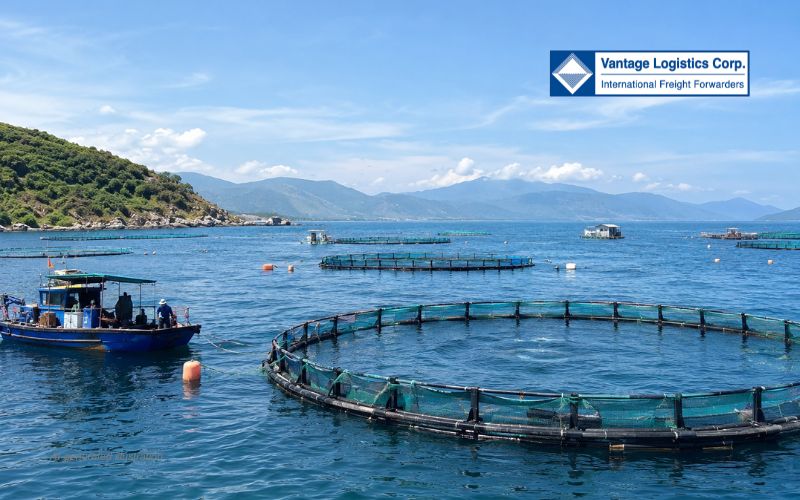
The sea is opening up new development opportunities for Vietnam, with significant potential in aquaculture, tourism, scientific research, and technology-driven economic activities. Among these areas, high-tech marine aquaculture is emerging as a new model focused on efficiency, scalability, and sustainable development. High-Tech Marine Aquaculture – A New Development Direction Moving beyond traditional farming methods, marine aquaculture is increasingly adopting technology across production and management processes. HDPE cage systems, AI cameras, automated feeding equipment, and environmental monitoring technologies are being introduced to improve farming conditions, reduce risks, and enhance operational efficiency. At the same time, marine spaces can be developed for multiple purposes, combining aquaculture with ecotourism, scientific research, environmental education, and livelihood development for coastal communities. Technology Expands the Value of the Marine Economy The development of high-tech marine aquaculture demonstrates how technology can contribute to increasing the value of economic activities at sea. Environmental monitoring systems, automation, and data management provide farmers with better tools to monitor production conditions and make informed decisions. These technologies also create a foundation for developing larger-scale and more professionally managed marine aquaculture models. When combined with long-term investment, marine spaces can generate greater value rather than relying on a single economic activity. Infrastructure and Policy – The Foundation for Development For the marine economy to develop sustainably, technology and investment need to be supported by appropriate planning, infrastructure, and management mechanisms. Clear regulations on marine spatial planning, sea-area use rights, investment policies, long-term financing, and insurance mechanisms will become increasingly important as project scales expand. At the same time, infrastructure supporting production, processing, and market connectivity needs to develop in parallel. This will help high-tech marine aquaculture models move from pilot projects toward stable and long-term operations. Expanding Development Opportunities from the Sea Vietnam’s marine economy is entering a new phase of development, with technology helping to transform how marine resources are managed and utilized. From floating cage systems to advanced monitoring and automation solutions, technological progress is creating new possibilities for generating value from the sea. A new development space is gradually taking shape – where technology, investment, people, and marine resources can come together to create long-term value for Vietnam’s economy Contact Vantage Logistics for tailored transport solutions and competitive quotations. Please provide details on cargo type, market, origin, destination, and estimated timeline. Vantage Logistics Corp – South East Asia (S.E.A) Logistics Provider One-Stop Shop For Integrated Logistics Services Head Office Viet Nam – Suite 6.01, Floor 6th, Block A, RiverGate Residence, 151-155 Ben Van Don, Khanh Hoi Ward, HCMC, Viet Nam Branch Thailand, Laos, Cambodia, Malaysia, Indonesia, Singapore Contact Us Email in**@*****om.vn Hotline +84-909-026-261 Website https://vantage-logistics.com   Send your shipment enquiry today and receive a tailored transport plan from the Vantage Logistics team. ...

29/09/2026

View More
vlc-news-paper-co-prodedures-28092026

Market updates

Paper C/O Procedures in Ho Chi Minh City: Changes to the Stamping Process

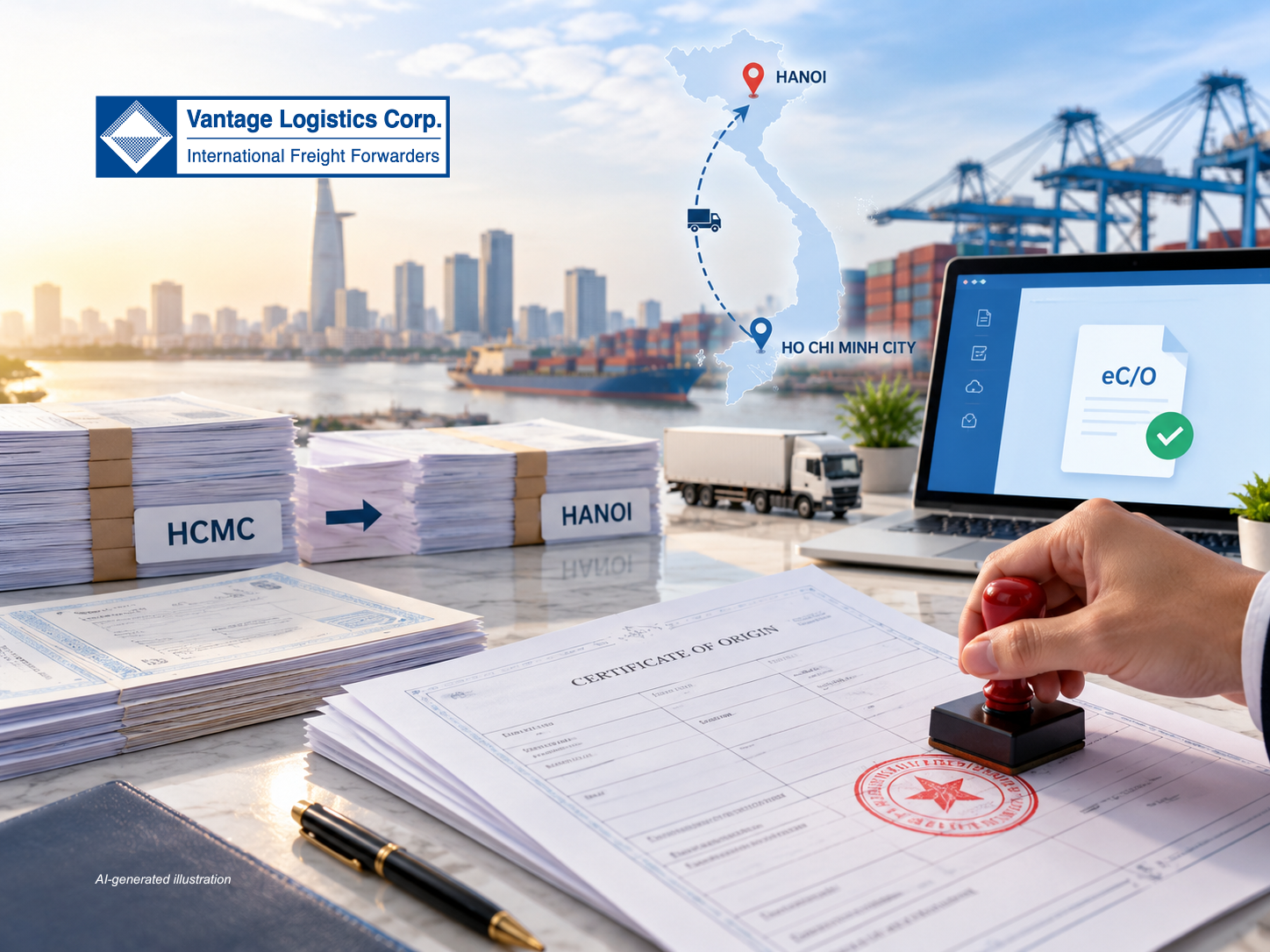
Certain paper C/O forms are being sent to Ha Noi for stamping while the Regional Import-Export Management Branch III completes the registration process for its new official seal. 1/ Structural Reorganization and Revised Stamping Procedures Pursuant to Decision No. 2232/QD-BCT, effective September 15, 2026, the Agency of Foreign Trade (Ministry of Industry and Trade) was restructured into four Regional Import-Export Management Offices. Among these, the Regional Import-Export Management Office No. III , located in Ho Chi Minh City, continues to administer the issuance of Certificates of Origin (C/O) for enterprises. While the administrative procedures for registering the new official seal and specimen signatures are being finalized, a temporary procedural adjustment applies to select paper-based C/O applications: Four C/O forms subject to inter-office routing: Forms EUR.1, EUR.1 UK, EAV, and AI , upon examination and signature endorsement in Ho Chi Minh City, are dispatched to the Agency of Foreign Trade headquarters in Hanoi for final stamping before the original documents are returned to applicants Updating issuing authority details: For Forms EUR.1 and EUR.1 UK, enterprises must update the designated name of the issuing authority in the relevant box in strict accordance with the latest official guidelines 2/ Electronic C/O (e-C/O) Operations Remain Uninterrupted Electronic Certificates of Origin (e-C/O) – including digitized data transmissions and certificates issued via the national single-window portal – administered by the Regional Import-Export Management Office No. III continue to operate normally without interruption. Exporters are encouraged to leverage electronic C/O mechanisms whenever supported under the applicable Free Trade Agreement (FTA) and accepted by the importing customs administration. 3/ Practical Recommendations for Exporters To mitigate risks of shipment delays, detention, or demurrage, exporting enterprises should undertake the following actions: Verify the applicable C/O issuance format: Clearly distinguish whether the shipment qualifies for an e-C/O or mandates a hard copy bearing an official wet seal (specifically under forms EUR.1, EUR.1 UK, EAV, or AI). Submit applications proactively: Lodge C/O documentation well in advance of departure, with particular attention to short-transit sea voyages and strict letter of credit (L/C) presentation deadlines Confirm clearance requirements with overseas buyers: Avoid assuming that C/O submissions can routinely be deferred post-arrival. Acceptance terms and allowable grace periods for retroactive C/O submissions are governed strictly by the provisions of each individual FTA and the destination customs authority Coordinate closely across operational stakeholders: Maintain active alignment between internal export documentation teams, freight forwarders, and overseas consignees to track application milestones and promptly integrate updates from the Regional Import-Export Management Office No. III and the Agency of Foreign Trade   Contact Vantage Logistics for tailored transport solutions and competitive quotations. Please provide details on cargo type, market, origin, destination, and estimated timeline. Vantage Logistics Corp – South East Asia (S.E.A) Logistics Provider One-Stop Shop For Integrated Logistics Services Head Office Viet Nam – Suite 6.01, Floor 6th, Block A, RiverGate Residence, 151-155 Ben Van Don, Khanh Hoi Ward, HCMC, Viet Nam Branch Thailand, Laos, Cambodia, Malaysia, Indonesia, Singapore Contact Us Email in**@*****om.vn Hotline +84-909-026-261 Website https://vantage-logistics.com Send your shipment enquiry today and receive a tailored transport plan from the Vantage Logistics team....

28/09/2026

View More
1 2 3 4 5 … 23